Needed to renew my driving license. My new one doesn’t have an EU flag on it. The sad reminders of Brexit just keep coming. 🇪🇺💔
Tag: driving
It took 13 years to notice my invalid vehicle registration certificate!
In 2014 we bought a car1, registered in my name. It’s a little long in the tooth now and we’re thinking about what might replace it, but for the time being it’s a useful workhorse and especially valuable when we need to move the entire family and still have space for luggage.
This week, I renewed my driving license2. While doing so, I was invited to connect the records of the vehicles I own. This would allow, for example, email notifications when my Vehicle Excise Duty is due on them.
How to register a car “wrong”
The newer of our two cars was easy to add: I provided the number plate; the website did some kind of lookup; and it was done. But when I tried to add the older car, I got an error message:
The website claimed that the details on my V5C – the vehicle registration certificate or “logbook” – didn’t match my personal information. So I pulled out the papers for both cars… and discovered that the personal information sections were identical. The front of a V5C has a section that shows your name and address, and on both my certificates looked the same: my name, followed by my address. So why was one failing to work?
I sat in a queue for their webchat service, and – after a lot of back-and-forth – the operator and I came to a conclusion about what was wrong: for this car only, my name had been entered into the “company name” field in their database, rather than the “name” field.
From the looks of things, this is what happened in 2014:
- The dealership filled the V55/4 form to register the car to me.
- The DVLA saw my unusual name3, figured “that can’t be a person’s name; it must be a company name”4, and put it into the “company name” field.
- The DVLA database differentiates between company name and person name, but the paper version just prints whichever one is present at the top of the address: information is lost in the translation to paper.
- So: the database was wrong, but the paper copy didn’t show that it was wrong.
Getting the problem fixed
Apparently if I send my V5C to them with the details “corrected”, with an accompanying letter explaining the the correction is to which field they should be storing the data in, then they’ll correct it within a month or so
And then they’ll issue me with a new paper copy. Which will, naturally, look identical to this one. The only change will be in their database.
What can we learn from this?
I wonder if there’s anything that could have been different to prevent this confusion? A simple change would be to improve the layout of the third page of a V5C certificate.
Perhaps instead of re-listing the name and address in the same format as on the front page, this page could list each field separately, perhaps with each alongside the corresponding field for changing it. This wouldn’t need much space, less than would be saved by consolidating submission instructions (which are repeated at least five times in some form or another, across the form).
There are other ambiguities and redundancies that could be cleared-up at the same time. For example, the company name field does double-duty as the title field, which is an unnecessary complication that I’m sure must make data entry harder. And the registration number and document reference number are duplicated many times on this page, even though the instructions prohibit separating the parts.
Maybe there’s something to be learned from this for all of us who work with databases and forms. Do you have any fields that serve double-duty? Do you produce output by concatenating fields in such a way that might result in ambiguous provenience? Do you have a process to validate that data has been entered into the right column? Are you unable to make changes without re-generating secondary resources (like paper hard copies), the the secondary resources are functionally unchanged?
But for now, I probably ought to get this form sent back to the DVLA. So they can change their database and send me back a near-identical form. Such bureaucracy!
Footnotes
1 This car is a Seat, and – because we name all of our cars – he’s call Arthur. Yes, for the pun.
2 The driving license renewal was super easy, by the way. Half a dozen clicks on a gov.uk page and it was done.
3 If you’re new to my blog you might not know, but my actual full name, which appears on my driving license and my passport and the electoral roll and (nowadays) my birth certificate is just: Dan Q. It sometimes causes problems with computer systems, leading to me getting strangely-addressed postal mail or being unable to fill out web forms without lying. I’m mostly understanding of the falsehoods programmers believe about names, but sometimes companies mess shit up so badly that if they don’t correct their mistakes they end up paying me to go away. My blog contains lots more stories of my unusual name causing trouble.
4 As far as I can tell, there’s never been a company called “Dan Q”. There was a “Danq”, once, and a “Dan QB” long after, and it makes you wonder why corporate registration of a vehicle doesn’t require as a minimum a cursory lookup on Companies House by the registering officer, but what do I know?
Dan Q found GC9Q6G6 PORTA DE BARCELONA
This checkin to GC9Q6G6 PORTA DE BARCELONA reflects a geocaching.com log entry. See more of Dan's cache logs.
A quick find exactly where it should be while driving from Tarragona to Barcelona. My family and I were in the area for the eclipse and then for a trip to PortAventura and are heading to Barcelona for a few days before flying home.
My partner and our kids went to the bathroom and snack bar while I jogged up to the bridge. The coordinates put my close but the hint moved me exactly where I needed to be. Strangely, I suddenly needed to tie my laces, and then just as suddenly the cache was in my hand!
Thanks for breaking up this long journey (full of bad traffic!) for us. TFTC, and greetings from Oxfordshire, UK!
A Random List of Silly Things I Hate
So apparently now this is a thing, so here I go:
- Websites that are just blank pages if the JavaScript doesn’t load from the CDN.1
- The misunderstanding that LLMs can somehow be a route to AGI.
- Computer systems that say my name is too short or my password is too long.2
- People being unwilling to discuss their wild claims later using the lack of discussion as evidence of widespread acceptance.
- When people balance the new toilet roll one atop the old one’s tube.3
- Shellfish. Why would you eat that!?
- People assuming my interest in computers and technology means I want to talk to them about cryptocurrencies.4
- Websites that nag you to install their shitty app. (I know you have an app. I’m choosing to use your website. Stop with the banners!)
- People who seem to only be able to drive at one speed.5
- The assumption that the fact I’m “sharing” my partner is some kind of compromise on my part; a concession; something that I’d “wish away” if I could. (It’s very much not.)
- Brexit.
Wow, that was strangely cathartic.
Footnotes
1 I have a special pet hate for websites that require JavaScript to render their images.
Like… we’d had the <img> tag since 1993! Why are you throwing it away and replacing it with something objectively slower, more-brittle, and
less-accessible?
2 Or, worse yet, claiming that my long, random password is insecure because it contains my surname. I get that composition-based password rules, while terrible (even when they’re correctly implemented, which they’re often not), are a moderately useful model for people to whom you’d otherwise struggle to explain password complexity. I get that a password composed entirely of personal information about the owner is a bad idea too. But there’s a correct way to do this, and it’s not “ban passwords with forbidden words in them”. Here’s what you should do: first, strip any forbidden words from the password: you might need to make multiple passes. Second, validate the resulting password against your composition rules. If it fails, then yes: the password isn’t good enough. If it passes, then it doesn’t matter that forbidden words were in it: a properly-stored and used password is never made less-secure by the addition of extra information into it!
3 This is the worst of the toilet paper crimes, but there’s a lesser but more-common offence.
4 Also: I’m uninterested in whatever multiplayer shooter game you’re playing, and no I won’t fix your printer.
5 “You were doing 35mph in the 60mph limit, then you were doing 35mph in the 40mph limit, now you’re doing 35mph in the 20mph limit. Argh!”
Heterophonic Homonyms
The elder of our two cars is starting to exhibit a few minor, but annoying, technical faults. Like: sometimes the Bluetooth connection to your phone will break and instead of music, you just get a non-stop high-pitched screaming sound which you can suppress by turning off the entertainment system… but can’t fix without completely rebooting the entire car.
The “wouldn’t you rather listen to screaming” problem occurred this morning. At the time, I was driving the kids to an activity camp, and because they’d been quite enjoying singing along to a bangin’ playlist I’d set up, they pivoted into their next-most-favourite car journey activity of trying to snipe at one another1. So I needed a distraction. I asked:
We’ve talked about homonyms and homophones before, haven’t we? I wonder: can anybody think of a pair of words that are homonyms that are not homophones? So: two words that are spelled the same, but mean different things and sound different when you say them?
This was sufficiently distracting that it not only kept the kids from fighting for the entire remainder of the journey, but it also distracted me enough that I missed the penultimate turning of our journey and had to double-back2
…in English
With a little prompting and hints, each of the kids came up with one pair each, both of which exploit the pronunciation ambiguity of English’s “ea” phoneme:
-
Lead, as in:
- /lɛd/ The pipes are made of lead.
- /liːd/ Take the dog by her lead.
-
Read, as in:
- /ɹɛd/ I read a great book last month.
- /ɹiːd/ I will read it after you finish.
These are heterophonic homonyms: words that sound different and mean different things, but are spelled the same way. The kids and I only came up with the two on our car journey, but I found many more later in the day. Especially, as you might see from the phonetic patterns in this list, once I started thinking about which other sounds are ambiguous when written:
- Tear (/tɛr/ | /tɪr/): she tears off some paper to wipe her tears away.
- Wind (/waɪnd/ | /wɪnd/): don’t forget to wind your watch before you wind your horn.
- Live (/laɪv/ | /lɪv/): I’d like to see that band live if only I could live near where they play.
- Bass (/beɪs/ | /bæs/): I play my bass for the bass in the lake.
- Bow (/baʊ/ | /boʊ/): take a bow before you notch an arrow into your bow.
- Sow (/saʊ/ | /soʊ/): the pig and sow ate the seeds as fast as I could sow them.
- Does (/dʌz/ | /doʊz/): does she know about the bucks and does in the forest?
(If you’ve got more of these, I’d love to hear read them!)
…in other Languages?
I’m interested in whether heterophonic homonyms are common in any other languages than English? English has a profound advantage for this kind of wordplay3, because it has weakly phonetics (its orthography is irregular: things aren’t often spelled like they’re said) and because it has diverse linguistic roots (bits of Latin, bits of Greek, some Romance languages, some Germanic languages, and a smattering of Celtic and Nordic languages).
With a little exploration I was able to find only two examples in other languages, but I’d love to find more if you know of any. Here are the two I know of already:
- In French I found couvent, which works only thanks to a very old-fashioned word:
- /ku.vɑ̃/ means convent, as in – where you keep your nuns, and
- /ku.və/ means sit on, but specifically in the manner that a bird does on its egg, although apparently this usage is considered archaic and the word couver is now preferred.
- In Portugese I cound pelo, which works only because modern dialects of Portugese have simplified or removed the diacritics that used to differentiate the
spellings of some words:
- /ˈpe.lu/ means hair, like that which grows on your head, and
- /ˈpɛ.lu/ means to peel, as you would with an orange.
If you speak more or different languages than me and can find others for me to add to my collection of words that are spelled the same but that are pronounced differently, I’d love to hear them.
Special Bonus Internet Points for anybody who can find such a word that can reasonably be translated into another language as a word which also exhibits the same phenomenon. A pun that can only be fully understood and enjoyed by bilingual speakers would be an especially exciting thing to behold!
Footnotes
1 I guess close siblings are just gonna go through phases where they fight a lot, right? But if you’d like to reassure me that for most it’s just a phase and it’ll pass, that’d be nice.
2 In my defence, I was navigating from memory because my satnav was on my phone and it was still trying to talk over Bluetooth to the car… which was turning all of its directions into a high-pitched scream.
3 If by “advantage” you mean “is incredibly difficult for non-native speakers to ever learn fluently”.
Note #26625
Sorry for any inconvenience
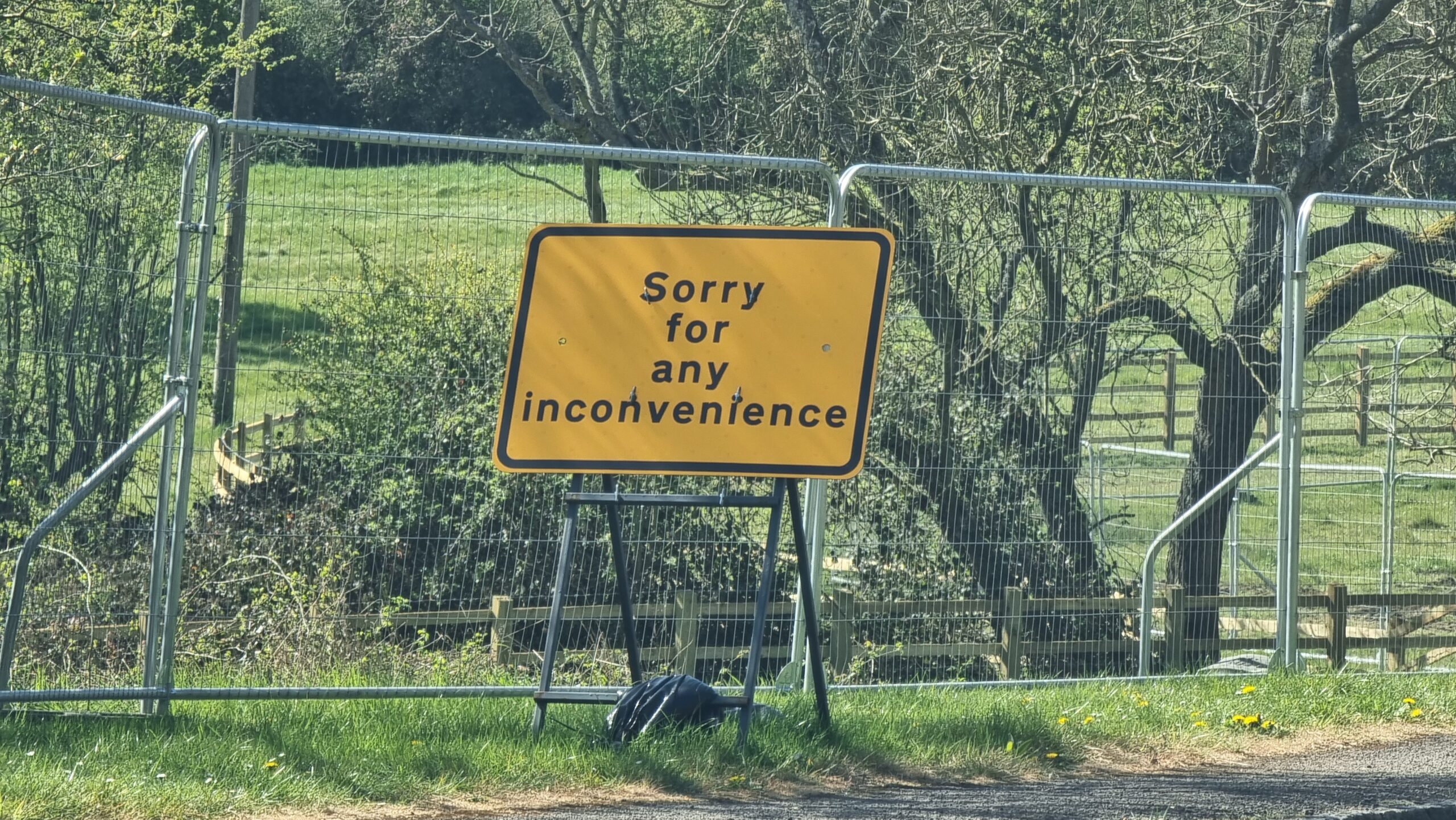
Rarely seen nowadays, these UK road signs were eventually declared “too impolite” and “brusque” and have now almost entirely been replaced with the ones that Brits are familiar with today, which read “Terribly sorry for the inconvenience, I hope it’s no bother, it’s all our fault really, so sorry, really sorry, sorry, I’ll put the kettle on shall I?”
To-go pint
Note #25538
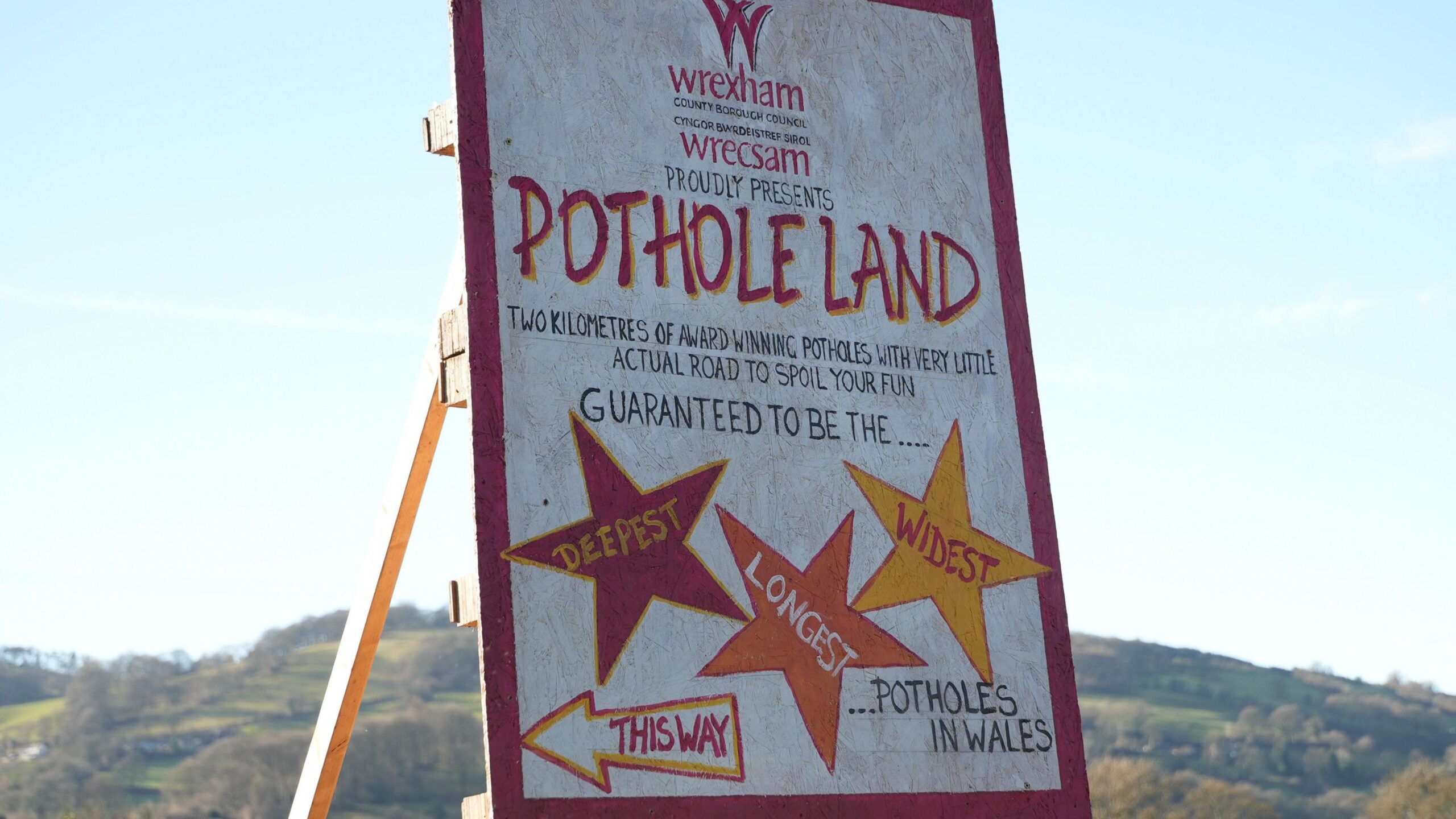
This is funny, but I’m confident Wrexham’s potholes have nothing on the Trinbagonian ones I’ve been experiencing all week, which have sometimes spanned most of the width of a road or been deep enough that dipping a wheel into them would strike the road with your underchassis!
Irish Signs
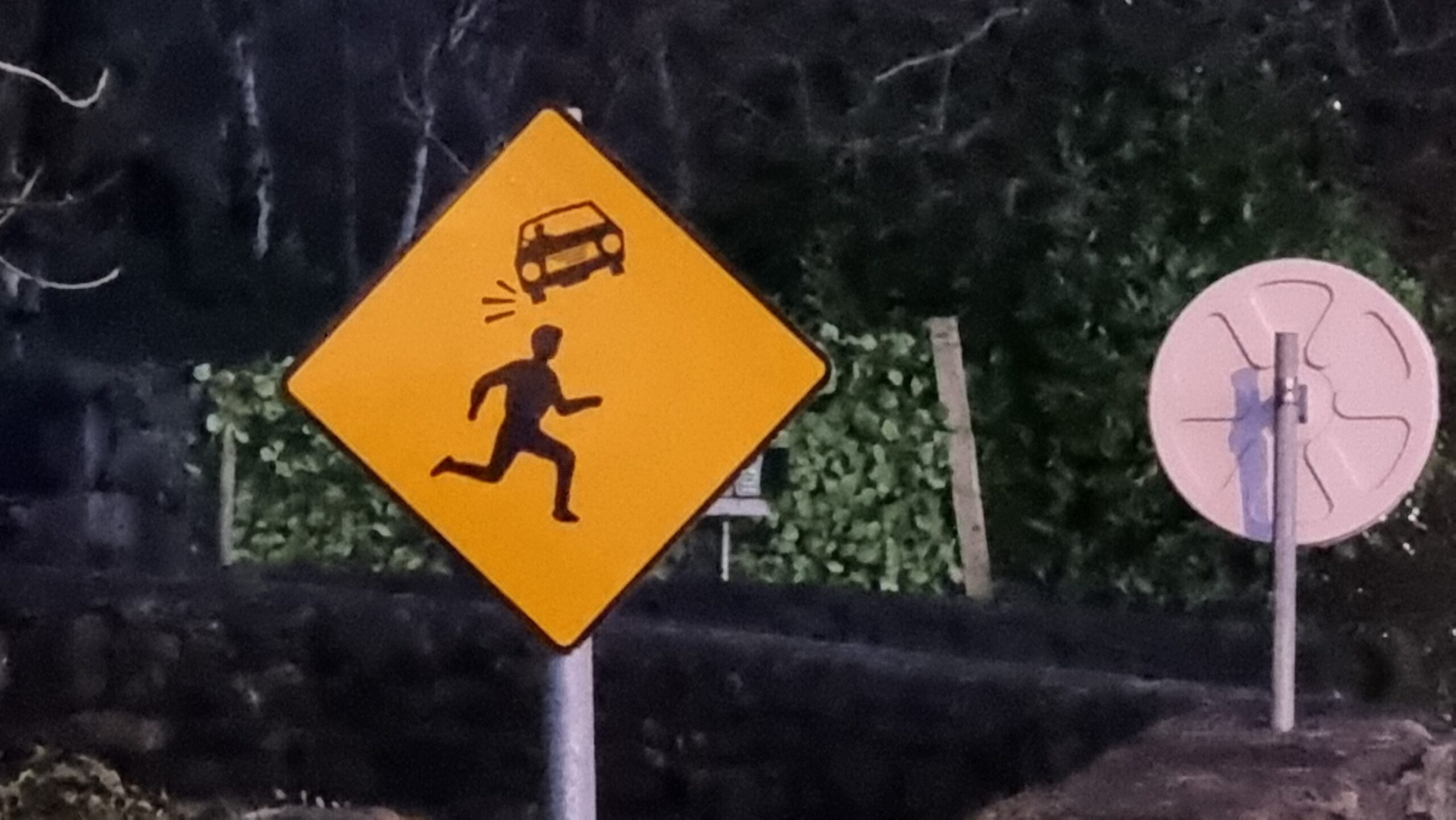
I’ve only been driving in Ireland for several days, so less than 100% of the iconography of the signage makes sense to me instantly, for now. But this one’s a complete mystery to me.
Is this warning joggers than tiny cars might bounce off their heads? Or is it exhorting distant swerving motorists to put on their right indicator to tell people which way to run to avoid being hit by them? Or maybe it’s advising that down this road is a football pitch for giants and they’ll play “headers” with you in your car if you’re not careful? I honestly haven’t a clue.
Special Roads
Podcast Version
This post is also available as a podcast. Listen here, download for later, or subscribe wherever you consume podcasts.
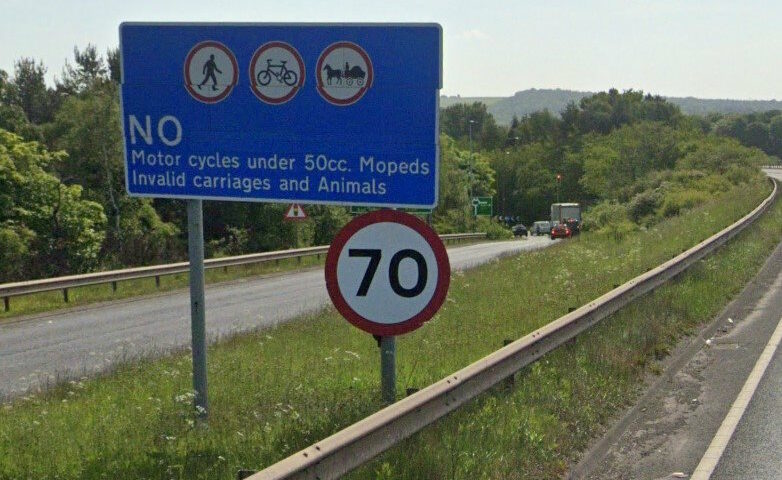
Sometimes I’ve seen signs on dual carriageways and motorways that seem to specify a speed limit that’s the same as the national speed limit (i.e. 60 or 70 mph for most vehicles, depending on the type of road), which seem a bit… pointless? Today I learned why they’re there, and figured I’d share with you!
To get there, we need a history lesson.
As early as the 1930s, it was becoming clear that Britain might one day need a network of high-speed, motor-vehicle-only roads: motorways. The first experimental part of this network would be the Preston By-pass1.
Construction wouldn’t actually begin until the 1950s, and it wasn’t just the Second World War that got in the way: there was a legislative challenge too.
When the Preston By-pass was first conceived, there was no legal recognition for roads that restricted the types of traffic that were permitted to drive on them. If a public highway were built, it would have to allow pedestrians, cyclists, and equestrians, which would doubtless undermine the point of the exercise! Before it could be built, the government needed to pass the Special Roads Act 1949, which enabled the designation of public roads as “special roads”, to which entry could be limited to certain classes of vehicles2.
If you don’t check your sources carefully when you research the history of special roads, you might be taken in by articles that state that special roads are “now known as motorways”, which isn’t quite true. All motorways are special roads, by definition, but not all special roads are motorways.
There’s maybe a dozen or more non-motorway special roads, based on research by Pathetic Motorways (whose site was amazingly informative on this entire subject). They tend to be used in places where something is like a motorway, but can’t quite be a motorway. In Manchester, a couple of the A57(M)’s sliproads have pedestrian crossings and so have to be designated special roads rather than motorways, for example3.
Now we know what special roads are, that we might find them all over the place, and that they can superficially look like motorways, let’s talk about speed limits.
The Road Traffic Act 1934 introduced the concept of a 30mph “national speed limit” in built-up areas, which is still in force today. But outside of urban areas there was no speed limit. Perhaps there didn’t need to be, while cars were still relatively slow, but automobiles became increasingly powerful. The fastest speed ever legally achieved on a British motorway came in 1964 during a test by AC Cars, when driver Jack Sears reached 185mph.
In the late 1960s an experiment was run in setting a speed limit on motorways of 70mph. Then the experiment was extended. Then the regulation was made permanent.
There’ve been changes since then, e.g. to prohibit HGVs from going faster than 60mph, but fundamentally this is where Britain’s national speed limit on motorways comes from.
You’ve probably spotted the quirk already. When “special roads” were created, they didn’t have a speed limit. Some “special roads” were categorised as “motorways”, and “motorways” later had a speed limit imposed. But there are still a few non-motorway “special roads”!
Putting a national speed limit sign on a special road would be meaningless, because these roads have no centrally-legislated speed limit. So they need a speed limit sign, even if that sign, confusingly, might specify a speed limit that matches what you’d have expected on such a road4. That’s the (usual) reason why you sometimes see these surprising signs.
As to why this kind of road are much more-common in Scotland and Wales than they are anywhere else in the UK: that’s a much deeper-dive that I’ll leave as an exercise for the reader.
Footnotes
1 The Preston By-pass lives on, broadly speaking, as the M6 junctions 29 through 32.
2 There’s little to stop a local authority using the powers of the Special Roads Act and its successors to declare a special road accessible to some strange and exotic permutation of vehicle classes if they really wanted: e.g. a road could be designated for cyclists and horses but forbidden to motor vehicles and pedestrians, for example! (I’m moderately confident this has never happened.)
3 There’s a statutory instrument that makes those Mancunian sliproads possible, if you’re having trouble getting to sleep on a night and need some incredibly dry reading.
4 An interesting side-effect of these roads might be that speed restrictions based on the class of your vehicle and the type of road, e.g. 60mph for lorries on motorways, might not be enforceable on special roads. If you wanna try driving your lorry at 70mph on a motorway-like special road with “70” signs, though, you should do your own research first; don’t rely on some idiot from the Internet. I Am Not A Lawyer etc. etc.
The Road (Segment) Less Travelled
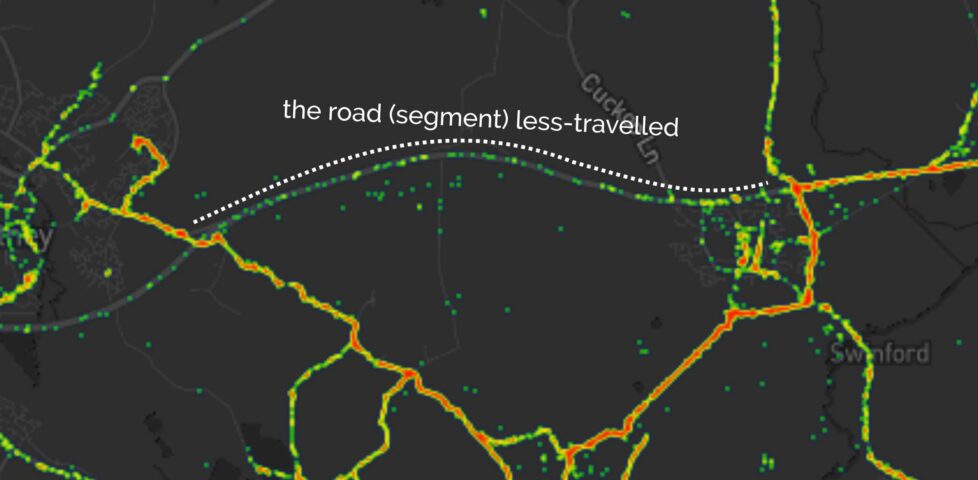
There are two junctions at which I can join the A40 trunk road from my house. When I drive East, I use the Easternmost of the two; when I drive West, I use the Westernmost; but I almost never drive the stretch of road between them!
A few years ago I generated heatmaps of my movements based on my long-running personal location log and, indeed, it shows a “cool spot” along this section of road too:
It’s inevitable I suppose that there should exist a “road (segment) less-travelled” right on my doorstep, but it still feels strange. Like when you live near a tourist attraction that you never get around to visiting. Except instead of a tourist attraction, I live near a major highway I rarely use.
Maybe I’m missing out on something great. Probably the commuters who use that road to get into and out of Oxford don’t think so.
Dan Q temporarily disabled GC9EXXX Church Micro 14129…Sutton
This checkin to GC9EXXX Church Micro 14129...Sutton reflects a geocaching.com log entry. See more of Dan's cache logs.
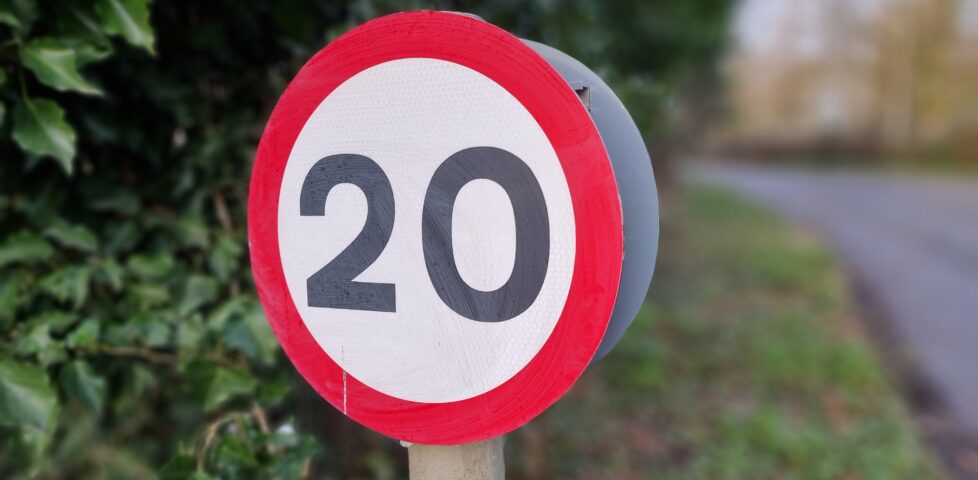
Cache removed and temporarily disabled. The council have just started installing new signage to advise of a new 20mph speed limit around here. 🎉
When they recently did the same in a nearby village, they removed a cache of this type as a (presumably accidental) side effect. I don’t know if this cache’s host is among those that’ll be affected but I suspect it will so I’ve temporarily removed this one as a precaution and I’ll reinstate it after the works are complete.
[Bloganuary] Road Trip!
This post1 is part of my attempt at Bloganuary 2024.2Today’s prompt is:
Think back on your most memorable road trip.
Runners-up
It didn’t take me long to choose a most-memorable road trip, but first: here’s a trio of runners-up that I considered3:
-
A midwinter ascent
On the last day of 2018, Ruth‘s brother Robin and I made a winter ascent of Ben Nevis, the highest mountain in the British Isles. But amazing as the experience was, it perhaps wasn’t as memorable as the endless car journey up there, especially for Robin who was sandwiched between our two children in the back of the car and spent the entire 12-hour journey listening to Little Baby Bum songs on loop.4 Surely a quick route to insanity.
-
A childhood move
Shortly after starting primary school my family and I moved from Aberdeen, Scotland to the North-West of England. At my young age, long car journeys – such as those we’d had to make to view prospective new houses – always seemed interminably boring, but this one was unusually full of excitement and anticipation. The car was filled to the brim with everything we needed most-imminently to start our new lives5, while the removals lorry followed a full day behind us with everything less-essential6. I’m sure that to my parents it was incredibly stressful, but for me it was the beginning of an amazing voyage into the unknown.
-
Live on Earth
Back in 1999 I bought tickets for myself and two friends for Craig Charles’ appearance in Aberystwyth as part of his Live on Earth tour. My two friends shared a birthday at around the date of the show and had expressed an interest in visiting me, so this seemed like a perfect opportunity. Unfortunately I hadn’t realised that at that very moment one of them was preparing to have their birthday party… 240 miles away in London. In the end all three of us (plus a fourth friend who volunteered to be and overnight/early morning post-nightclub driver) attended both events back to back! A particular highlight came at around 4am we returned from a London nightclub to the suburb where we’d left the car to discover it was boxed in by some inconsiderate parking: we were stuck! So we gathered some strong-looking fellow partygoers… and carried the culprit’s car out of the way7. By that point we decided to go one step further and get back at its owner by moving their car around the corner from where they’d parked it. I reflected on parts of this anecdote back in 2010.
The winner
At somewhere between 500 and 600 road miles each way, perhaps the single longest road journey I’ve ever made without an overnight break was to attend a wedding.
The wedding was of my friends Kit and Fi, and took place a long, long way up into Scotland. At the time I (and a few other wedding guests) lived on the West coast of Wales. The journey options between the two might be characterised as follows:
- the fastest option: a train, followed by a ludicrously expensive plane, followed by a taxi
- the public transport option: about 16 hours of travel via a variety of circuitous train routes, but at least you get to sleep some of the way
- drive along a hundred miles of picturesque narrow roads, then three hundred of boring motorways, then another hundred and fifty of picturesque narrow roads
Guess which approach this idiot went for?
Despite having just graduated, I was still living very-much on a student-grade budget. I wasn’t confident that we could afford both the travel to and from the wedding and more than a single night’s accommodation at the other end.
But there were four of us who wanted to attend: me, my partner Claire, and our friends Bryn and Paul. Two of the four were qualified to drive and could be insured on Claire’s car8. This provided an opportunity: we’d make the entire 11-or-so-hour journey by car, with a pair of people sleeping in the back while the other pair drove or navigated!
It was long, and it was arduous, but we chatted and we sang and we saw a frankly ludicrous amount of the A9 trunk road and we made it to and from what was a wonderful wedding on our shoestring budget. It’s almost a shame that the party was so good that the memories of the road trip itself pale, or else this might be a better anecdote! But altogether, entirely a worthwhile, if crazy, exercise.
Footnotes
1 Participating in Bloganuary has now put me into my fifth-longest “daily streak” of blog posts! C-c-c-combo continues!
2 Also, wow: thanks to staying up late with my friend John drinking and mucking about with the baby grand piano in the lobby of the hotel we’re staying at, I might be first to publish a post for today’s Bloganuary!
3 Strangely, all three of the four journeys I’ve considered seem to involve Scotland. Which I suppose shouldn’t be too much of a surprise, given its distance from many of the other places I’ve lived and of course its size (and sometimes-sparse road network).
4 Okay, probably not for the entire journey, but I’m certain it must’ve felt like it.
5 Our cargo included several cats who almost-immediately escaped from their cardboard enclosures and vomited throughout the vehicle.
6 This included, for example, our beds: we spent our first night in our new house camped together in sleeping bags on the floor of what would later become my bedroom, which only added to the sense of adventure in the whole enterprise.
7 It was, fortunately, only a light vehicle, plus our designated driver was at this point so pumped-up on energy drinks he might have been able to lift it by himself!
8 It wasn’t a big car, and in hindsight cramming four people into it for such a long journey might not have been the most-comfortable choice!
Normal for Children
Lacking a basis for comparison, children accept their particular upbringing as normal and representative.
Kit was telling me about how his daughter considers it absolutely normal to live in a house full of insectivorous plants1, and it got me thinking about our kids, and then about myself:
I remember once overhearing our eldest, then at nursery, talking to her friend. Our kid had mentioned doing something with her “mummy, daddy, and Uncle Dan” and was incredulous that her friend didn’t have an Uncle Dan that they lived with! Isn’t having three parents… just what a family looks like?
By the time she was at primary school, she’d learned that her family wasn’t the same shape as most other families, and she could code-switch with incredible ease. While picking her up from school, I overheard her talking to a friend about a fair that was coming to town. She told the friend that she’d “ask her dad if she could go”, then turned to me and said “Uncle Dan: can we go to the fair?”; when I replied in the affirmitive, she turned back and said “my dad says it’s okay”. By the age of 5 she was perfectly capable of translating on-the-fly2 in order to simultaneously carry out intelligble conversations with her family and with her friends. Magical.
When I started driving, and in particular my first few times on multi-lane carriageways, something felt “off” and it took me a little while to work out what it was. It turns out that I’d internalised a particular part of the motorway journey experience from years of riding in cars driven by my father, who was an unrepentant3 and perpetual breaker of speed limits.4 I’d come to associate motorway driving with overtaking others, but almost never being overtaken, but that wasn’t what I saw when I drove for myself.5 It took a little thinking before I realised the cause of this false picture of “what driving looks like”.
The thing is: you only ever notice the “this is normal” definitions that you’ve internalised… when they’re challenged!
It follows that there are things you learned from the quirks of your upbringing that you still think of as normal. There might even be things you’ll never un-learn. And you’ll never know how many false-normals you still carry around with you, or whether you’ve ever found them all, exept to say that you probably haven’t yet.
It’s amazing and weird to think that there might be objective truths you’re perpetually unable to see as a restult of how, or where, or by whom you were brought up, or by what your school or community was like, or by the things you’ve witnessed or experienced over your life. I guess that all we can all do is keep questioning everything, and work to help the next generation see what’s unusual and uncommon in their own lives.
Footnotes
1 It’s a whole thing. If you know Kit, you’re probably completely unsurprised, but spare a thought for the poor randoms who sometimes turn up and read my blog.
2 Fully billingual children who typically speak a different language at home than they do at school do this too, and it’s even-more amazing to watch.
3 I can’t recall whether his license was confiscated on two or three separate ocassions, in the end, but it was definitely more than one. Having a six month period where you and your siblings have to help collect the weekly shop from the supermarket by loading up your bikes with shopping bags is a totally normal part of everybody’s upbringing, isn’t it?
4 Virtually all of my experience as a car passenger other than with my dad was in Wales, where narrow windy roads mean that once you get stuck behind something, that’s how you’re going to be spending your day.
5 Unlike my father, I virtually never break the speed limit, to such an extent that when I got a speeding ticket the other year (I’d gone from a 70 into a 50 zone and re-set the speed limiter accordingly, but didn’t bother to apply the brakes and just coasted down to the new speed… when the police snapped their photo!), Ruth and JTA both independently reacted to the news with great skepticism.