The Husbands by Holly Gramazio

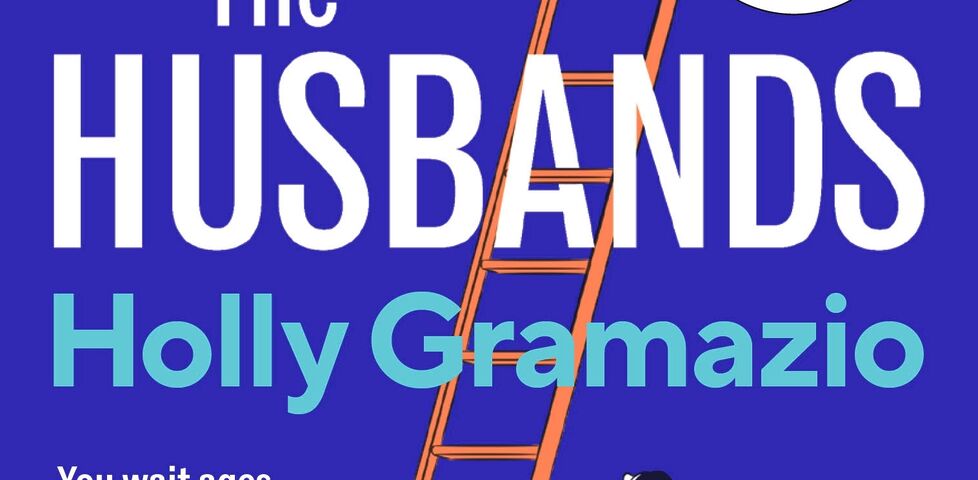
Cover of The Husbands by Holly Gramazio, with tagline 'you wait ages for The One... then 203 come along at once'. Five-colour poster art shows a woman wearing a sleeveless top, long skirt, and trainers using a hand saw to cut through a ladder which stretches up through the title and at the top of which we can just make out the trousered legs of a man, climbing past a pendant light.I’m still lagging way-behind on writing-up the nonfiction I’ve been reading this year, and I’m long overdue1 to share my love of Holly Gramazio‘s debut novel, The Husbands. Which is excellent; truly un-put-downable. I’d come across Holly’s writing before by playing Dicey Dungeons, but I hadn’t realised that until later when, four chapters into this book, I decided to look her up (in the hope, perhaps, that she’d written any other books I could add to my reading list – the answer is… not yet).

Here’s the skinny. Lauren comes home from a night out to find her husband waiting for her. Which is immediately confusing and concerning, because when she left for the evening, she wasn’t married. But all the evidence suggests that now, somehow, mysteriously, she has a husband: she finds letters addressed to the pair of them, her phone is full of photos of them together going back through their wedding and beyond, and all of her friends back up the fact that she really has made a life with this man… that she just can’t remember.

But the weirder bit she discovers a little later. Whenever her husband goes up into the attic, he’s replaced with a different husband. A different man, it seems, that she could conceivably have married, in some strange alternate timeline. By controlling how and when they do so, she comes to discover that she can cycle through a seemingly-endless supply of husbands, and as she comes to accept and understand her new life, begins to use this as a kind-of… dating superpower? “Trying on” a husband for as many minutes, hours, days, or months it takes to decide whether or not to “keep” him2.

That’s the premise, and it’s perfectly fun (although occasionally dark) – sort of a parody of “swipe-left/swipe-right” modern dating, taken to an extreme – but wouldn’t by itself be reason enough to recommend it. But what comes next is what makes it so special.

Aaand… I feel like I can’t say more without spoiling it. And you really should read it! Suffice to say that the writing is compelling, and engaging, and there are plenty sufficient twists and turns to keep you interested even if you wouldn’t normally go in for… what I’m going to describe as a romantic-comedy. Our protagonist’s situation feels relatable even while it’s unfamiliar, and I enjoyed both laughing at her exploits while also grieving her losses. And again: the surprises and quirks are really fun.

So yeah – you should 100% read this fantastic debut. I loved it so much, and everybody I’ve already recommended it to has agreed with me that it’s a great page-turner. And while you wait for your copy to arrive, why not generate yourself a random husband courtesy of a widget on Gramazio’s website?

Footnotes

1 I think I finished reading it about the same time as Terence Eden, who also gave a rave review, if you’re wondering exactly how far “behind” I am.

2 Needless to say, I found myself thinking of how to apply the Secretary Problem to Lauren’s lifestyle long before it came up in the book!

×

The Varieties of Intimate Relationship

This is a repost promoting content originally published elsewhere. See more things Dan's reposted.

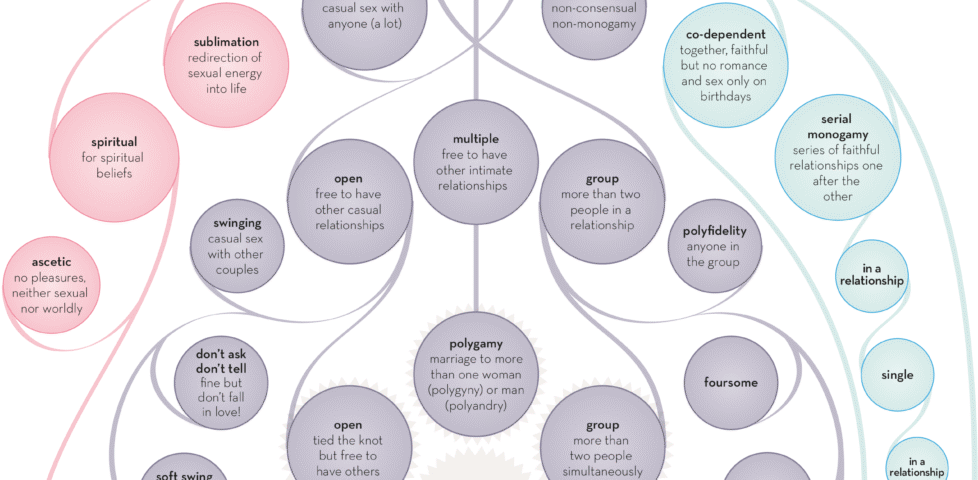
Diagram dividing varieties of intimiate relationships into monogamy, polyamory, celebacy, and a few things in-between.

A slightly tongue-in-cheek (see the “serial monogamy” chain and some of the subtitles!) but moderately-complete diagram of popular varieties of relationship structure. Obviously there’s gaps – relationships are as diverse as their participants – and lots of room for refinement, but the joy of an infographic is making visible the breadth of a field, not in providing encyclopaedic comprehension of that field. I especially like the attention to detail in “connecting” often-related concepts.

Monogamy and Mathematics

“We have to split up… in case somebody better comes along!”

Either from our own real life or from popular culture and the media, we’ve all come across a statement like that. It’s rarely quite so brazen: instead, it’s sometimes concealed behind another reason, whether tactful or simply false. But it still reeks of a lack of commitment and an unwillingness to “give it a try.”

With thanks for Flickr user "i.am.rebecca".

However, it turns out that there’s actually a solid mathematical basis for it. Let’s assume for a moment that you:

  1. Engage exclusively in monogamous relationships. To each their own, I suppose.
  2. Are seeking for a relationship that will last indefinitely (e.g. traditional monogamous marriage, “’til death do us part,” and all that jazz).
  3. Can’t or won’t date your exes.
  4. Can rate all of your relationships relative to one another (i.e. rank them all, from best to worst)?
  5. Can reasonably estimate the number of partners that you will have the opportunity to assess over the course of your life. You can work this out by speculating on how long you’ll live (and be dating!) for, and multiplying, though of course there are several factors that will introduce error. When making this assumption, you should assume that you break up from any monogamous relationship that you’re currently in, and that no future monogamous relationship is allowed to last long enough that it may prevent you from exploring the next one, until you find “the one” – the lucky winner you’re hoping to spend the rest of your life with.

Assuming that all of the above is true, what strategy should you employ in order to maximise your chance of getting yourself the best possible lover (for you)?

The derivation of the optimal policy for the secretary problem.

It turns out that clever (and probably single) mathematicians have already solved this puzzle for you. They call it the Secretary Problem, because they’d rather think about it as being a human resources exercise, rather than a reminder of their own tragic loneliness.

A Mathematical Strategy for Monogamy

Here’s what you do:

  1. Take the number of people you expect to be able to date over the course of your lifetime, assuming that you  never “settle down” and stop dating others. For example’s sake, let’s pick 20.
  2. Divide that number by e – about 2.71828. You won’t get a round number, so round down. In our example, we get 7.
  3. Date that many people – maybe you already have. Leave them all. This is important: these first few (7, in our example) aren’t “keepers”: the only reason you date them is to give you a basis for comparison against which you rate all of your future lovers.
  4. Keep dating: only stop when you find somebody who is better than everybody you’ve dated so far.

And there you have it! Mathematically-speaking, this strategy gives you a 37% chance of ending up with the person who – of all the people you’d have had the chance to date – is the best. 37% doesn’t sound like much, but from a mathematical standpoint, it’s the best you can do with monogamy unless you permit yourself to date exes, or to cheat.

Or to conveniently see your current partner as being better than you would have objectively rated them otherwise. That’s what love will do for you, but that’s harder to model mathematically.

Of course, if everybody used this technique (or even if enough people used it that you might be reasonably expected to date somebody who did, at some point in your life), then the problem drifts into the domain of game theory. And by that point, you’d do better to set up a dating agency, collect everybody’s details, and use a Stable Marriage problem solution to pair everybody up.

This has been a lesson in why mathematicians shouldn’t date.

×