Of all the products announced today at Google’s massive event, the Daydream View might be the best seller. At only $79, Daydream packs a “Good enough” controller and VR headset into a
single box, allowing anyone with a brand new phone (for now only a brand new Google phone) to experience virtual reality. The Daydream opens up the Gear VR concept to the entire
Android Ecosystem, with future Android devices expected to support the standard…
An interview conducted in the back of a moving car with Sarah, the true talent behind Godzilla Huntley’s Family Vlog. Supplements my review to episodes 15, 16 and 17.
Short version of the review: a few teething problems aside, we all had a wonderful time and we’d certainly consider a Daggerville game for our next murder
mystery party. The characters were, on the whole, wonderful characters well-realised and fully-developed within the constraints of the genre, the twist was clever, there were moments
of great hilarity (such as the point when we realised that there’d been a veritable conga-line of people stealthily following one another around the hotel), and the event built up to
a fun and satisfying conclusion. I’d suggest that you all keep an eye on Daggerville in the future.
As implied earlier this week, this weekend
Ruth, JTA and I had planned to host the latest in a long
series of murder mystery party nights (a handful of which have been reviewed on this
blog). Despite our earlier worries, we eventually filled the “missing” slots in our party with our friends Liz and Dean: exactly the couple we’d planned to fill it with in the first place, but
they’d been painfully slow at RSVPing.
When they eventually turned up late, but still earlier than our other guests, Liz and Dean quickly found themselves back in our good books.
We’ve played a lot of murder mystery games over the years: we could probably be described as connoisseurs of the genre, and that might be worth bearing in mind when you
read what we had to say about this particular event. To enumerate, there’s been:
The entire back catalogue of Paul Lamond‘s Murder a la Carte / Inspector McClue
series
And several murder mystery games that I’ve written: one in a “scripted” style, the rest in an “open” style
That said, this latest party really had the opportunity to cross the board, with Liz and Dean having never been to a murder mystery night before and (other) Liz and Simon having been to only
a few. And to top it all off, we were working with a completely new game from a creator of whom we’d had no experience. What could be more exciting?
See: even JTA’s excited.
You see: I was contacted a little over two months ago, via my web form,
by a Martin from Daggerville Games, a new murder mystery party provider of the “buy-and-download” variety. Upon
visiting their website, I was immediately struck by some of the similarities between their signup form (which asks for player names to be associated with characters, genders to be
chosen for characters whose gender can be selected based on the gender balance among the players, and email addresses to which invitations will be sent) and a prototype one of my own
design, used in the construction of my upcoming games Murder at the Glam Rock Concert and Murder on the Social Network, the first of which we hope to host in
about a year’s time. I mentioned this to Martin, in the hope that they won’t think I’m ripping them off if I eventually put some of my pieces online for the world to play, too.
One of the quirks of Daggerville is that they email fragmented scripts directly to your players, which they’re then welcome to read completely before they turn up (or not; whichever
they prefer).
The Daggerville folks, perhaps anticipating that I would be likely to blog about the event in hindsight and thus provide them with some free publicity, offered me a voucher for a free
game of my choice, which I accepted. After a little discussion, we settled upon The Ambassador’s Notebook, a 7-player murder mystery set in a rural 1920s hotel and revolving around the untimely death of a Mr.
Sullivan, presumably related to a valuable journal that was in his possession.
But who can the murderer be, Liz ponders, from her comfortable chair in the Accusing Chamber.
In order to keep the spoilers at the tail end of this blog post (there’ll be a nice big warning before you get to them, so you can refrain from reading them if you’re planning to
someday play this game yourself), I’ll cut to the chase and first provide a summary of the night as a whole.
Right before I opened the “Deus Ex Manilla”, otherwise known as the “Miss. Marple Envelope”, in which the solution would be found, I – as usual – encouraged a vote on who we’d be
turning over to the police.
We all had a fun time: as usual for these gatherings, there was good wine, great company, and spectacular food (Ruth had, once again, put together a wonderfully thought-out and
thematically-sound menu): honestly, under these conditions we’d be pretty-much guaranteed a good night no matter what. The murder mystery itself was a scripted affair similar to those
you’ll find in any off-the-shelf kit, but with a few quirks. For a start, as hinted above, everybody gets their fragments of the script (along with dialogue entry and exit cues) very
early on: it’s possible, permitted, and even encouraged that players read their script before they arrive for the event. Some of us were concerned that this might result in
“spoilers”, and a few of those of us who did pre-read our scripts said that they regretted doing so, so be aware: it’s a spoiler-risk.
If you pay attention to following a fragmented script, you might lose track of a clue. But if you pay attention to the clues, you might lose track of your place in the script. It’s a
challenge.
Unlike similar-styled games, though, players aren’t given additional information outside of the script, and we all felt that this made things challenging when it came to
the discussion breaks. All that we had to go on for our deliberations was exactly what we’d all heard, just minutes before, tempered by our own speculation. Sometimes somebody would
ask, or consider asking, a valid question after somebody’s whereabouts, alibi, or history, but no answer was forthcoming because all that we had, collectively, was the script. This
caused additional confusion when, for example, Liz’s character mentioned JTA’s character by his first name, it was a surprise to everybody… even JTA, who had no idea to
begin with that it was supposed to be his name!
The lack of “character sheets” did encourage imaginative ad-libbing, for example, such as Simon’s decision that his character had just come over from Australia.
None of the problems we experienced “broke” the game, and we found our way to a reasonably-satisfactory conclusion. A majority of us voted correctly, determining the identity of the
murderer, and Ruth even managed to identify an important twist (albeit not based on anything more than speculation: the “flash” was a little subtle for us). There were a few anachronisms in the script, but they’re of the kind that only
nerds like us would notice (the National Theatre is mentioned despite the fact that it won’t be founded for another four decades or so, and a character makes a reference to a frozen
turkey, even though freezing of meat in the West wasn’t yet commonplace, for example). We’d have really liked to have each had a brief – even just half a page! – to tell us each more
about our own characters (their names, for example, as well some of the secrets that they might be concealing and any established relationships they have with other characters), and if
we knew that Daggerville were adding this feature, it’d make us far more-likely to buy their products in future.
The short review would be: a few teething problems aside, we all had a wonderful time and we’d certainly consider a Daggerville game for our next murder mystery
party. The characters were, on the whole, wonderful characters well-realised and fully-developed within the constraints of the genre, the twist was clever, there were moments of great
hilarity (such as the point when we realised that there’d been a veritable conga-line of people stealthily following one another around the hotel), and the event built up to a fun and
satisfying conclusion. I’d suggest that you all keep an eye on Daggerville in the future.
[spb_message color=”alert-warning” width=”1/1″ el_position=”first last”]Spoiler warning: reading beyond here could result in seeing spoilers. Don’t read on if you’re
likely to ever take part in a game of The Ambassador’s Notebook.[/spb_message]
Aside from the lack of character “introductions”, another thing we found difficult in this game were issues in the script. The script for “The Neighbour” ended up one-number out of sync
in the middle of Scene 2, where her ‘line 42’ indicated that a different person should be talking to what the rest of the scripts said. On another occasion, the script for “The
Proprietress” seemed to be missing a line (although other characters had the ‘tail end’ of that line). The character of “The Journalist” can be played by a man or a woman, and although
I selected “male” when I filled in the form, some of the scripts referred to the character as a woman! At first I thought that this might be related to difficulties some of us had had
receiving the emailed scripts (Martin at Daggerville was incredibly helpful at sending out fresh ones, though), but we found at least one instance in which one person flip-flopped
between referring to “The Journalist” as female or male!
(there’s a video I’ve put together of some of the highlights of our evening, but there’s possible spoilers in it)
Our traditional end-of-game shot shows the murderer, played by Dan, accused by the rest of the participants. (Ruth is behind the camera)
Personally, though, my favourite moment of the night came right at the start, as we all introduced our characters. One of the Liz’s, an American, had decided to play her
character as an American, and introduced herself as such. “Oh,” said the other Liz, whom she’d just met, “Are you going to do an accent?”
Those of you who’ve met my family will probably already have an understanding of… what they’re like. Those of you who haven’t are probably about to gain one.
Did you did you… did you know that: Becky can eat mango, all by herself?
It started on a weekend in April, when my mother and I went to a Pink concert. The support act were a really fun band called
Walk the Moon, who finished their energetic set with I Can Lift A Car, with its’ catchy chorus hook “Did you did you… did you know know: I can lift a car up, all by
myself?” Over the weeks that followed, perhaps because of its earworm qualities,
this song became sort-of an inside Rickroll between my mum and I.
For example, this Bel-Air-meme style text message used a shaggy dog story to deliver a play on words.
At one point, she sent me a link to this video (also visible below), in which she is seen to lift
a (toy) car. My sister Becky (also known as “Godzilla”) was behind the camera (and, according to the credits,
everything else), and wrote in the doobly doo: “I think I’m gonna start doing family vlogs.”
She’d experimented with vlogging before, with a short series of make-up tutorials and a “test video post” on her blog, but this represented something new: an effort to show off her family (and guest appearances from her
friends) as they really are; perhaps this was an effort to answer the inevitable question asked by people who’ve visited them – “are they always like that?” Perhaps that’s
why she chose the name she did for the Family Vlog – “IRL”.
The essential Family Vlog (“IRL”) scene is the car scene, with the camera facing backwards from the dashboard. See also my second review…
At the time of writing, Becky (on her YouTube channel) has produced eight such videos
(one, two, three, four, five, six, seven, eight), reliably rolling out one a week for the last two
months. I thought they were pretty good – I thought that was just because they were my family, but I was surprised to find that it’s slowly finding a wider reach, as I end up speaking
to friends who mention to me that they “saw the latest family vlog” (sometimes before I’ve had a chance to see it!).
As I was visiting Preston, I ended up featuring in “IRL – Week 6”. My review (click on the image for it), therefore, seemed to be equal in parts recursive and narcissistic.
Naturally, then, the only logical thing to do was to start producing my own YouTube series, on my channel,
providing reviews of each episode of my sister’s vlog. I’ve managed to get seven out so far (one, two, three, four, five, six, seven), and I’d like to think
that they’re actually better than the originals. They’re certainly more-concise, which counts for a lot, because they trim the original vlog down to just the highlights
(interrupted only occasionally by my wittering atop them).
The widget above (or this playlist) will let
you navigate your way through the entire body of vlogs, and their reviews (or lets you play them all back to back, if you’ve got two and a quarter hours to spare and a pile of brain
cells you want killing). But if you’re just looking for a taster, to see if it’s for you, then here are some starting-out points:
The best episode? My favourite is six, but number two has the most views, probably the keywords “lesbian foursome” are popular search terms. Or possibly “girls peeing”. I’m
not sure which scares me the most.
Of if you just want to drop-in and have a taster, start from the latest review.
Looper is a time travel movie of the “self-healing timeline” mechanic (a-la Back To The Future, although Looper “fixes” itself faster and changes to the time stream can be
observed and remembered by everybody affected by them). As a result of this, and a few other issues, it suffers from a handful of plotholes and internal inconsistencies: however, it’s
still an enormously fun film that I’d recommend that you see.
Looper. The second-best film of its category. For a given definition of “category”.
Looper is the second-best of all three movies that feature Bruce Willis travelling back in time and encountering a younger version of himself – and now it’s going to bug you until you
work out what the other two are.
The mobile app presents you with a special six-digit code that is used to withdraw the cash.
RBS Group this week
rolled out a service to all of
its customers, allowing them to withdraw cash from an ATM without using their bank card. The service is based upon the same technologies that’s used to provide emergency access to
cash by people who’ve had their cards stolen, but integrates directly into the mobile banking apps of the group’s constituent banks. I decided to give it a go.
The first step is to use the mobile app to request a withdrawal. There’s an icon for this, but it’s a bit of a mystery that it’s there unless you already know what you’re looking for.
You can’t make a request from online banking without using the mobile app, which seems to be an oversight (in case you can’t think of a reason that you’d want to do this, read on:
there’s one at the end). I opted to withdraw £50.
Next, it’s off to find a cash machine. I struck out, without my wallet, to try to find the nearest Royal Bank of Scotland, NatWest, or Tesco cashpoint. The mobile app features a GPS
tool to help you find these, although it didn’t seem to think that my local Tesco cashpoint existed, walking me on to a branch of NatWest.
The readout of the cash machine demonstrates that the roots of the “Get Cash” system lie in the older “Emergency Cash” feature: the two are functionally the same thing.
As instructed by the app, I pressed the Enter key on the keypad of the cash machine. This bypasses the usual “Insert card” prompt and asks, “Do you wish to carry out a
Get Cash or Emergency Cash transaction?” I pressed Yes.
The number displayed upon the screen is entered into the cash machine.
The ATM asked for the PIN I’d been given by the mobile app: a 6-digit code. Each code is only valid for a window of 3 hours and can only be used once.
The cash machine asks for the PIN a second time, and then asks for the sum of money to be withdrawn.
I’m not sure why, but the ATM asks that the PIN is confirmed by being entered a second time. This doesn’t make a lot of sense to me – if it was mistyped, it’d surely fail anyway (unless
I happened to guess another valid code, within its window), and I’d simply be able to try again. And if I were an attacker, trying to guess numbers, then there’s no difficulty in typing
the same number twice.
It’s possible that this is an attempt at human-tarpitting,
but that wouldn’t be the best way to do it. If the aim is to stop a hacker from attempting many codes in quick succession, simply imposing a delay would be far more effective (this is
commonplace with cash machines anyway: ever notice that you can’t put a card in right after the last transaction has finished?). Strange.
Finally, the ATM asks what value of cash was agreed to be withdrawn. I haven’t tried putting in an incorrect value, but I assume that it would refuse to dispense any cash if the wrong
number was entered – this is presumably a final check that you really are who you claim to be.
It feels strange taking money and a receipt from a cashpoint without first having to retrieve my card. I spent a few minutes after the experience with a feeling that I’d forgotten
something.
It worked. I got my money. The mobile app quickly updated to reflect the change to my balance and invalidated the code: the system was a success.
The banks claim that this will be useful for times that you’ve not got your card with you. Personally, I don’t think I ever take my phone outdoors without also taking my wallet with me,
so the chance of that it pretty slim. If my card were stolen, I’d be phoning the bank to cancel the card anyway, so it wouldn’t save me a call, either, if I needed emergency cash. But
there are a couple of situations in which I’d consider using this neat little feature:
If I was suspicious of a possible card-skimming device on a cash machine, but I needed to withdraw money and there wasn’t an un-tampered ATM in the vicinity. It’d be nice to know
that you can avoid having your card scanned by some kid with a skimmer just by using your phone to do the authentication rather than a valuable piece of plastic.
To send money to somebody else. Using this tool is cheaper than a money order and faster than a bank transfer: it’s an instantaneous way to get small sums of cash
directly into the hands of a distant friend. “Sure, I’ll lend you £50: just go to a cash machine and type in this code.” I’m not sure whether or not this is a legitimate
use of the service, but I can almost guarantee that it’ll be the most-popular. It’ll probably be reassuring to parents of teenagers, for example, who know that they can help their
offspring get a taxi home when they’ve got themselves stranded somewhere.
What do you think? If you’re with RBS, NatWest or Tesco, have you tried this new mobile banking feature? Do you think there’s mileage in it as an idea, or is it a solution in need of a
problem?
I’d just like to say a few words of praise for Andy‘s new album, The Signal and the Noise. It’s not
the first time I’ve said nice things about him, but it’s the first time since he’s been recording
under his full name, rather than as “Pagan Wanderer Lu”.
I can say this for sure, though: The Signal and the Noise has finally dethroned my previous favourite Lu album, Build Library Here (or else!). It’s catchy, it’s
quirky, and it’s full of songs that will make you wish that you were cleverer: so far, so good. I think that one of the things that particularly appealed to me in this album were that
the lyrical themes touched on so many topics that interest me: religion and superstition, artificial intelligence, the difficulties of overcoming materialism, cold war style espionage,
and cryptography/analysis… all wrapped up in fun and relatable human stories, and with better-than average running-themes, links, and connections.
One of the joys of Andy’s (better) music comes from the fact that rather than interpretation, it lends itself far better to being issued with a reading list. To which end, here’s a
stack of Wikipedia articles that might help you appreciate this spectacular album a little better, for the benefit of those of you who weren’t lucky enough to have read all of this
stuff already:
Oh; backing vocals, you’re too kind! But this is just another chapter in the story of my life.
The Omniscient Narrator
The final track’s a little weaker than the rest (the actual final track, not the “hidden track” bit), and I’m left with a feeling that this was so-close but not quite a concept album
(which would have been even more spectacular an achievement), but these are minor niggles in the shadow of an otherwise monumental album.
Go get a copy.
By the way; I’ve got a spare – who wants it? Spare copy’s gone to Claire as an early birthday present. Somehow she failed to preorder a copy of her own.
This weekend was the worst net weekend of cinemagoing experiences that I’ve ever had. I went to the cinema twice, and both times I left dissatisfied. An earlier blog post talked about the second of
the two trips: this is about the first.
You know what – 2012 has been a pretty shit year, so far. We’ve had death (my father’s), more death
(my partner’s grandmother’s), illness (my sister’s horrific face infection), and injury (a friend of mine lost her leg to a train, a few weeks ago, under very
tragic circumstances). We’ve had breakups (a wonderful couple I know suddenly separated) and busy-ness (a cavalcade of day-job work, Three Rings work, course work, and endless bureaucracy as executor of my dad’s will).
But it gets worse:
Of all the things that have gone horribly, tragically wrong so far this year… going to the cinema to watch this film was the worst.
On Friday night, I went out with my family to watch Piranha 3DD.
This is one of those bad films that falls into the gap of mediocrity between films that are bad but watchable and films that are so bad that they wrap right around to
being enjoyable again (you know, the “so bad they’re good” kind of movies). To summarise:
[one_half]
The Good
Lots of nudity, all presented in 3D. If there’ll ever be anything that convinces me that 3D films are a good idea, porn will probably be it. Boobs boobs boobs.
3D films remain a pointless gimmick, still spending most of their time playing up the fact that they’re 3D (lots of long objects, like broom handles, pointing towards the camera,
etc.), and still kinda blurry and headache-inducing. Plus: beams of light (e.g. from a torch) in 3D space don’t look like that. The compositor should be fired.
The cameos mostly serve to show off exactly how unpolished the acting is of the less well-known actors.
Plenty of less-enjoyable pop culture references: if you’re not going to do the “false leg is actually a gun” thing even remotely as well at Planet Terror, don’t even try – it’s like trying to show a good movie in the middle of your crappy movie,
but not even managing to do that.
Unlikeable, unmemorable characters who spend most of their time engaging in unremarkable teen drama bullshit. Same old sex joke repeated as many times as they think they can get
away with. And then a couple of times more.
Lackluster special effects: mangled bodies that don’t look much like bodies, vicious fish don’t look remotely like fish (and, for some reason, growl at people), and
CGI that would look dated on a straight-to-video release.
This weekend was the worst net weekend of cinemagoing experiences that I’ve ever had. I went to the cinema twice, and both times I left dissatisfied. This blog post is about the second
of the two trips.
Man, this movie looks good. Wish I was watching it and not, say, a black screen.
The less-awful of the two trips happened on Saturday. Ruth, JTA and I turned up for the 20:10 showing of Avengers Assemble at Oxford Vue. We were quite surprised, entering the cinema right on time, to find that they weren’t already showing
adverts and trailers – the screen was completely dark – but we found our way to our seats and sat down anyway.
A little over 20 minutes later, nothing had
happened, so I went out to where the ticket collectors were doing their thing, down the corridor, and asked if they were planning on showing a film in screen six at some point this
evening. “There’s a technical problem with the projector,” I was informed, “We’re trying to fix it now.”
“When were you planning on telling the audience who are all just sat there in the dark?” I asked. There were mumbles of concern, but they were half-hearted: these people were paid
primarily to tear tickets, not to deal with irate customers. The stub collector apologised, and I returned to the cinema to feed back to the others. Sensing the dissatisfaction of the
other audience members, I briefly considered making an announcement to them all: “Ladies and gentlemen: I regret to inform you that Vue Cinemas doesn’t care about you enough as human
beings to tell you themselves, but there’s a technical fault and they’re working on repairing it.” Instead, I grumbled to myself in a British fashion and took my seat.
“I could have downloaded a pirated copy by now,” I joked, “But then I wouldn’t be getting the real cinema experience.”
“For example, it’d start when you pressed the play button,” replied JTA.
(for those of you who know the story of his employment there, you might be unsurprised to hear that this was the very Vue cinema at which Paul worked, very briefly)
"Is the film on yet?" / "Nope; still just a black screen."
A little while later – still with no announcement from staff, we got sick of the whole thing and went and demanded a refund. The manager – when we finally got to see him (apparently
he’s also the guy who was fixing the projector: I guess the cinema must be run on a skeleton staff) – was suitably apologetic, offering us free passes for our next visit as well as
giving us a full refund. Another staff member apologised for the delay in sorting out the refund, explaining that “it always gets busy, especially on Orange Wednesdays.” I’m not sure why he told us this, given that it was now Saturday. Perhaps there were
still patrons from the previous Wednesday, also still waiting to see their film, too.
As we explained to the manager, it wasn’t the wait that bothered us so much as the lack of information about the reason (or an estimate of the duration) of the delay. All it would have
taken would have been a staff member to turn up at five or ten minutes, apologise, and explain, and we’d have understood: things break sometimes. All we wanted was a little respect.
Ruth and I went out to the cinema last night and saw The Artist, and I’m inclined to agree with the critics: this film is spectacular.
For the benefit of anybody who hasn’t come out of hibernation yet, The Artist is
a modern film whose production is heavily influenced by the cinematographic style and technology of the late 1920s movie industry. It’s shot in black and white and is, almost without
exception, silent apart from the musical soundtrack. Title cards provide explanation of plot-critical dialogue, but for the most part the story is told through the (excellent) visual
performance of the actors.
But there’s a warning – this is not a happy film. To go in expecting something dramatic-but-fun, as I did, then you’re in for a shock. This film is deeply tragic, incredibly sad and
moving. On at least two occasions during the more despair-ridden parts of the story, I found myself begging the movie to find the twist and lighten up… and on both occasions it
responded only by becoming more doleful still.
Beautiful, mournful, sometimes meta and fourth-wall-breaking, and a testament to the writer/director’s ability to work with the incredibly challenging constraints imposed by a
now-archaic medium… well worth a look: in the cinema, if you get the chance.
Last week, I wrote about two of the big-name video games I’ve been
playing since I suddenly discovered a window of free time in my life, again. Today, I’d like to tell you about some of the smaller independent titles that have captured my interest:
Minecraft
A well-developed Minecraft city port, on the edge of a sprawling and mountainous landmass.
I’d love to be able to say that I was playing Minecraft before it was cool, and I have been playing it since
Infdev, which came before the Alpha version. But Minecraft was always cool.
Suppose you’ve been living on another planet all year and so you haven’t heard of Minecraft. Here’s what you need to know: it’s a game, and it’s also a software toy, depending on how you choose to play
it. Assuming you’re not playing in “creative mode” (which is a whole other story), then it’s a first-person game of exploration, resource gathering and management, construction, combat,
and (if you’re paying multiplayer, which is completely optional) cooperation.
Your character is plunged at dawn into a landscape of rolling (well, stepped) hills, oceans, tundra, and deserts, with infinite blocks extending in every direction. It’s a reasonably
safe place during the daytime, but at night zombies and skeletons and giant spiders roam the land, so your first task is to build a shelter. Wood or earth are common starting materials;
stone if you’ve got time to start a mine; bricks later on if you’ve got clay close to hand; but seriously: you go build your house out of anything you’d like. Then begins your
adventure: explore, mine, and find resources with which to build better tools, and unlock the mysteries of the world (and the worlds beyond). And if you get stuck, just remember that
Minecraft backwards is the same as Skyrim forwards.
Parts of it remind me of NetHack, which is one of the computer games that consumed my life: the open world, the randomly-generated terrain, and the scope of the
experience put me in mind of this classic Rougelike. Also perhaps Dwarf Fortress or Dungeon Keeper: there’s plenty of opportunities for mining,
construction, trap-making, and defensive structures, as well as for subterranean exploration. There are obvious similarities to Terraria, too.
I think that there’s something for everybody in Minecraft, although the learning curve might be steeper than some players are used to.
Limbo
This is not a game for those with a fear of spiders.
I first heard about Limbo when it appeared on the XBox last year, because it got a lot of press at the time for it’s dark stylistic
imagery and “trial and death” style. But, of course, the developers had done a deal with the devil and made it an XBox-only release to begin with, putting off the versions for other
consoles and desktop computers until 2011.
But now it’s out, as Paul was keen to advise me, and it’s awesome. You’ll die – a lot – when you play it, but
the game auto-saves quietly at very-frequent strategic points, so it’s easy to “just keep playing” (a little like the equally-fabulous Super Meat Boy), but the real charm in this game comes from the sharp contrast between the light, simple platformer interface and the dark, oppressive environment
of the levels. Truly, it’s the stuff that nightmares are made of, and it’s beautiful.
While at first it feels a little simplistic (how often nowadays do you get a game whose controls consist of the classic four-button “left”, “right”, “climb/jump”, and “action”
options?), the game actually uses these controls to great effect. Sure, you’ll spend a fair amount of time just running to the right, in old-school platformer style, but all the while
you’ll be getting drawn in to the shady world of the game, set on-edge by its atmospheric and gloomy soundtrack. And then, suddenly, right when you least expect it: snap!, and
you’re dead again.
The puzzles are pretty good: they’re sometimes a little easy, but that’s better in a game like this than ones which might otherwise put you off having “one more go” at a level. There’s
a good deal of variety in the puzzle types, stretching the interface as far as it will go. I’ve not quite finished it yet, but I certainly will: it’s a lot of fun, and it’s a nice bit
of “lightweight” gaming for those 5-minute gaps between tasks that I seem to find so many of.
Blue Lacuna
Those with limited capacity for imagination should be aware that this is not an in-game screenshot. An in-game screenshot would consist pretty-much of just text.
I know, I know… as an interactive fiction geek I really should have gotten around to finishing Blue Lacuna sooner.
I first played it a few years ago, when it was released, but it was only recently that I found time to pick it up again and play it to, well, it’s logical conclusion.
What do you need to know to enjoy this game? Well: firstly, that it’s free. As in: really free – you don’t have to pay to get it, and anybody can download the complete source code (I’d recommend finishing the game first, because the source code is, of course,
spoiler-heavy!) under a Creative Commons license and learn from or adapt it themselves. That’s pretty awesome, and something we don’t see enough of.
Secondly, it’s a text-based adventure. I’ve recommended a few of these before, because I’m a big fan of
the medium. This one’s less-challenging for beginners than some that I’ve recommended: it uses an unusual user interface feature that the developer calls Wayfaring, to make it easy and
intuitive to dive in. There isn’t an inventory (at least, not in the conventional adventure game sense – although there is one optional exception to this), and most players won’t feel
the need to make a map (although keeping notes is advisable!). All-in-all, so far it just sounds like a modern, accessible piece of interactive fiction.
But what makes this particular piece so special is it’s sheer size and scope. The world of the game is nothing short of epic, and more-than almost any text-based game I’ve played
before, it feels alive: it’s as much fun to explore the world as it is to advance the story. The “simplified” interface (as described above) initially feels a little limiting
to an experienced IFer like myself, but that quickly gives way as you realise how many other factors (other than what you’re carrying) can be used to solve problems. Time of day, tides,
weather, who you’ve spoken to and about what, where you’ve been, when you last slept and what you dreamed about… all of these things can be factors in the way that your character
experiences the world in Blue Lacuna, and it leads to an incredibly deep experience.
It describes itself as being an explorable story in the tradition of interactive fiction and text adventures… a novel about discovery, loss, and choice.. a game about words and
emotions, not guns. And that’s exactly right.
It’s available for MacOS, Windows, Linux, and just about every other platform, and you should totally give it a go.
As I previously indicated, I’ve recently found myself
with a little free videogaming time, and I thought I’d share some of the things that have occupied my time, over the course of two blog posts:
Skyrim
Ava, a level 38 Dark Elf Florist and Dog-Walker, glad that he's wearing thermal underwear beneath his dragonscale armour.
Well; here’s the big one. This game eats time for breakfast. It’s like World Of Warcraft for people who don’t have friends. No, wait…
Seriously, though, Bethesda have really kicked arse with this one. I only played a little of the earlier games in the series, because they didn’t “click” with me (although I thoroughly
enjoyed the entire Fallout series), but Skyrim goes a whole extra mile. The game world feels truly epic and “living”: you don’t have to squint more than a little to get the illusion
that the whole world would carry on without you, with people eating and sleeping and going to work and gossiping about all the dragon attacks. The plot is solid, the engine is
beautiful, and there’s so much content that it’s simply impossible to feel that you’re taking it all in at once.
It’s not perfect. It’s been designed with console controls in mind, and it shows (the user interface for skills upgrades is clunky as hell, even when I tried it on my XBox
controller). The AI still does some damn stupid things (not standing-and-talking-to-walls stupid, but still bad enough that your so-called “friends” will get in your way, fire
area-effect weapons at enemies you’re meleeing with, and so on). Dragons are glitchy (the first time I beat an Elder Dragon it was mostly only because it landed in a river and got its
head stuck underwater, like it was seeing how long it could hold it’s breath while I gradually sliced its tail into salami).
But it’s still a huge and beautiful game that’s paid for itself in the 55+ hours of entertainment it’s provided so far. Recommended.
Update: between first drafting and actually publishing this list, I’ve finished the main questline of Skyrim, which was fun. 85 hours and counting.
Modern Warfare 3
I was incredibly excited by the opportunity to fight my way through the London Underground, until I realised that the Tube in the game was designed by aliens rather than TfL.
I should confess, first, that I’m a Call Of Duty fanboy. Not one of the these modern CoD fanboys, who rack up kills in multiplayer matchups orchestrated by ability-ranking
machines in server farms, shouting “noob” as they teabag one another’s corpses. I mean I’m a purist CoD fanboy. When I got my copy of the first Call Of Duty game,
broadband was just beginning to take off, and games with both single-player and multiplayer aspects still had to sell themselves on the strength of the single-player aspects, because
most of their users would only ever play it that way.
And the Call of Duty series has always had something that’s been rare in action-heavy first-person shooters: a plot. A good plot. A plot that you can actually get behind and care about.
Okay, so we all know how the World War II ones end (spoiler: the allies win), and if you’ve seen Enemy At The Gates then you also know how every single Russian mission goes, too, but they’ve still got a fun story and they work hard to get you
emotionally-invested. The first time I finished Call of Duty 2, I cried. And then I started over and shot another thousand Nazis, like I was some form of human tank.
Modern Warfare was fantastic, bringing the franchise (complete with Captain Price) right into the era of nuclear threats and international terrorism. Modern Warfare 2 built on this and
took it even further, somehow having a final boss fight that surpassed even the excellence of its predecessor (“boss fights” being notoriously difficult to do well in first-person
shooters inspired by the real world). Modern Warfare 3… well…
It was okay. As a fanboy, I loved the fact that they finally closed the story arc started by the two previous MW games (and did so in a beautiful way: I maintain that Yuri is my
favourite character, simply because of the way his story is woven into the arc). The chemical weapon attacks weren’t quite so impressive as the nuclear bomb in MW2, and the
final fight wasn’t quite as good as the previous ones, but they’re all “good enough”. The big disappointment was the length of the campaign. The game finished downloading
and unlocked at 11pm, and by 4am I was tucked up in bed, having finished it in a single sitting. “Was that it?” I asked.
Recommendation: play it if you’re a fan and want to see how the story ends, or else wait until it’s on sale and play it then.
Part Two will come when I find time, along with some games that you’re less-likely to have come across already.
Recently, I wrote about the fact that I’m driving to and from Aylesbury once a week in order to study there.
I passed my driving test a year and a half ago, but, of course, I don’t actually own a car.
What I’ve been doing is using a car sharing company called Zipcar (technically, Streetcar, when I started, but the latter is merging into the former).
Golf “Eulalia”, one of the Oxford Streetcar/Zipcar vehicles, seen here parked at Aylesbury College.
There are two varieties of car sharing clubs. These are:
Ones like Zipcar, which are companies with a large fleet of vehicles, pre-vetting of customers, and
“live”/”on-demand” booking.
Ones like WhipCar, which act as portals to allow members of the public to borrow one another’s privately-owned cars.
I haven’t had the chance to try the latter variety yet, although there are a number in my area. The important things are the things that both types have in common, and that is
distinctfrom most traditional car rental companies:
They keep their fleets spread out in disparate locations, meaning that you don’t have to “go somewhere” to pick up a car.
They make heavy use of the Internet, mobile apps, and – in the case of the corporate varieties – remotely-managed engine computers and RFID technology, to give their members access
to vehicles.
As a result of the above, they cater in particular to people who want to borrow a car occasionally, conveniently, but only perhaps for a few hours at a time.
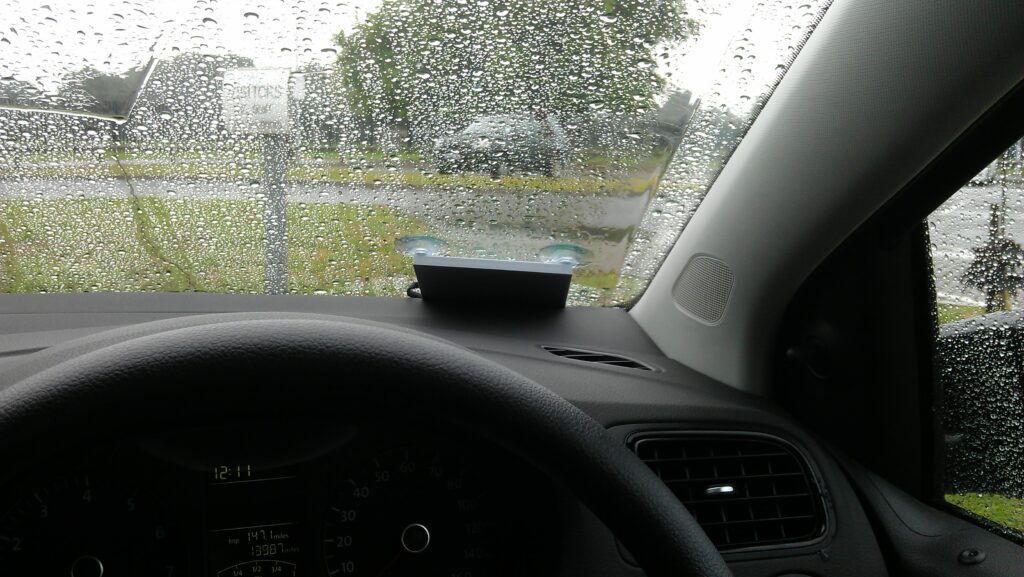
The sensor on the top of the dashboard allows the car to be locked and unlocked with your RFID card (assuming that you’ve made a booking).
For me, at least, it’s far cheaper than owning a car – I only make one journey a week, and sometimes not even that. It’s far more convenient for that journey, for me, than public
transport (which would involve travelling at awkward times and a longer journey duration). If I were using my own car, I’d have to park it in Oxford city centre on Mondays in
order to make my journey possible (which is as challenging as it is expensive). Paying by the half-hour makes it convenient for short hops, and the ability to book, pick up, and return
the car without staff intervention means that it doesn’t matter if it’s midnight or a bank holiday or anything: if I ever need access to a car or van in a hurry, there’s almost always
one available for me to just “swipe into”.
And it’s far simpler than a conventional car rental company… at least, once you’ve gone through the telephone set-up process: a three-way phone call between you, the DVLA, and the car
hire company. If I want a car, I pop up the website or pull out my phone, find a nearby one that’s free when I want it, and go drive.
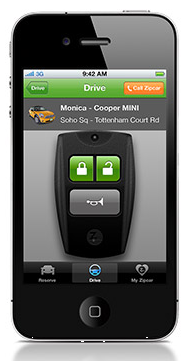
As you can probably see, this is the iPhone version of the app. The Android one is virtually identical.
The cars are all new and well-kept, and the pricing is reasonable: you get a daily mileage allowance (now 40 miles, which is pretty ideal for me, as my round trip journey is barely more
than that), and then pay a mileage rate thereafter (if you need to fuel up, there’s a fuel card in the car). Paying by the mile, rather than the litre, has the unfortunate side-effect
of failing to encourage eco-driving, but other than that it’s a sensible policy which allows you to accurately anticipate your costs.
It’s been great, so far. I’ve been doing it for a few months and I’ve only had one niggle: I was on my way to college, as usual, when Zipcar called me to let me know that the previous
person booking my car was running late. I’d never had this happen before: I’d never even been lined up back-to-back with another user before; it actually seems to be quite rare. In any
case, Zipcar found me another car, which I declined (it was on the wrong side of town, and by the time I’d cycled back to it and driven across to this side again, I might
as well have waited). In the end, the other user was fined, and I was given a discount in excess of the “missed” time, which I spent on a tin of biscuits to share with my classmates by
way of apology for turning up late and disrupting the lesson. I’ve had a few difficulties with their website, especially when they first started taking over Streetcar’s fleets, but
they’ve been pretty good about fixing them promptly.
So there we go: a nod of approval for Zipcar from me. So if you’re based in London (where there’s loads of them), Brighton, Bristol, Oxford, Cambridge, or – soon –
Maidstone, Guildford, or Edinburgh, and occasionally have need for an on-demand car, look into them. And if you sign up using this link or the shiny button below, we’ll each get £25 of free driving credit. Bonus!
Update (2022): Many years later, ZipCar would come to start mis-charging me and then repeatedly fuck up my
requests for them to stop doing so and stop processing my personal information (they actually told me twice that they’d done the latter, and I needed to log into my account to produce
screenshots for them with which to demonstrate that they were lying to me). As a result, I can’t give them the same level of glowing recommendation as I used to.
Update (2023): Somehow, ZipCar are still fucking-up my personally-identifiable information, despite
repeatedly being told to delete it (and on several occasions promising that they would or had). I can no longer in good faith recommend them as a company. Please don’t use them.
Update (2026): It looks like ZipCar have been/are pulling out of the UK to focus on their business in other countries.
Co-Wheels is till good, although I’ve not had need to use them in a long while because, well, these days I own a car!
I’ve recently gotten a new phone – a HTC Sensation running
Android 2.3, and I thought I’d offer up a few thoughts on
it. But first…
Hang on: what was wrong with your old phone?
Well-remembered! You’re right, of course, that last year I got a Nokia N900, and that it was the
best mobile communications device I’d ever owned. I don’t care so much about a slim profile or an “app store”, but I do care about raw power and geeky hardware features, and the N900
delivers both of those in spades. I’ve had several phones that have, at the time, been the “best phone I’ve ever owned” – my 7110 and my N96 both also earned that distinction, whereas my 7610 and my C550 – the latter of which had only one redeeming feature – fell far short.
Nokia N900 with keyboard extended
Awesome though it is, with it’s beautiful hardware keyboard, mighty processor, FM receiver and transmitter, Bluetooth and IR, etc., and completely unlocked,
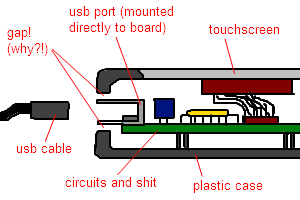
tamper-friendly architecture, the N900 suffers from one terrible, terrible flaw: for some reason, the engineers who built it decided to mount the Micro-B USB port (used for charging,
tethering, mounting etc. the phone) not to the hard plastic case, but to the fragile inner circuit board. Allow me to illustrate:
A cross-section of a Nokia N900, showing how the USB port is mounted directly to the circuit board, and doesn't touch the hard plastic case.
Why is this a problem? Well, as Katie explained to me at the New Earth housewarming party,
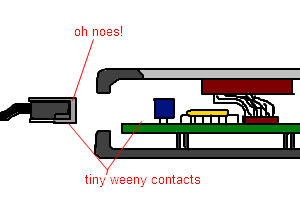
most of her other friends who’d had N900s had encountered a problem by now, whereby the USB cable used to charge the device eventually puts a strain on the connection between the port
and the board, tearing them apart. “Nope,” I told her, “I’ve never had any such problem with mine.”
A cross-section of a Nokia N900, showing the USB port snapped off by the USB cable.
Looks like I spoke too soon, because that very week, I managed to break my N900 in exactly this way. My theory: that girl is cursed. I shall be attempting to
exorcise the anti-technology demons in her the very next time I see her, possibly in some kind of ceremony involving high-voltage direct current. In any case, I found myself with a
phone that I couldn’t charge.
So you replaced it?
No, of course not. My N900 remains a fantastic palmtop and a great device. It’s just got a minor problem in that it’s no longer possible to charge or “hard”-tether it to anything any
more. The latter problem was an easy one to fix: a separate battery charger (I already carry a spare battery for it, so this was no hardship), bought for about £4 on eBay, made it easy
to keep the device rolling. The second problem’s not so much of an issue, because I tend to do all of my synchronisation by Bluetooth and WiFi anyway. But even if
these were an issue, it looks like a pretty
simple job to re-solder the USB port (and epoxy it to the case, as it should have been to begin with!). I might give it a go, some day, but my current soldering iron is a little big
and chunky for such fine and delicate work, and I’m a little out of practice, so I’ll save that project for another day.
The repairing of a Nokia N900 USB port
However, I’m a big believer in the idea that when the Universe wants you to have a new phone, it finds a fault with your current phone. Perhaps this is the geek equivalent of thinking
that “When God
closes a door, He opens a window”.
So: I’ve got myself a HTC Sensation, which narrowly beat the Sony Ericsson Xperia Arc after carefully weighing up the reviews. I’d always planned that I’d try an Android device next, but
I’d originally not expected to do so until Ice Cream Sandwich, later this year. But… when the Universe
closes your USB Port, it opens a Gingerbread shop… right?
The New Sensation
After a few difficulties relating to my name – it turns out that my mobile
phone network has recorded my name correctly in their database, and I can’t change it, but whenever I use their web-based checkout it asks me to enter a longer surname even though I
don’t have a surname field to change – I finally received my new phone.
HTC Sensation seen from the back, front, and side.
The first thing one notices about this phone is that it’s fast. Blindingly fast. I’ve used a variety of Android-powered HTC devices before, as well as other modern
touchscreen smartphones like the iPhone, and I’m yet to use anything that consistently ramps up high-end graphics and remains slick and responsive like this does. Its mighty dual-core
1.2GHz processor’s the cause of this, little doubt. I originally worried that battery life might be limited as a result – I don’t mind charging my phone every night, but I don’t want to
have to charge it during the day too! – but it’s actually been really good. Using WiFi, GPRS, GPS, playing videos, surfing the web, and other “everyday” tasks don’t put a dent in the
battery: I’ve only once seen it dip to under 10% battery remaining, and that was after 40 hours of typical use during a recent camping weekend (with no access to electricity).
It’s also been really well-designed from a usability perspective, too. Those familiar with Android would probably just start using it, but I’ve not had so much exposure to the platform
and was able to come to it with completely fresh eyes. Between Android 2.3 and HTC Sense 3, there’s a nice suite of “obvious” apps, and I didn’t have any difficulty synchronising my contacts, hooking up my various email
accounts, and so on. There are some really nice “smart” touches, like that the phone rings loudly if it thinks it’s in a bag or pocket, more quietly after you pick it up, and silences
the ringer completely if you pick it up from a table and flip it from face-up to face-down. These simple gestural touches are a really nice bit of user interface design, and I
appreciate the thought that’s gone into them.
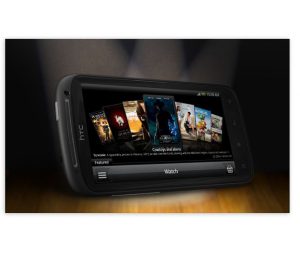
Browsing movies for HD streaming on the HTC Sensation.
The Android Marketplace is reasonable, although I feel as though I’ve been spoiled. On the N900, if there was an application I needed, I usually already knew what it was and where I’d
find it: then I’d either apt-get it, or download the source and
compile it, right there on the device. For somebody who’s already perfectly confident at a *nix command-line, the N900 is fab, and it feels a little restrictive to have to
find equivalent apps in a closed-source environment. It’s not that the pricing is unreasonable – most of the applications I’ve wanted have been under a quid,
and all have been under £4 – it’s just that I know that there are FOSS alternatives that would have been easy to compile on my old device: I guess it’s just a transition.
On the other hand, the sheer volume of applications so-easily available as the Android Market is staggering. I’ve been filled with app ideas, but every idea I’ve had but one or
two already exist and are just waiting to be installed. It’s a little like being a kid in a candy store.
It’s also taking me quite some time to get used to the way that process management works on an Android device. On Android devices, like the iPhone/iPad, returning to the home screen
doesn’t (necessarily) close the application, but it might – that’s up to the developer. If it doesn’t, the application will probably be “paused” (unless it’s
a media player or it’s downloading or something, then it’ll likely keep going in the background). And when you re-launch the same application, it could be
simply unpausing, or perhaps it’s relaunching (in which case it may or may not restore its previous state, depending on the whim of the developer)… You see
all of the keywords there: might, probably, likely, could, perhaps. Great for most users, who don’t want to have to
think about what their phone is doing in the background, but it feels like a step backwards to me: I’m used to being able to ALT-TAB between
my currently-running applications, to know what’s running, when (and I can always use top and find out exactly what resources a process is eating). Putting all of this process management into the hands of developers feels to me like giving
up control of my device, and it’s a challenging change to undergo. Yes: despite the openness of the platform, Android feels just a little out of my control compared to
what I’m used to.
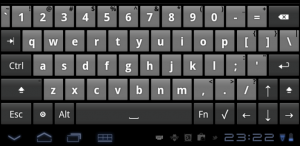
Hacker's Keyboard, my preferred keyboard layout for SSH, etc.
Switching from a physical to a virtual keyboard for the first time is a significant change, too, and it’s slowed me down quite a lot, although applications like SwiftKey X – with its incredibly intelligent personalised predictions – and Hacker’s Keyboard – which gives me back some of the keys I was
“missing” – have helped to ease the transition a lot.
In summary: the HTC Sensation seems to be a fantastic device, and I’m really enjoying using it. I’ve got a few niggles to contend with, but these are all things that were destined to
catch me out upon switching away from a platform as open as the N900, and they’re not severe enough to make me give up and get an N950 instead: I’m reasonably confident that I’ll come
to love the Sensation and we’ll go on to be very happy together.
But will it become my latest “best phone ever”? Time will tell, I guess.














![Cash machine: "Do you wish to carry out a Get Cash or Emergency Cash transaction? [No] [Yes]"](https://bcdn.danq.me/_q23u/2012/06/IMG_5833-300x200.jpg "Cash machine: \"Do you wish to carry out a Get Cash or Emergency Cash transaction? [No] [Yes]\"")