AI peaked in 20141
with the invention of the Taco Bot 30002.
With artificial (taco) intelligence and the latest cheese dispensing technology, it truly represented the summit of human technological achievement the likes of which we might not see
again3.
Footnotes
1 Yes, Taco Bot’s song
came out in 2019, teaching us about the far-reaching capabilities of this high-powered platform, but a prototype Taco Bot with a reduced featureset was seen in 2014’s Raining Tacos.
2 Is it AI? The term gets thrown-around a lot nowadays and refers to a lot of different
technologies, let’s not forget that that’s always been the case. Was the El Ajedrecista machine (1914) AI?
Arguably, yes: even though it was effectively using a ruleset, it achieved its goal of exhibiting a behaviour that had previously been argued to be demonstrative of human
intelligence, and beyond the capability of an automaton (consider also the Nimatron from 1940). Looking for something
less-deterministic? The Ising Model (1920) could be argued to have been the first neural net. It didn’t attempt to “act” in a
way that most humans think of when they consider “AI”, but it used fundamentally the same model as future artificial neural nets did. By 1950, Turing and von Neumann had laid-out
more-concrete definitions of machine “thought”, some of which had, at least conceptually, already been demonstrated by the above examples, but if you don’t consider response
precomputation a valid AI strategy, then consider Prinz’s Chess (1951) which calculated on-the-fly
solutions. Or if your view on AI is sufficiently narrow that you only consider a “chatbot” to count, let’s not forget that ELIZA got there in 1965. My point is that there’s a whole lot of things that can and have been legitimately called AI, and a
walking, talking, bad-guy-fighting, taco-dispensing robot might certainly count, in my mind.
3 By which I mean to say, the Raining Tacos saga by Parry Gripp (whom you’ve almost certainly come across either from his silly videos or else because he performed the Buffy the Vampire Slayer
theme song) finally came to an end in April of this year after taking 14 years to release 9 short songs. If you blinked and
missed the last decade and a half of Internet wackiness, go watch the director’s cut of the whole thing, which came out last
month.
I’m still lagging way-behind on writing-up the nonfiction I’ve been reading this year, and I’m long
overdue1 to share my love of
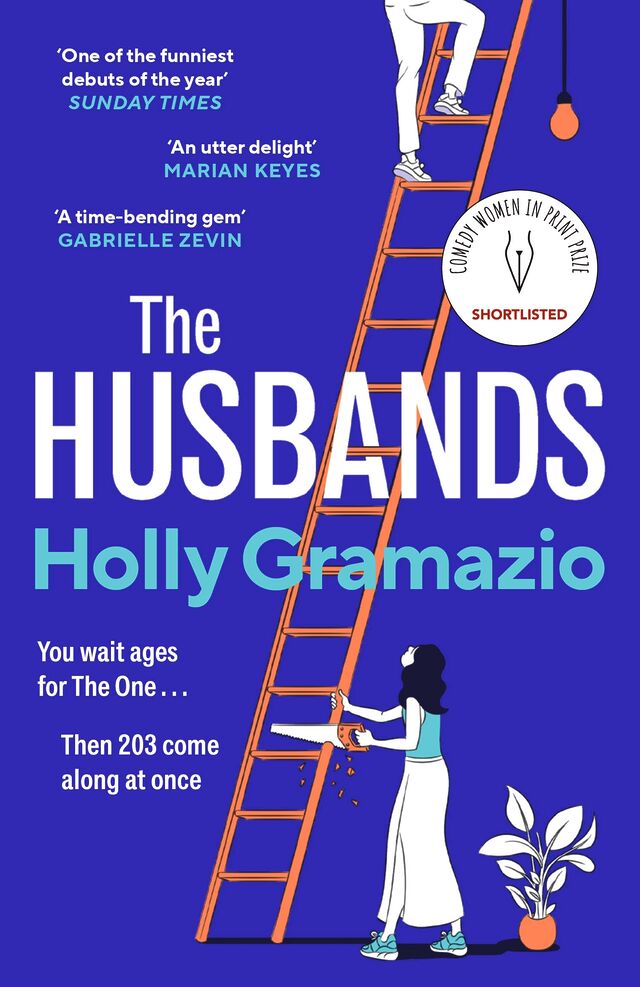
Holly Gramazio‘s debut novel, The Husbands. Which is excellent; truly
un-put-downable. I’d come across Holly’s writing before by playing Dicey Dungeons, but I hadn’t realised that until later when,
four chapters into this book, I decided to look her up (in the hope, perhaps, that she’d written any other books I could add to my reading list – the answer is… not yet).
Here’s the skinny. Lauren comes home from a night out to find her husband waiting for her. Which is immediately confusing and concerning, because when she left for the evening, she
wasn’t married. But all the evidence suggests that now, somehow, mysteriously, she has a husband: she finds letters addressed to the pair of them, her phone is full of photos of them
together going back through their wedding and beyond, and all of her friends back up the fact that she really has made a life with this man… that she just can’t remember.
But the weirder bit she discovers a little later. Whenever her husband goes up into the attic, he’s replaced with a different husband. A different man, it seems, that
she could conceivably have married, in some strange alternate timeline. By controlling how and when they do so, she comes to discover that she can cycle through a
seemingly-endless supply of husbands, and as she comes to accept and understand her new life, begins to use this as a kind-of… dating superpower? “Trying on” a husband for
as many minutes, hours, days, or months it takes to decide whether or not to “keep” him2.
That’s the premise, and it’s perfectly fun (although occasionally dark) – sort of a parody of “swipe-left/swipe-right” modern dating, taken to an extreme – but wouldn’t by itself be
reason enough to recommend it. But what comes next is what makes it so special.
Aaand… I feel like I can’t say more without spoiling it. And you really should read it! Suffice to say that the writing is compelling, and engaging, and there are plenty sufficient
twists and turns to keep you interested even if you wouldn’t normally go in for… what I’m going to describe as a romantic-comedy. Our protagonist’s situation feels relatable
even while it’s unfamiliar, and I enjoyed both laughing at her exploits while also grieving her losses. And again: the surprises and quirks are really fun.
HTTP status code 204 means “no content”. No update. Nothing to tell you.
Which I’m reminded of as I write about progress on our house repairs following the flood that swept through our home on Friday 13 February… 204 days ago. Because that’s how the summer’s repairs have felt: No updates. Nothing to say.
It was already pretty jarring to return from an epic holiday and get back into work-mode. But it was doubly-regrettable to discover that
the various tradespeople who’d been given access to our house in our absence had done… pretty-much nothing.
No work done. And also: no update messages. Everything had just… stopped.
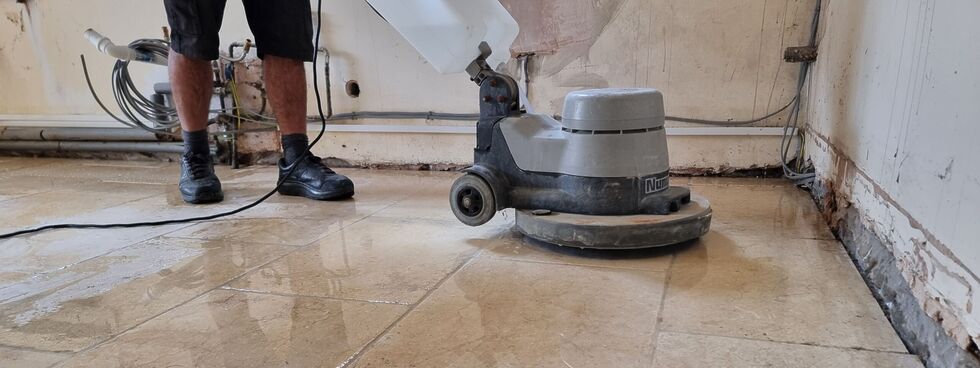
I tell a lie: the restoration of the kitchen floor – a one-day task that didn’t block any of the other next-tasks on the list – happened at the start of August.
So we gathered the builders and the loss adjuster and demanded an update. Sometimes you just have to step up and say “hey, what the fuck guys, are we ever gonna get to move back into
our house?”
It turns out there’d been a few blockers. The contractor who’d been sourced to lay the new underfloor screed in the living room and library had not turned up. The new tiles that would
replace the flooring across the ground floor were still being quarried. The electrical work had complexities that had caused it to overrun be split into two visits, separated by the
electricians’ other contracts.
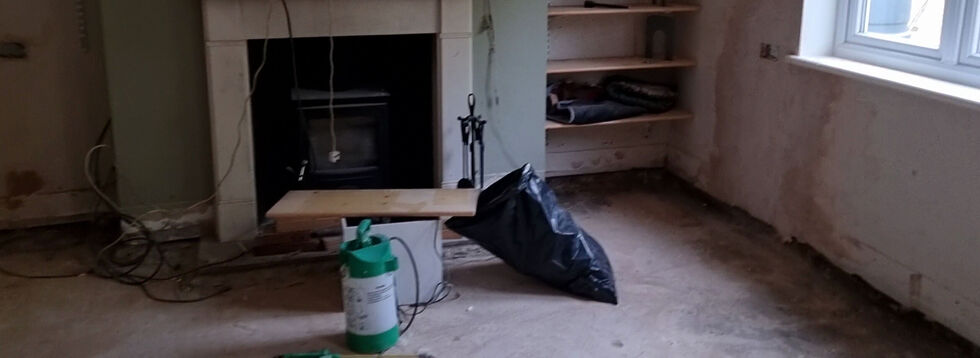
When I visited this week the living room’s condition was identical to how it had looked six weeks prior. Sigh.
Which is frustrating, of course, but it was definitely exacerbated by the lack of communication.
Anyway: our meeting with the various parties led to a new timeline, and it optimistically proposes that we might be able to move back into our home as soon as November… so, F-Day plus
262 through 291, I guess? Here’s hoping. (Obviously any update will make it into my now long-running series of posts about our experience of getting
flooded-out.)
We’re really keen to be back home by Christmas. The Chicory House is okay as temporary accommodation but there are plenty of things I dislike about it, and I’m ready to move back into our actual house now, thanks.
In 2014 we bought a car1, registered in my name. It’s a little long in the tooth now and we’re
thinking about what might replace it, but for the time being it’s a useful workhorse and especially valuable when we need to move the entire family and still have space for luggage.
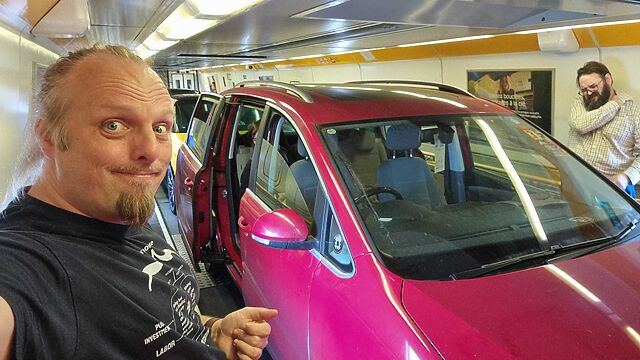
This large car was super helpful for a trip to France via the Channel Tunnel earlier this summer… at least, once I’d hacked Le Shuttle’s
API to work around their inability to cope with us bringing home different adults than we took on the outbound leg!
This week, I renewed my driving license2. While doing so, I was invited to connect the records of the
vehicles I own. This would allow, for example, email notifications when my Vehicle Excise Duty is due on them.
How to register a car “wrong”
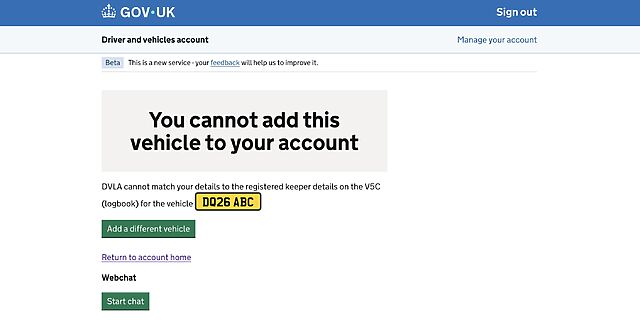
The newer of our two cars was easy to add: I provided the number plate; the website did some kind of lookup; and it was done. But when I tried to add the older car, I got an error
message:
I’d have probably just treated this as “just one of those things” and ignored it, were it not for the fact that our other car was added without any difficulty! Why the
disparity?
The website claimed that the details on my V5C – the vehicle registration certificate or “logbook” – didn’t match my personal information. So I pulled out
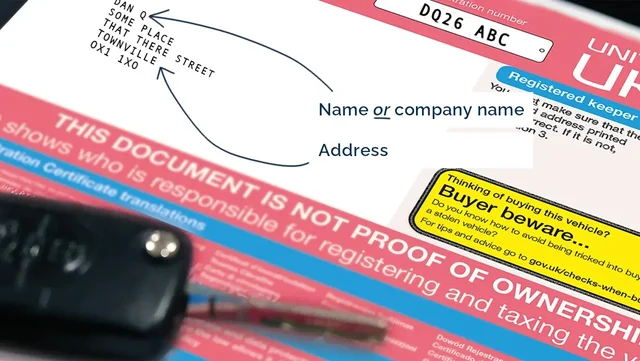
the papers for both cars… and discovered that the personal information sections were identical. The front of a V5C has a section that
shows your name and address, and on both my certificates looked the same: my name, followed by my address. So why was one failing to work?
I sat in a queue for their webchat service, and – after a lot of back-and-forth – the operator and I came to a conclusion about what was wrong: for this car only, my name
had been entered into the “company name” field in their database, rather than the “name” field.
It’s impossible to tell conclusively from a paper certificate whether the first line represents a person or a company: they’re both displayed identically.
From the looks of things, this is what happened in 2014:
The dealership filled the V55/4 form to register the car to me.
The DVLA saw my unusual name3,
figured “that can’t be a person’s name; it must be a company name”4,
and put it into the “company name” field.
The DVLA database differentiates between company name and person name, but the paper version just prints whichever one is present at the top of the address: information is
lost in the translation to paper.
So: the database was wrong, but the paper copy didn’t show that it was wrong.
Getting the problem fixed
Apparently if I send my V5C to them with the details “corrected”, with an accompanying letter explaining the the correction is to which field they should be storing the
data in, then they’ll correct it within a month or so
And then they’ll issue me with a new paper copy. Which will, naturally, look identical to this one. The only change will be in their database.
What can we learn from this?
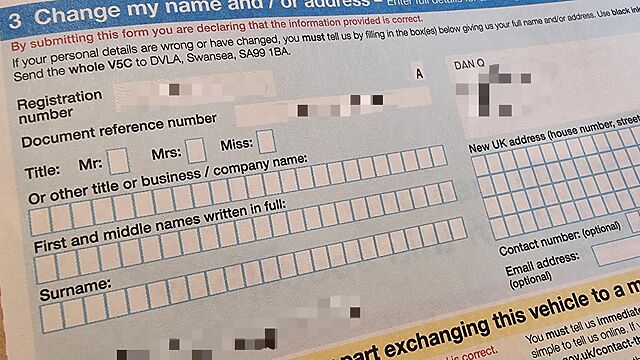
I wonder if there’s anything that could have been different to prevent this confusion? A simple change would be to improve the layout of the third page of a V5C certificate.
This is the part of the form I need to “change” by entering a first and surname, representing no actual change to the paper version but a significant difference to
DVLA’s database.
Perhaps instead of re-listing the name and address in the same format as on the front page, this page could list each field separately, perhaps with each alongside the
corresponding field for changing it. This wouldn’t need much space, less than would be saved by consolidating submission instructions (which are repeated at least five times in some
form or another, across the form).
There are other ambiguities and redundancies that could be cleared-up at the same time. For example, the company name field does double-duty as the title field, which is an unnecessary
complication that I’m sure must make data entry harder. And the registration number and document reference number are duplicated many times on this page, even though the instructions
prohibit separating the parts.
Maybe there’s something to be learned from this for all of us who work with databases and forms. Do you have any fields that serve double-duty? Do you produce output by
concatenating fields in such a way that might result in ambiguous provenience? Do you have a process to validate that data has been entered into the right column? Are you unable to make
changes without re-generating secondary resources (like paper hard copies), the the secondary resources are functionally unchanged?
But for now, I probably ought to get this form sent back to the DVLA. So they can change their database and send me back a near-identical form. Such bureaucracy!
Footnotes
1 This car is a Seat, and – because we name all of our cars – he’s call Arthur. Yes, for
the pun.
2 The driving license renewal was super easy, by the way. Half a dozen clicks on a gov.uk
page and it was done.
4 As far as I can tell, there’s never been a company called “Dan Q”. There was a “Danq”, once, and a “Dan QB” long after, and it makes you wonder why corporate registration of a vehicle doesn’t require
as a minimum a cursory lookup on Companies House by the registering officer, but what do I know?
When you buy a domain name, your registrar will typically offer to provide you with a collection of DNS nameservers. For most people, most of the time, that’s plenty sufficient.
A trip back to 2006
My secondary domain danq.dev has three nameservers, operated by its registrar Gandi.
This wasn’t always the case. In the long-distant past, I’ve registered domains for which I’ve had to run my own nameservers. Or else, where I’ve chosen to run my own
nameservers in order to gain more control, or power, or just to play about with the technologyinevitably break things.
When I transitioned to using third-party DNS around 2006, I used to be a big fan of vanity nameservers. “Vanity nameservers” (or “white-label DNS”) is where your nameservers
are hosted at subdomains of the domain for which they’re the nameserver.
So instead of the nameservers for danq.me being, say, looking like ns-48-a.gandi.net and ns-228-b.gandi.net, they might look like, say,
ns1.danq.me and ns2.danq.me. They might still be provided by the same third-party (or might not!), but you don’t get to see that. DNS protocol doesn’t
care about the hostname it’s connecting to, it just needs the right A/AAAA records and it’s good to go!
Well, once you solve the bootstrapping problem, anyway!
If the nameservers for a domain are at a subdomain of that domain, you’ve got a circular dependency. To solve that, you have the servers one level
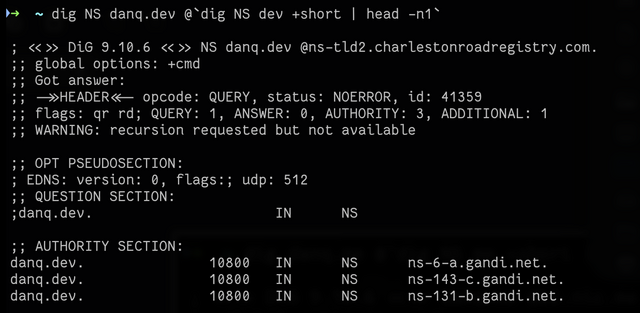
higher provide “glue records” in addition to the list of nameservers. The glue records, which are shown in the “additional section:” of dig‘s output, above, solve
the circular dependency. Now, the nameservers can be found without first having to… find the nameservers!
Tada! For the first time in about 20 years I’ve configured “vanity DNS”: danq.me‘s nameservers are now called ns1.danq.me, ns2.danq.me,
ns3.danq.me and ns4.danq.me.
Vanity nameservers in 2026
The essential steps for setting up vanity nameservers are fundamentally the same as they always were. Propagation times are much shorter now and I was able to
have the whole thing done and dusted within a couple of hours. In case you’re looking to follow-along, here’s the broad steps (the specifics depends on your registrar, DNS provider,
etc.):
Set up A (and AAAA, it’s 2026 you know!) records pointing ns1.example.com (or whatever your domain is) to their IP addresses.1
Change the NS records for your domain to point to your new vanity nameservers.
Change the SOA record for your domain to point to the first vanity nameserver2. Bump
your serial.
Have your registrar create glue records mirroring those you created in step 1.
Have your registrar change the authoritative nameservers for your domain to those you created in step 1.
(Optional) 😰 Frantically and repeatedly poke the registry’s DNS servers with dig until you’re confident that you didn’t just make a hideous typo and broke your domain
in a way that would have been a pain in the arse to unpick when you last did this, in 2006. Calm down when you remember that it’s 2026 and nowadays it’s gonna be easy to fix via some
API or web portal of your registrar!
That’s all there is to it.
But… why would anybody do this?
For most folks, this is pointless. Larger companies, especially in tech fields, sometimes do it as a branding exercise, especially if they’re re-selling services atop
somebody else’s infrastructure and don’t want to so-clearly lampshade that3.
But I took a look and… I don’t think people bother any more.
Hit up a handful of corporate domains you know and, with the exception of the few that run their own DNS, you’ll see the same big providers keep cropping up: Cloudflare, Amazon, Google,
Microsoft… I experimentally probed a hundred or so domains that I thought might use “vanity DNS” in front of a third-party DNS service… and found… none4.
Nobody cares any more. You’re either running your own, or you tell the world who’s running it for you, with no in-between.
Bringing back an old tradition
Vanity DNS is a dying art.
Soo… I’m now doing vanity DNS ondanq.me; it’s the first time I’ve run vanity DNS on a personal domain since… I want to say 2010‽
The journey started when Jacob asked me about my DNS setup, and it made me nostalgic for a time when nerdy techies whose nameservers were
provided by a third party would just “do” vanity DNS as a matter of course.
Vanity DNS felt nerdy and fun back in 2006. And I guess that nowadays… it still feels nerdy and fun. It’s still as pointless as it ever was, but I don’t care. I’m doing
something that I thought was cool when I first learned about it in 2001, just for the fun of it.
Type dig NS danq.me in your terminal to see the result: four nameservers, all with a .danq.me suffix5.
Cute!
Footnotes
1 There’s a convention of naming nameservers ns1, ns2,
ns3 etc., but if you want “fun” names then that’s fine too. Cloudflare’s nameservers have cute names, if you haven’t seen already!
2 Check your dotted-notation hostmaster email while you’re there; everybody forgets to
look at these and so they’re often outdated.
3 Using vanity nameservers to conceal an underlying DNS provider does not conceal the
third-party’s identity because you can always use the IP address of those nameservers to work out who’s behind them. For example, if you’re interested in seeing who’s really
providing the DNS for danq.me, you might run NS_NAME=`dig NS danq.me +short | head -n1` to get the name of a random one of my nameservers, then
NS_IP=`dig ${NS_NAME} +short | head -n1` to get its IP address, and finally do an reverse DNS lookup on that with e.g. dig -x $NS_IP. Often, this canonical
name will be a giveaway and you won’t even have to look at the lists of who owns which blocks of IP addresses. It’s not a secret. (Gotta admit, though I’m not entirely happy with my
provider… maybe it’s time to switch… or even go back to selfhosting DNS once more!)
4whatsapp.com appears to have its own nameservers
a.ns.whatsapp.com through d.ns.whatsapp.com, but their A records point to IP addresses whose reverse DNS names are a.ns.facebook.com through
d.ns.facebook.com. Not terribly exciting, nor surprising, that Meta are running their own DNS services for their various properties (the same thing happens with
instagram.com). paypal.com seems to have both its own DNS servers and some replicas provided by Digicert UltraDNS, which for a moment excited me
when I thought that they might be part-way through a white-labelling exercise, but no: they’re two different services. I thought I’d find something interesting via one of the big
blog, eccomerce, or VPS providers that offer free subdomains: folks like Bearblog, Dreamwidth, Substack or Medium. But nope; some seem to run their own DNS, and others just sit on top
of a big third-party. Sigh.
5 Want to see the glue records? Run dig NS me +short to get the names of the
authoritative nameservers for the .me TLD, e.g. a0.nic.me, and then query it directly with e.g. dig NS danq.me @a0.nic.me: you’ll see not just that I
have four nameservers under .danq.me but also their IP addresses (in the “additional section”) – that’s the glue doing its thing!
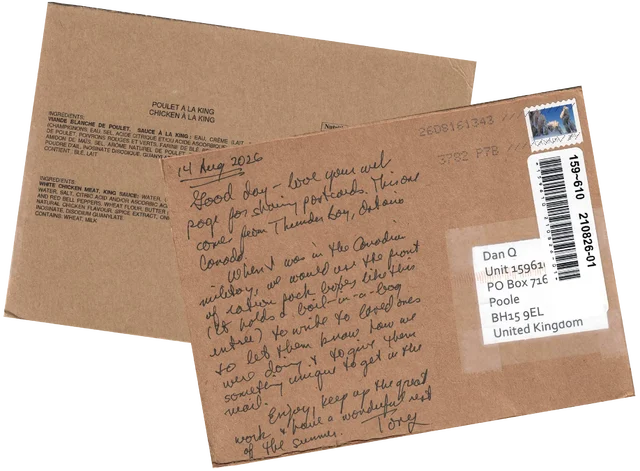
For almost a year now, I’ve been actively soliciting Internet strangers to send me a postcard (in addition to the
usual ways of contacting me, via comments or email). I had no idea it would be so-successful: I’ve received a postcard almost every month! I’ve been keeping them in a mildly-interactive gallery if you’d like to see.
Today was novel, though. Today, for the first time, I received a postcard from somebody… whom I can’t identify.
The postcard is from “Tony”. So I can identify them that far. But… who the heck is Tony‽
In the case of every previous postcard I’ve received, it’s been somebody I’ve been able to “trace”: either because they’ve previously left a comment on my blog, or emailed me, or we’ve
moved in the same circles of a (relatively small community) website, or they’ve included a URL or some other way to “find” them.
This one though, is a mystery.
Let me tell you my favourite thing about this postcard, though: it taught me something cool. The postcard is made out of the (billingual) outer packaging of some kind of
MRE/boil-in-the-bag ration pack, and Tony tells me that when they were in the Canadian armed forces, their unit would send postcards like this “back home”: written directly onto the
packaging.
How neat! If I had a family member in the services, it’d be neat to get a postcard from wherever they were deployed that not only told me how they were doing… but as a side-effect what
they’d been having for dinner. It’s cute.
If you’re out there Tony, feel free to say hi in the comments or email, too. And thanks for the card!
Among the correspondence I engaged in following my blog post about my (boring) polyamory were a few examples of people being concerned
about the equality of our arrangement: how we keep things “fair”1.
By way of example, let’s take a look at a specific example that’s come up. Here’s something that I was asked recently:
Why does [my partner] Ruth not have her own bedroom? Both of her partners [JTA and I] get one!
Where does my partner sleep?
It’s been joked that polyamory is just a fetish for calendar management. Our family calendars are moderately simple, I imagine, compared to those of people in larger polycules or with
less routine.
Except when she’s travelling or otherwise elsewhere2,
Ruth spends her nights in an approximately even split3
between JTA‘s bedroom and mine.
This leads some people to observe that:
JTA has a bedroom of his own,
I have a bedroom of my own, and
Ruth “shares” both of those,
and this is unfair because her partners both get something that she is denied.
Superficially, this sounds true. But it conflates “fairness” with “parity”.
Fairness versus parity
Parity is making sure that everybody gets the same thing. It’s a simple, but crude, measure of equality. That’s probably why it’s so-popular with
children.
“My sister got a doughnut so I should get one too.”
“You had an iced finger instead. You said you prefer iced fingers to doughnuts. And your sister doesn’t like iced fingers. Both of you got what you wanted.”
“Yeah, but now I want a doughnut because she had one!”
– the kind of conversation that’s probably familiar to you if you have children
When you aim for parity, you’re trying to make sure that every person gets the same thing. But this isn’t ideal, because not every person wants
or needs the same thing!
“I don’t even want this. I just don’t want to feel like you’re getting something I’m not!”
Fairness, is aiming to for everybody to be content.
Ideally, everybody would get everything they wanted, all the time! But where that’s impossible, we can aim to at-least ensure that everybody is content. That everything is
“good enough” for everybody. Unlike a quest for parity, this respects the fact that people have different needs.
Me personally? I absolutely prefer to have a bedroom of “my own”! In fact, to go even further than that: if I were in Ruth’s position I probably would want a room of
my own, if it were feasible. Also, in some kind of hypothetical universe in which neither of us had other partners… I’d still ideally want to sleep alone some of the
time (maybe once every couple of weeks?), because I’m of an inclination to occasionally luxuriate in being able to totally starfish-out.
If it were me instead of Ruth at the fulcrum of our V-shaped polycule… I suspect I’d have different needs to Ruth. And that’s fine!4
I’m a big fan of people being able to have their own space if they want it.
When the three of us first started cohabiting I suggested that Ruth should have her own bedroom. In our first shared house, we ensured that she did! But in practice, it never
got used. Over time we’ve dropped it in favour of having a spare bedroom: a versatile space that can be place for gaming, or television, or guests5.
It was valuable to start from a position of assuming that we would all get “our own” room: parity is a good starting point! But fairness –
meeting everybody’s needs in the most-equitable manner – is a better finishing point.6
Communicating a way to fairness
The world sometimes sucks. Many of the social interactions humans engage in, on a day-to-day basis, are not rooted in fairness. Some human social interactions go to the
opposite extreme: they even exploitative.
Have you ever been in a salary negotiation? You might have heard the idiom that the first person to say a number loses. Salary negotiations are an adversarial
game. Both sides want to come out with the most money, and so neither side is incentivised to show their hand.
Everything I learned about salary negotiations… I learned from playing Theme Park. Just make sure you’ve got a
deal before you run out of biscuits.
Relationships between people who care about each another don’t have to work by adversarial rules (and, in fact, probably shouldn’t!7).
If you love and trust and want the best for one another, then – hopefully – you can be honest about what you want, and can be okay with being hearing whether or not it’s
something that your partner(s) can provide. Or else work together to find compromise position that best facilitates everybody’s needs!
So: if Ruth decides that she wants to have a bedroom of her own again, we can try to make that happen. If I start an additional serious/committed relationship and decide that I’m not
getting enough “alone time”, we can work out how to achieve that. If JTA’s work starts requiring a long and tiring commute and he needs fewer childcare responsibilities, we’d solve for
that. We tackle these problems as a family who love and care for one another, with the goal of getting an outcome that’s fair to everybody!
Those outcomes don’t have to mean that we each get “the same”. Just that we each, as far as possible, get what we most want.
Footnotes
1 Sometimes somebody – almost always a man – will claim that our arrangement is unfair to
both JTA and I who have to “share” one woman, as if her role were to be “owned” by one of us. Sometimes somebody – almost always a woman – will claim that our arrangement is unfair to
Ruth because she has to split her time and attention between two men. I find it hilarious that these two arguments, diametrically opposed, are most-often made on gender lines.
2 The other month, for example, Ruth stayed over at her aunt and uncle’s house after
celebrating her uncle’s birthday. JTA and I hung out and watched some RobWords until I, tired after an afternoon
of beginners’ tango, took an early night!
3 In actuality, Ruth spends slightly more nights sleeping in JTA’s room than in mine.
This, too, is one of those things where people will sometimes instinctively assume represents some kind of injustice to me and that I’m somehow being hard done by or deprived
of some kind of relationship “rights”. This is, clearly, nonsense.
4 Also: I couldn’t think of a better way to graphically represent us swapping around into
some differently-pivoted V-shaped relationship than by using the deck of playing cards that was on my desk anyway. I was feeling unimaginative, apparently. Can you tell?
5 Or – indeed – a spare room can be a space for for one of us to use, if we’re ill or
leaving early in the morning or something and don’t want to disturb a bedpartner.
6 If you’re looking for another example of the difference between parity and fairness,
consider taxation! A flat tax like a poll tax exhibits strong parity, because everybody pays the same, but it doesn’t
exhibit much fairness because the value of that tax burden is less for somebody who is wealthy than for somebody who is poor. We call taxes that favour parity over fairness
regressive taxes. I guess that we could call sharing of family resources in a way that favours parity over fairness
regressive sharing?
7 If you’re in a relationship that’s routinely adversarial, then… and I don’t mean to be
judgemental… that doesn’t sound like a very healthy relationship to me. Perhaps step back and re-assess whether it serves you both?
Ruth, JTA, the kids and I are all back in the UK1
after a three week period during which some or all of us were consistently in Spain. The whole adventure was the kind of masterpiece of epic planning that only Ruth could have pulled
off, and it worked spectacularly2.
I wasn’t around for the first week of the trip, but continued working from home (with the dog, pictured) as per the usual.
San Sebastián
Through clever permutations of remote-working from overseas (mostly by Ruth) and overlapping/intersecting stretches of annual leave (mostly by JTA and I), we were able to avoid having
to send the dog to the dogsitter for a block of more than a single week3,
didn’t need to break the bank on our collective leave budgets, and managed to give the kids the longest possible block of continuous immersion in the language and culture of Spain.
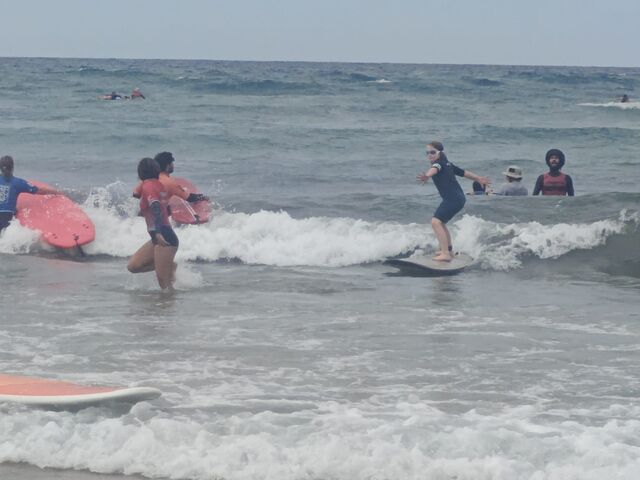
The one time I tried surfing, I wasn’t good at it, but I was reassured that was normal for a first day. The kids disproved that theory,
becoming pretty reasonable boarders very quickly.
In the first week (when I wasn’t there), the kids got to take a mixture of surfing classes and Spanish language lessons in San Sebastián, among other activities. The Bordeaux wildfires caused some travel chaos for the others getting there, but they made it work in the end.
Tarragona
Later, I flew out to meet up with them and we switched to the opposite coast of Spain, staying in a delightful little
villa North of Tarragona. The summer heatwaves that are affecting the continent made the middle of the day especially
oppressive, so we did as the locals do and sensibly sheltered indoors during the hottest part of the day… but the kids in particular were glad to be able to take a dip in the pool to
cool off.
The villa was a lovely building in a fabulous spot, nestled among hillside olive groves and vineyards, but the lack of wired Internet
access/WiFi plus the signal-blocking stone walls made it more “disconnected” than we’d anticipated4!
As has become my tradition when travelling and on family holidays – because I’m an earlier riser than most, but also because I wanted to make the most of the coolest part of the day – I
got out early most days for a whole bunch of geocaching expeditions5.
But once others were awake we found plenty of other opportunities to explore the area.
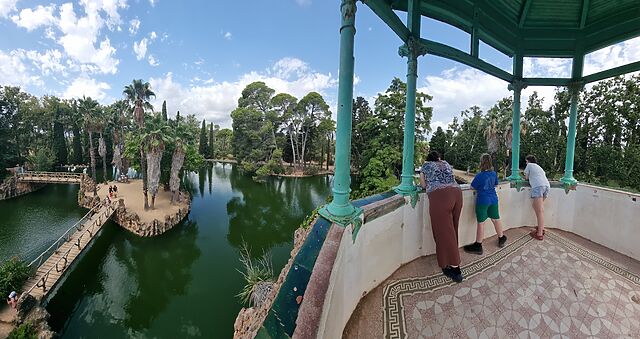
Parc Samà‘s breezy towers and water features took some of the heat out of the day, when we visited its attractive botanic gardens.
Having come from, remarkably, a similar level of temperature and humidity in the UK, I was interested to see how much greener everything was here on the Mediterranean
coast. The plants here, better-adapted to hot and dry summers than those that we plant on our little island, were clearly more-suited to these kinds of conditions. Is it perhaps time
that Britain started ditching her lawns and other year-round thirsty vegetation… instead planting more tropical-adjacent plants to provide shade (and carbon capture!) as the climate
continues to shift?
This little fella had the right idea about keeping cool.
I enjoyed that we were able to split out time between a diversity of activities. A week-long jaunt can be dominated by a single activity – a skiing holiday, for example – but by the
time you’re spending most of a month exploring a country, you want to be able to mix things up a bit, right?
Sometimes we kept it slow-paced and relaxing, like reading by the pool while the children invent splashing-based games or playing board games in the shade. Other times we explored
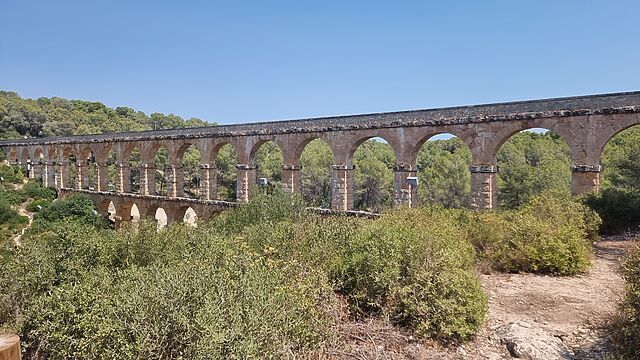
history and culture, like our visit to the Ferreres Aqueduct, the Catedral de Tarragona, or the old Roman amphitheatre.
An augmented reality tour of the amphitheatre was both engaging and educational for the kids, bringing to life its long and complex history: did you know it started as an
amphitheatre, but later was the ground of a church (commemorating Saint Fructuosus, who was executed there), then
became a prison, and now… it’s an amphitheatre again: in addition to being a historical monument it’s used to stage concerts and things!
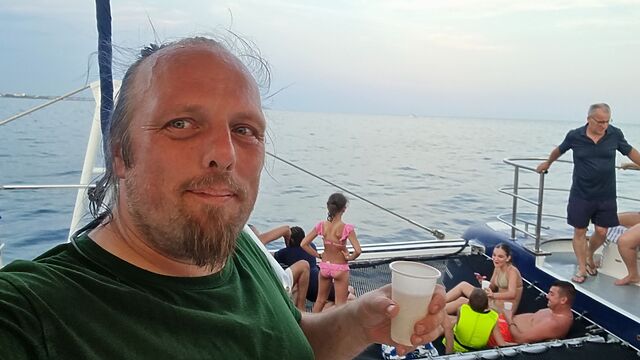
And other times still we even did the typical “British tourist in Spain” things, like a trip to the beach or an expedition out on a catamaran to swim in the sea while the sun set.
I expected the catamaran trip to be a bit tacky, but it was actually lush. (I may have availed myself of the open bar, a bit!)
Obviously the biggest reason for our trip was to catch sight of the total solar eclipse as it passed over the region, and our villa’s garden/vineyard was without a doubt a superlative
spot for this. We’d initially been concerned that visibility of the low-in-the-sky/close to sunset eclipse might be obstructed by the hills and that, therefore, we’d need to find
another spot from which to spectate, but an early-in-the-week experiment of watching the sunset (with an eye on the clock) reassured us that this wasn’t the case. So – as long as we
were lucky with the cloud cover – we should be set.
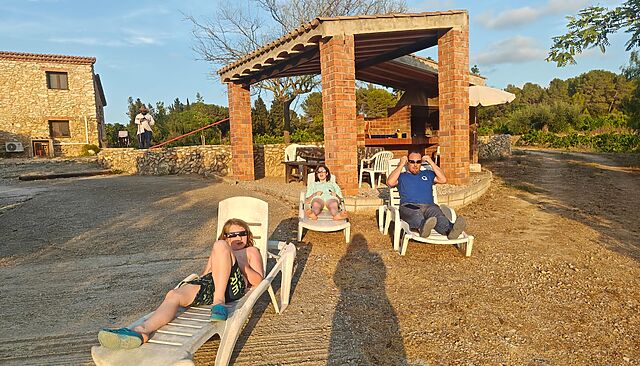
A particular highlight of the entire trip was hanging out as a family in our private vineyard, watching the solar eclipse.
I’ve been fortunate enough to have had great visibility of a total solar eclipse once before, in 1999, but honestly: this one beat
it. The perfect location, the reds of the setting sun, the “moon illusion” exaggerating the perceived size of the moon as it
approached the sun, the joy of vicariously sharing in the childrens’ wonder… all of these made the whole experience pretty mind-blowing.
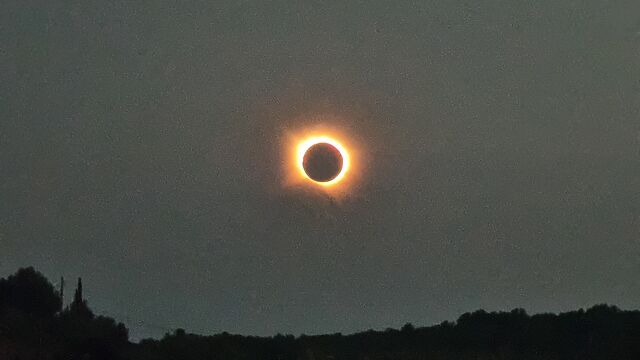
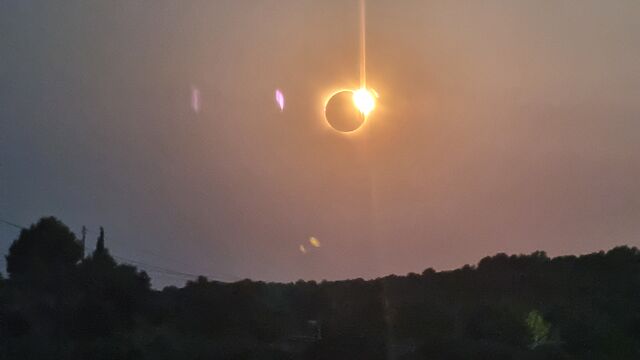
You’ve seen pictures of eclipses before, but this one is mine. I maintain that even the good/professional photographs are poor substitutes for the real experience, though!
We watched, we awed, and then we saw the still half-obscured sun gradually disappear over the horizon. And then, a round of hugs and cheers and conversation later, we sat up late to
enjoy the Perseids begin their nocturnal display.
Mostly I was looking at the sky (through the safety of my eclipse glasses, of course). But I managed to snap a handful of photographs that, despite the limitations of my phone’s
camera, came out pretty well.
PortAventura
After our week in the villa we delivered JTA to the airport to return home. Then Ruth, the kids and I drove on to PortAventura, perhaps
our favourite theme park anywhere in the world. Since our last visit, the younger kid has reached a milestone of height that permits him to ride all of the largest rides, and he was
excited to take advantage of this newfound privilege.
A particularly useful thing about PortAventura compared to some other theme parks is that it’s designed with heatwaves in mind: it’s got lots of natural shade, cooling-off
areas, and the right ratio of water rides for when you positively, absolutely need a good soaking.
Both the elder child and I were particularly excited to share with him my favourite non-looping
rollercoaster, Shambhala. Shambhala is simply excellent: it’s a highly-vertical smooth ride with a free and open-feeling restraint that, collectively, give amazing “air”
and a sensation of “flying” that’s hard to compare to almost any other coaster ride I’ve been on. I could sing its praises aplenty.
The second we reached the front of the line for our first ride on Dragon Khan…
it broke down. But we got to watch it being repaired right in front of us, so that’s cute!
Going to Disneyland Paris and PortAventura in the same summer gives me the confidence to say: PortAventura is the better theme park. The rides, the
theming, the food, the queue management, the accommodation, the value-for-money… it’s all better. So if you’re considering a European theme park trip and you don’t
care about getting your photo taken with Goofy or whatever… PortAventura would be my suggestion.
PortAventura’s water park is good too, although it was pretty busy on the day we went. Their 30-metre tall near-vertical waterslide King Khajuna is a little
intimidating7,
but nothing our thrillseeking little man wasn’t up for.
Barcelona
Finally, we made our way to Barcelona for a “wind-down” couple of days at a hotel we’ve always enjoyed there. Aside for being mistaken for staff
while I was using my laptop by the rooftop pool, there’s little of note to say about it: we took it easy, did as little as we could get away with, and generally “unplugged” before
our journey back to the UK and a return to normal life (boo!).
Altogether a fabulous trip… and a really interesting experiment in a model that we could replicate if we ever opted for a three week (but drop-in/drop-out/telework) holiday in future.
Though… I’d again want (our scheduling queen) Ruth to wrangle the logistics, because it gets complicated when there are so many moving parts!
2 For a while, she was talking about trying to engineer it into a five-week
expedition spanning both this and our trip to France earlier in the summer (to which JTA, the kids and I drove/LeShuttle’d, and to which Ruth flew following a work-related
event in Austria: my, what a cosmopolitan life we’re leading this year!). But that’d have been an enormously more-complicated affair and I’m glad we settled on this “simpler” trip in
the end!
3 Not that she cares: the dog loves hanging out with her little doggy friends, and is
always excited to be taken to our dogsitter‘s, where she also “commutes” for a workday or two most weeks.
4 During out post-holiday ‘retro’ (because of course that’s what we do), the lack of connectivity appeared as both a negative
and a positive on some of our lists! Obviously we’re all aware that a little digital disconnection is healthy and valuable, but sometimes it takes being in the middle of
nowhere to impose the requisite self-discipline to keep off your devices!
6 Obviously, the Devil’s Bridge nearest where I used to live and at which Ruth and I spent our first anniversary – back when we had no idea that we’d be able to make our relationship last… what…? 19 years this month!) –
will always have a special place in my heart.
7 Reaching the top of King Khajuna’s tower, you can feel it swap in the breeze, and when
you get to the slide itself its ‘horizon’ disappears precipitously until you shuffle completely up to it, at which point there’s little choice about your destination! While we queued
for our first goes, we witnessed several people reach the top, change their minds, and turn back!
Which led me today to ask: how many caches does Geocaching.com think I’ve found? It’s the biggest, but not the only, site I use, and so I didn’t expect it to show
the same total as me. A difference is expected.
Well… it turns out how you ask it. In the top-right corner of the page, when I log in, it says that I have… 1,035 finds:
That turns out to be significantly higher than I’d anticipated, which initially made me wonder: did I fail to count some in my tally?
My tally comes from those which have been imported right here onto my blog. I use a computer-assisted but still-manual approach1 to PESOS my geocaching logs from various sites – Geocaching.com, OpenCache.uk2,
TerraCaching, etc.3 –
onto my blog, and then I count them here. Could my data be wrong?
So I went about checking it. Which turned out to be challenging, because the “foreign key” I use to associate the caching logs on my website is the log ID that appears in the links on
Geocaching.com… and those changed format somewhere along the way.4 So first I had to fix all of my metadata spanning
about 750 rows. Then I was able to check.
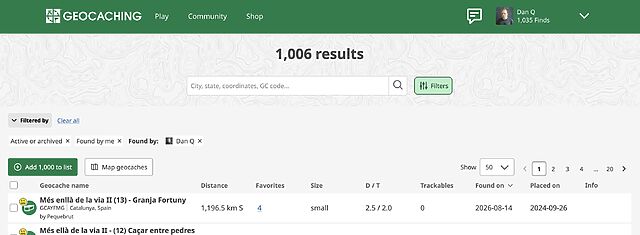
But while I did that, I noticed something strange. When I click on that link that says I have “1,035 finds”, the resulting page has a link to see what they are. And it
claims there are… 1,005 finds:
Stranger still, a different link from the same page on Geocaching.com told me that I had 1,006 finds!
This screenshot’s my favourite, because it shows two different totals at the same time!
Even before I’d corrected all of my metadata and rechecked my totals, I was becoming increasingly convinced that I couldn’t trust any of Geocaching.com’s totals. How many finds
is it, exactly: is it 1,035? Or 1,006? Or 1,005?
It doesn’t really matter, of course. I keep my own count, and I’m now even-more confident than ever that it’s accurate. The correct answer to to the question
“how many geocaches have I found?” is 1,019.
And for some reason, Geocaching.com can’t count even the ones that are logged on their site three times and get the same number twice. 🤣
Footnotes
1 This helps me sidestep Geocaching.com’s draconian rules on scraping and API access.
2 I got in trouble once with a Geocaching.com reviewer for hinting at the
existence of other geocaching listing sites, once. I don’t understand why: they’re unlikely to be a commercial threat to Geocaching.com’s business, and those other sites
typically allow you to talk about Geocaching.com! I guess that they’re mostly afraid that it weakens their trademark on the word “geocaching”, which I’ve never been convinced is
legitimate anyway because it was being widely used online to describe the activity it represents before they tried to start centralising and hoovering-up all of the cache listings.
It’s just sneaky monopolistic silo behaviour on the part of Geocaching.com, really. I’m not a fan. I can list plenty of examples of this kind of dipshittery on the part of
Geocaching.com, but I’ll spare you for now.
This week, I’m living in a villa on a vineyard about 9km North of Tarragona, on the East coast of Spain.
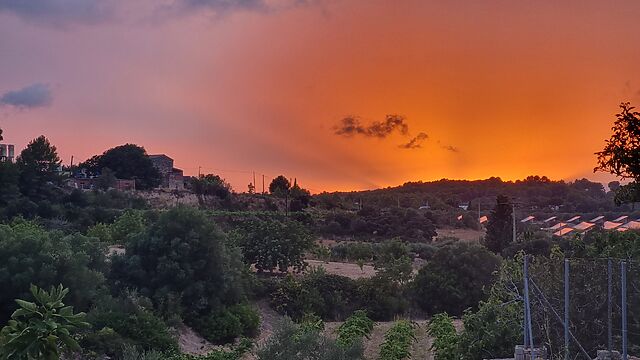
Gotta say, it’s a pretty place to walk the grounds of.
A large part of our choice of location for this trip was, of course, the total solar eclipse that’s expected
this evening, whose path of totality just barely passes over this spot before disappearing somewhere over the Mediterranean.
We tested by watching a couple of sunsets that, at the time of day the eclipse will occur, the sun will still be visible over the horizon.1
26 years ago, almost to the day, I blogged about witnessing the 1999 solar eclipse from Paris, where we were fortunate enough that Europe’s cloudy conditions on that day broke just
in time for a midday totality and a proper “diamond ring” occlusion. I’m not confident I’ll ever see an eclipse quite so spectacular again in my lifetime, but I’m hopeful!
Obviously the eclipse is a primary deciding factor in our location this summer, but this family holiday’s about more than just seeing the sun vanish and hoping that it comes
back out again.
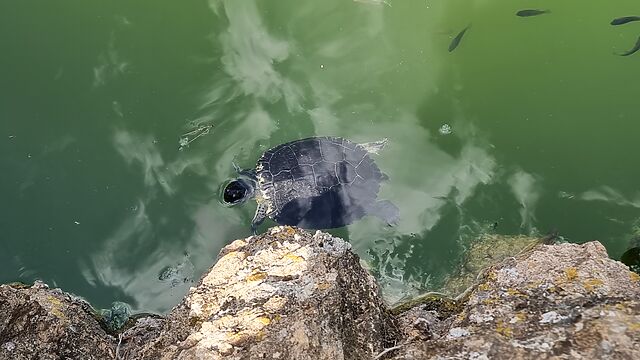
For example, we’ve also braved the August heat for a variety of outings around the area, such as to the beautiful botanic gardens of Parc Samà where
we met this curious little turtle.
I’ve been out geocaching a lot on the mornings, for example, as is my way when visiting any foreign country! I’ve enjoyed taking advantage of being a
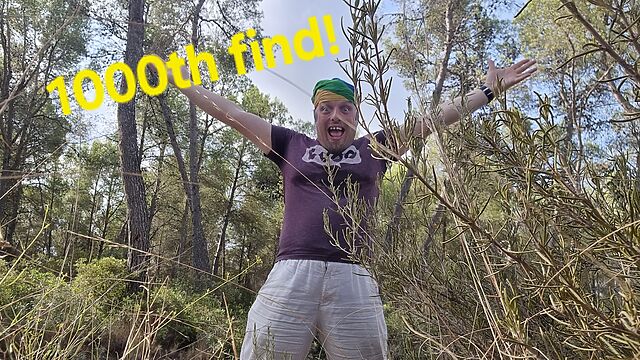
naturally earlier-riser than most of my family, coupled with the cooler morning temperatures, to explore the hills and forests of this region. And look: I found my thousandth ever geocache!2
The one downside3 of our accommodation is the lack of connectivity. There’s no wired
Internet here, and the hilly location and stone walls make acquiring a reasonable cellular signal… challenging.
To look into a Three Rings issue this morning, I first needed to drive down the hill and around the valley a short way to get
line-of-sight to a cellular tower, in order to get more than one bar of 5G signal and tether myself a reasonable Internet connection!
Anyway: it’s beautiful and bright (and scorchingly hot!) out here, and I’ve got my fingers crossed for clear skies in eight hours’ time. Here’s hoping!
Footnotes
1 Without clouds in the way, the prettiest pictures of sunsets occurs just after
this point, of course. I’ve spared you seeing a photo of an unoccluded sun, which – depending on the brightness fidelity of your screen – you’d possibly need to wear special shades to
look at anyway?
2 I know, I know: I’ve been geocaching for sixteen
years – I “should” have found more than that by now. Well, I’m pretty laid-back about the sport, and often only target caches with a reasonable number of positive reviews or that
are otherwise interesting to me. I’m not so-interested in making the “number go up” as I am in exploring interesting places and seeing cool things.
3 Or is it an upside? It’s certainly keeping my focus on the world around me and away from
screens!
My living room TV is attached to an ageing Windows box that we use as a media centre and middleweight gaming1
PC. To better fill the room with sound (I hate those tinny flat speakers they like to put into TVs these days!), the TV is also attached to a soundbar.
The problem is that the soundbar keeps shutting itself down. If it doesn’t receive any signals for ~20 minutes, it enters sleep mode2. It automatically turns
itself on when the TV turns on, but it turns itself off all by itself.
This is annoying, because if we pause what we’re watching for a conversation or something, the soundbar switches itself off, even though the computer and television are still
switched-on. It’s doubly-annoying because we then have to get up and walk over to it to switch it back on again, because the
dog ate the remote3.
LED’s gone red again?5
Sigh. Whose turn is it to get up and press the button?
My solution is BeepAlive, a little Go program that runs in a Windows system tray and makes a very quiet noise once every 9 minutes.
I’ve tuned the noise so that it’s quiet enough that I can’t hear it unless I’m specifically listening for it… but loud enough that it the soundbar sees that there are still audio
signals coming in, so it doesn’t go to sleep.
Now, so long as the media centre computer and TV remain powered-on, the soundbar stays awake. And that’s how a hacky engineer like me can solve a hardware problem with a software tool.
Footnotes
1 Mostly the gaming’s done by the kids, and they’re likely-as-not to use the Switch or
Steam Deck instead… or, when we’re not at the Chicory House, Bee, the Bazzite-powered gaming rig I set up in the playroom… but in principle it’s equipped for gaming. I guess we sometimes fire a Jackbox Party Pack on it when we have guests?
2 It doesn’t even seem to save any power to be in sleep mode: my power checker tool says
it draws basically the same amount whichever mode it’s in!
3 It’s triply-annoying because our soundbar is the only infrared-controlled device in our
house that doesn’t follow the IrDA standard, which makes it incredibly difficult for me to automate switching it on from the TV remote, our Flic hub, any “universal remote” etc. I managed to pull off a replay using my Flipper
Zero, but that’s not a solution I want to put into the hands of the kids (or anywhere that the dog might eat it). I suppose I could buy a replacement remote, but I don’t feel like
giving any more money to a company that turned their nose up at IrDA.
4 Okay, so technically I solved this with software a few years ago, but I
misplaced the software and it, frankly, wasn’t very good. My thinking is that by doing it better, and open-sourcing it, I’ll be able to find it when I need it next. And as a bonus, it
might just maybe help somebody else, someday.
5 At our regular house, rather than the Chicory House, the soundbar lives
above the TV, close to the ceiling, and it’s hard to even see the annoying LED. So I mounted a tiny mirror, about a quarter of the size of a fingernail, to the ceiling above
it to improve its visibility from the sofa. Now that’s a hardware solution!
Like many others1, MEEK’s Fabulous has been stuck on-loop in my head for most of this year. What a fucking banger of a track,
amirite?
And yet… somehow, today was the first time I figured I’d watch the music video. If you’ve not seen it (or perhaps not even heard the song), go do that now; I’ll wait.
The outdoor shots start about 20 seconds in, and… they’re instantly-recognisable by what they aren’t.
They aren’t London, where singer-songwriter Georgia Meek hails from, that’s for sure.
You don’t get this level of deprivation in the South. Also, I’m pretty sure the director must’ve deliberately flung the tail-end scratchings from a crisp packet into the road to get
those seagulls to play ball.
You probably know from the title of this blog post, but the filming location MEEK and her team chose is… Blackpool!
The music video winds its way around a few streets in the town centre: this one’s distinctively-badly paved-over cobblestones makes it clear it’s the East end of Pier Street. Oh; and I gather that the guy with the
dog was just a random passer-by who Meek collared and got to sign a release and just recruited for the video, then and there. Badass.
The music video goes indoors, continuing – nay, increasing – how fabulously queer-and-glam it is, through a theatre and arcade/bingo hall3. Eventually, it hits and a series of fast food
establishments cumulating in Feast About.
It’s easy enough to line up the tower with The Strand to find this location, even if the named shops didn’t give it away. We’re
on the opposite corner of the block from Ma Kelly’s now, and just around the corner from Garlands (if you’re looking for a cheap drink
and a drag show) and The Flying Handbag (where my 18th birthday party‘s pub
crawl began).
Then there’s some faster and blurrier videography, but it’s clearly the Golden Mile, where she’s heading South and… hey, wait… is this music video actually shot in a
geographically-sound order? So far, she seems to have moderately-consistently been moving South through the roads about one or two streets back from the Promenade, from a little
North of the North Pier down towards the Central Pier…
Half-way down the Golden Mile, this carnival game looks distinctly like the Camel Derby at Coral Island: you can see it photographed from a definitive angle in this review post!
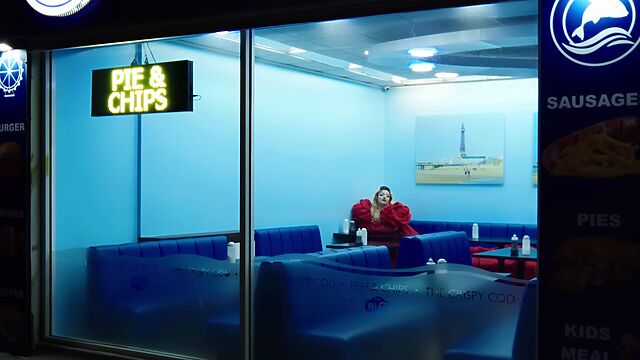
Anyway; after her party night out, she finds her way to a late-night chippy, as you do.
She’s still heading South… which makes me think that the ruined steps she’s seen sitting on for literally three seconds might be somewhere between Coral Island and the Crispy Cod.
Anybody know?
Anyway, the bottom line is that this music video was – surprisingly but delightfully – set in the area of… what might be the gayest pub crawl in the UK. Which, on top of this already
awesome song, leaves me… feeling fucking fabulous.
Footnotes
1 Especially those in queer or adjacent spaces, obvs.
2 Pier Street and York Street Car Park’s are a comfortable walk from Ma Kelly’s Cabaret Bar, which – and I’m less-certain about this one – might be the host of some of the interior shots from the music video.
Anyway, if you go around the corner in Google Street View you’ll find Higgitts Arcade and Burger Bar, which – just trust me and go look at it – is the most-Blackpool thing imaginable.
3 I’m almost-certain the arcade is the Higgitts, which I mentioned previously because of
its proximity to an earlier shot!
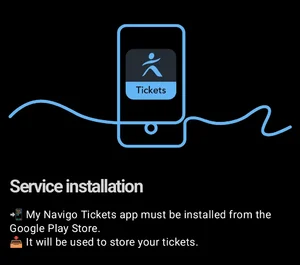
Fuck Paris. The only way to buy a metro ticket is to download an app. Fair enough. But, after downloading the app it tells you to install another app!
What the actual fuck? A convoluted, messy, and frustrating situation which has resulted in awful reviews for them.
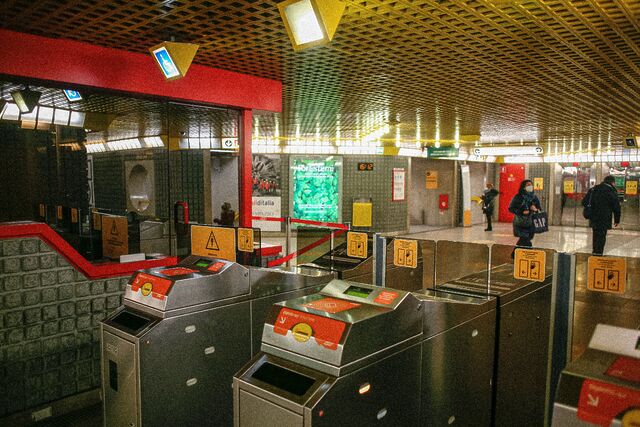
Trains and metro travel require separate tickets at different prices. You can’t easily hop from one to another. You need to think carefully about the route you’re taking. A more
convoluted route may be significantly cheaper because it doesn’t involve swapping between services.
This absolutely parallels my experience of hopping around the Paris’s metro area, last time I was there.
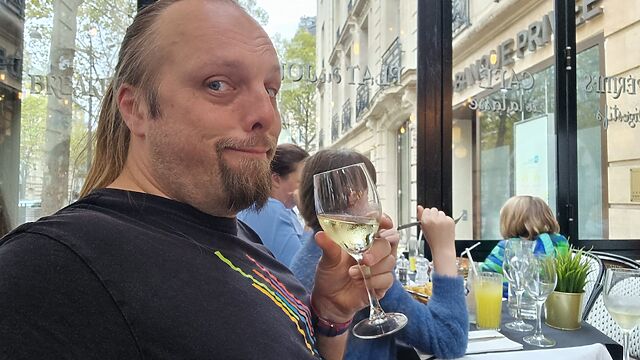
If I’ve got to navigate my way through Paris’s public transport network… I’m going to need a drink first.
From the sounds of things, this is clearly designed as a convenience for visitors to the city, not regulars and locals:
Dès le 30 juin 2026, les touristes et les voyageurs hyperoccasionnels pourront opter pour valider leur titre en sortie de l’aéroport d’Orly sur la
ligne 14 avec la carte bancaire.2
Paris’s relationship with tourists is different from London’s
Les prix des titres de transport via les bornes d’achat sont les suivants :
Bus/tram/funiculaire : 2,55 € (soit + 0,50 € sur le prix classique) ;
Métro/train/RER : 3,35 € (soit + 0,80 € sur le prix classique) ;
Aéroports : 14,80 € (soit + 0,80 € sur le prix classique).
Buying transport tickets in Paris using a contactless card… costs 0.50 € to 0.80 € more. Paris will charge you for the convenience of tapping in and
out with your carte bancaire.
Tap in, tap out. Unless you’re eligible for discounted travel, you probably might as well use your debit card to get around London. Photo by Luca Sammarco.
Contactless is clearly more-convenient for city visitors, but I think the difference between London and Paris’s attitude to it says something about the relationship both cities have
with their tourists. In London, most travellers can use whatever bank card and mobile wallet they’ve already got… and they’ll get as good a deal as possible. But in Paris,
doing the same will invariably cost more than a conventional ticket would. You pay a convenience-tax.
Both cities get tens of millions of annual visitors and extract billions of euros worth of financial benefit from their tourist economies. Paris doing slightly better overall, but
they’re closely-comparable enough that differences like this probably mean something.
Tap in, pay a premium for the privilege. Thanks, Paris! Photo by Candelario Benítez.
I’m not saying that London loves tourists and Paris hates them! It’s not so simple as that. But I think perhaps the cites try to present themselves in a different way.
London’s public transport says: we’ll work around you. You can learn the rules as you go; you don’t have to “learn London” to get around. Just use your usual
contactless card wherever you go; we’ll work out the details, and your daily cost will get capped just the same as if you chose to pick up an Oyster card. Visiting the city as a tourist
is an ordinary use-case for the transport network.
Paris’s public transport says: you should learn the rules. You’re welcome to visit, but you either need to do the work to be a “temporary Parisian”… or you can
just use your usual contactless card but we’ll charge you a premium for the convenience. Visiting the city as a tourist is a special case that the transport
network sees differently from being a local.
Neither approach is “wrong”… but I think it’s interesting. And now I’m wondering what the approach is like across other European cities.
Footnotes
1 I’ll almost-certainly have to tackle the current-generation of Paris’s public transport
at some point before then, but I’ll look forward to the improved version once it rolls-out.
2 “From 30 June 2026, tourists and hyper-ocassional travellers will be
able to pay by bank card on Line 14 out of Orly Airport.” Emphasis mine.
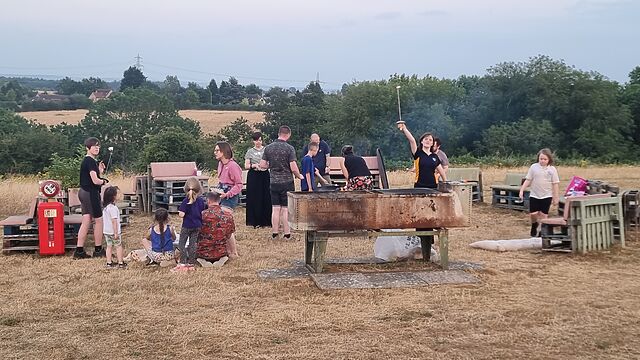
The campsite provided our large group with an entire field to ourselves, including spaces for socialising, a fire pit (at which the
kids enjoyed toasting marshmallows), and a wood-fired hot tub.
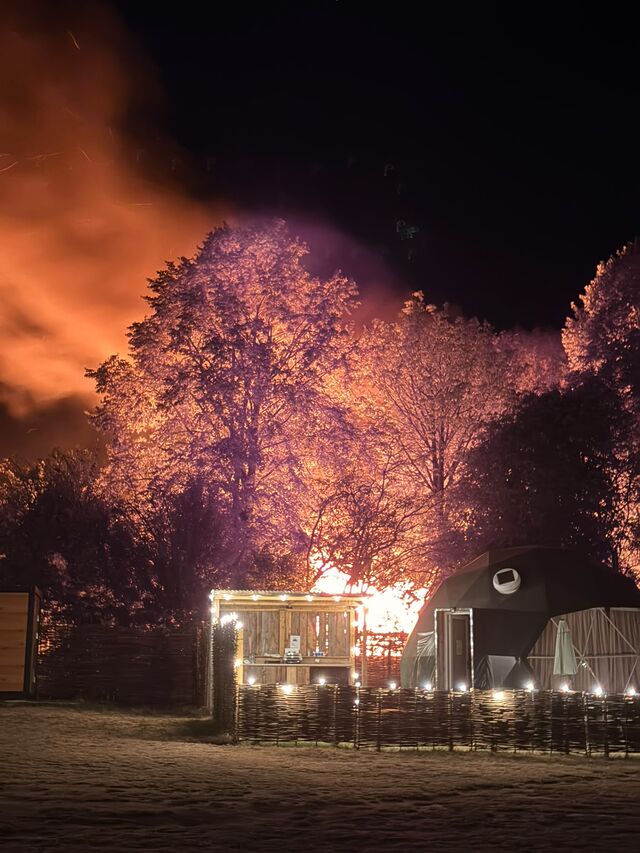
The entire weekend would have surely been a memorable experience already, but one particular event will probably stick in the minds of everybody in attendance: the
fire.
The fire
The UK’s in its unprecedented third heatwave of the year: the grass is all dying and everything is tinder dry. And so it was that, on Friday night as the kids and I slept in our
glamping “dome”, I was woken by the distant beep-beep-beep of a domestic smoke alarm. A few seconds later, I heard a second such alarm with a different tone, and it became clear that
this wasn’t just somebody’s toast on fire.
Not recorded: the sound of the occupant of this static caravan/cabin – having jumped through the window to safety as the front door was blocked by flames – on the phone to the fire
brigade.
I went back into the dome to check on the children, which is when Penny knocked on my door to ensure I was aware of what was going on. The kids were sound asleep, so I ran out to the
car park to move the car (which was parked in such a position that embers were raining down on it!) and to check on the situation.
The fire intensity of the fire grew particularly intense as the sound of fire engine sirens began to be heard from the valley below. Photo copyright Rory Prior.
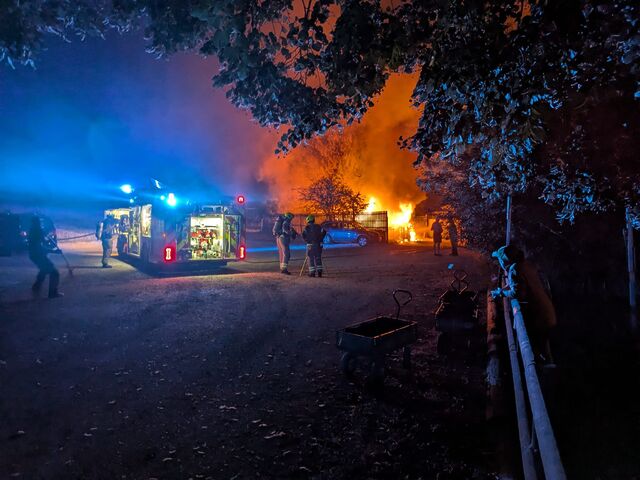
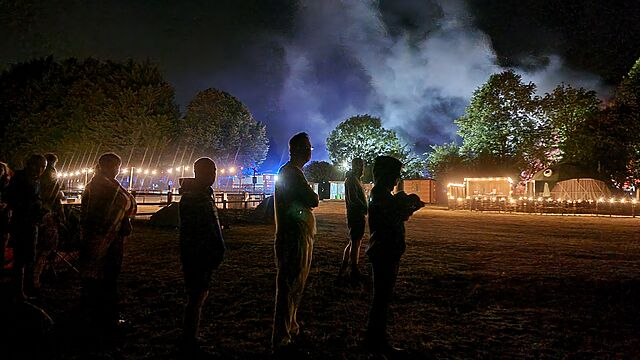
I returned to the dome and got the children dressed. We evacuated to a safer distance and watched as the firefighters arrived and began to tackle the blaze. Short of water, they had one
pump dousing the flaming building while two others relayed water from the nearest fire hydrant, way down the hill.
There was a brief faux pas when one of the Abnib kids exclaimed “this is so cool“… without realising that he was standing right next to the people whose
home was being destroyed in front of us.
Eventually the situation came under control and we were all able to return to bed.
The battery pack
I spoke to Mike, whose holiday home was the building that was destroyed. He’d managed to escape with some shorts and his mobile phone, but little else: in particular, his car keys
remained inside and were probably destroyed, which rendered him unable to drive back to his regular home.
The firefighters worked quickly, but it still took over three hours before they were able to finish spreading out and drenching everything that had caught light. We watched from a
distance, and sheltered all the children (including those of a non-Abnib family on-site) in one of our tents.
Mike had been turning his phone on only in bursts in order to conserve battery for all of the essential calls he’d have to make (e.g. his bank, to extract some money without his cards,
and a locksmith, to get him back into his car). His phone charger – an awkward USB-B-Micro one – hadn’t survived the fire.
But conveniently… I happened to have such a cable in my bag. Plus a fully-charged battery pack. So I lent both to Mike, in the hope that it’d make it easier for him to do all of the
necessary administration1.
It’s got to be a pretty-devastating thing to happen to your holiday home and everything in it. Mike was surprisingly chill about it when I spoke to him, taking soft-of an attitude of
“well, there’s no point fretting about it after the fact!”
“You saved my life!”
Anyway: on Saturday night, shortly after the kids and I had turned-in, there was a knock on the door. It was Mike, come to return the battery pack I’d lent him.
The kids didn’t know who he was, so I explained: “This is Mike; he’s the fella who lived in the home that burned down last night.”
Mike handed over the battery pack and charging cable and, grateful for them, used a metaphor that. “Thanks,” he said, passing the hardware to me, “You saved my life!”
I hadn’t told Mike which glamping pod was ours, and just figured I’d see him around. Or else if I didn’t get my battery pack back, that’d be fine: it’ll have been more-useful to him
than to me in the days to come! But there we were, in our pyjamas, when he appeared at our door.
He turned and left, and both kids sprung out of bed and exclaimed “You saved the life of the guy whose house burned down‽”
I’m sure they had in their minds the idea that, during the period between the fire starting and me waking and evacuating them, I’d singlehandedly dragged this dude out of a burning
building. Y’know, instead of just lending him a phone charger after-the-fact.
I only let them hold the misapprehension for a few minutes, but for a moment it lightened the mood.
Footnotes
1 I was already using my phone to call our insurance company before our flood, earlier this year, had finished. I can only imagine how inconvenient it is to suffer a disaster and lose your communications lifeline at the
same time!
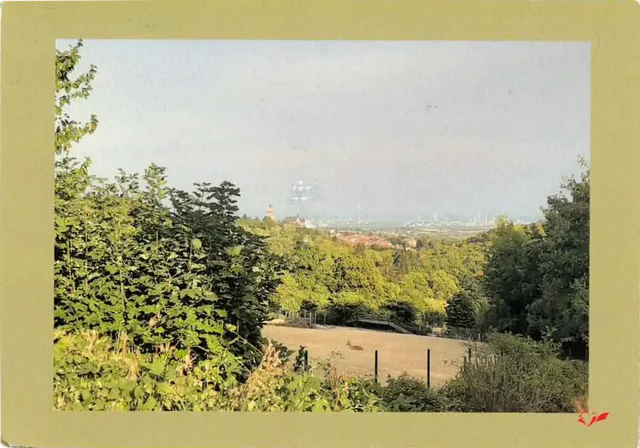
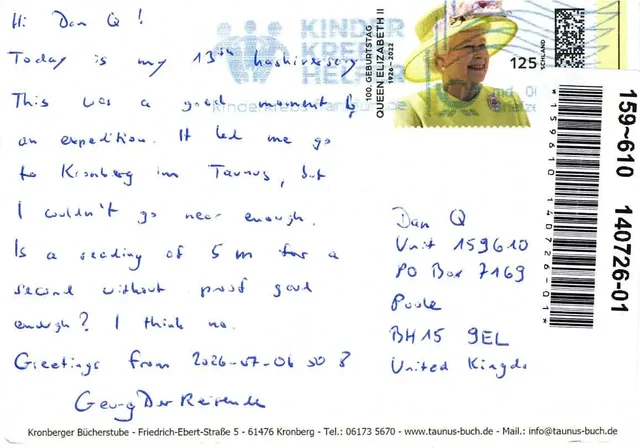
Well: today I received my second hashcard (and tenth “postcard from the Internet”)! This one came from GeorgDerReisende, whose 800+ expeditions are more than a little intimidating! He’d spent his 13th hashiversary on an expedition to a location outside
Frankfurt earlier this month, where he narrowly failed to reach the hashpoint because it was just slightly too far into somebody’s private property.
But at least he was able to claim the hashcard achievement (although not for the first time)! Well done,
GeorgDerReisende!