Wikipedia @ 25: Cirrothauma Murrayi

Duration

Podcast Version

This post is also available as a podcast. Listen here, download for later, or subscribe wherever you consume podcasts.

To celebrate the site’s 25th birthday this year, Wikipedia is encouraging/challenging people to read one Wikipedia article a day for 25 consecutive days. I felt that I could do one better than that: not only reading an article but – where I found one that was particularly interesting – to write a blog post or record a podcast episode for each of those days, sharing what I learned. For each entry, I’ll hit “random article” a few times until something catches my interest, start reading, and then start writing! Everything I’ve written below came from Wikipedia… so you should check other sources before you use it to do your homework. Happy birthday, Wikipedia!


Today’s random article: Cirrothauma
Today’s topic: Cirrothauma murrayi

My random landing page today is a genus for which there’s only a single species, so I hopped over to that species’ page.

And what a species!

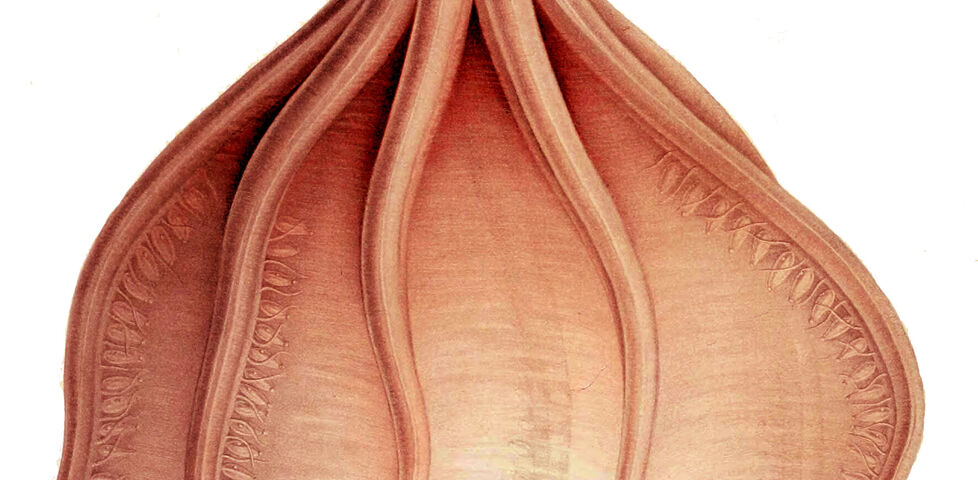
Orange-pink octopus with a long web skirting between its tentacles and a distinct butterfly-shaped elongated shell from its head.
Somehow it looks more like an alien than octopodes normally do! Drawing produced by Carl Chung in 1910.

This is the blind cirrate octopus (cirrothauma murrayi), a species found beneath the oceans all around the world but at such a depth that they’re not well-understood. We’re not even sure whether the specimens we’ve studied represent a single species or two separate species!

The Latin name comes from oceanographer John Murray, best known for his Challenger Expedition from 1872–1876, but whose four month North Atlantic Oceanographic Expedition in 1910 – which he self-funded – was the first to find this unusual species. It was described by Carl Chun, whose previous claim to fame had been the discovery of the (also amazingly alien-looking) vampire squid, seven years earlier.

(The vampire squid is its own amazing thing: did you know that it turns itself inside out to evade predators, exposing the inner surface of its spiked tentacles? Also it can spit glow-in-the-dark mucus to dazzle an attacker.)

You can tell it’s a cirrate octopus by those fins on its head. Cirrates are one of the two major families of octopodes: they’re the ones that do have a pair of mini strands dangling off each sucker on each tentacle, but don’t have an ink sac. They’re also notoriously fragile, and when we’ve pulled them up for research purposes they’re often in poor condition by the time they’re on the surface… and that’s especially true for deep dwellers like the blind cirrate octopus.

As for blind: well – it’s got eyes… but those eyes don’t have lenses. As a result, they’re probably able to tell light from dark but probably can’t make out the particular shapes of objects. (This is a great example, contrary to claims of irreducible complexity in the eye by proponents of “intelligent design” of an eye with only some of the components that seem essential to a fully-functional organ that still provides value for its host!).

Speaking of which – do you know how cool the eyes of an octopus are?

Illustration showing the difference between vertebrate and cephalapod eyes.
Vertebrate (left) and cephalopod (right) eyes have several distinct differences which suggest different evolutionary origins. In cephalopods, the retina (1) is routed in front of the nerve fibres (2) that connect to the optic nerve (3), meaning that cephalopods do not have the “blind spot” (4) that vertebrates do.
  1. Like all cephalopods, they have no blind spot because their retina is in front of the nerve fibres instead of behind them.
  2. Like squid and possibly cuttlefish, they can differentiate the polarisation of light. (I believe that sheep and goats can, too!)
  3. Their pupils automatically rotate to stay horizontal, no matter which way up they are!

There’s some debate about whether or not octopodes and other cephalopods’ eyes evolved from a shared ancestor or are an example of convergent evolution, and the arguments for both are really interesting.

Of course, our friend the blind cirrate octopus is, umm… mostly blind. Very different from other octopodes.

As I said, we know so little about it! We don’t know what it eats (we think it probably eats whole shellfish). We don’t know how it breeds. We don’t know how commonplace it is or whether its environment is under threat.

But what we do know is that it’s a freaky-looking thing from way down deep. Thanks, Wikipedia, for telling me about this strange beast. Let’s see what you have to share with me tomorrow!

Peripheral Vision

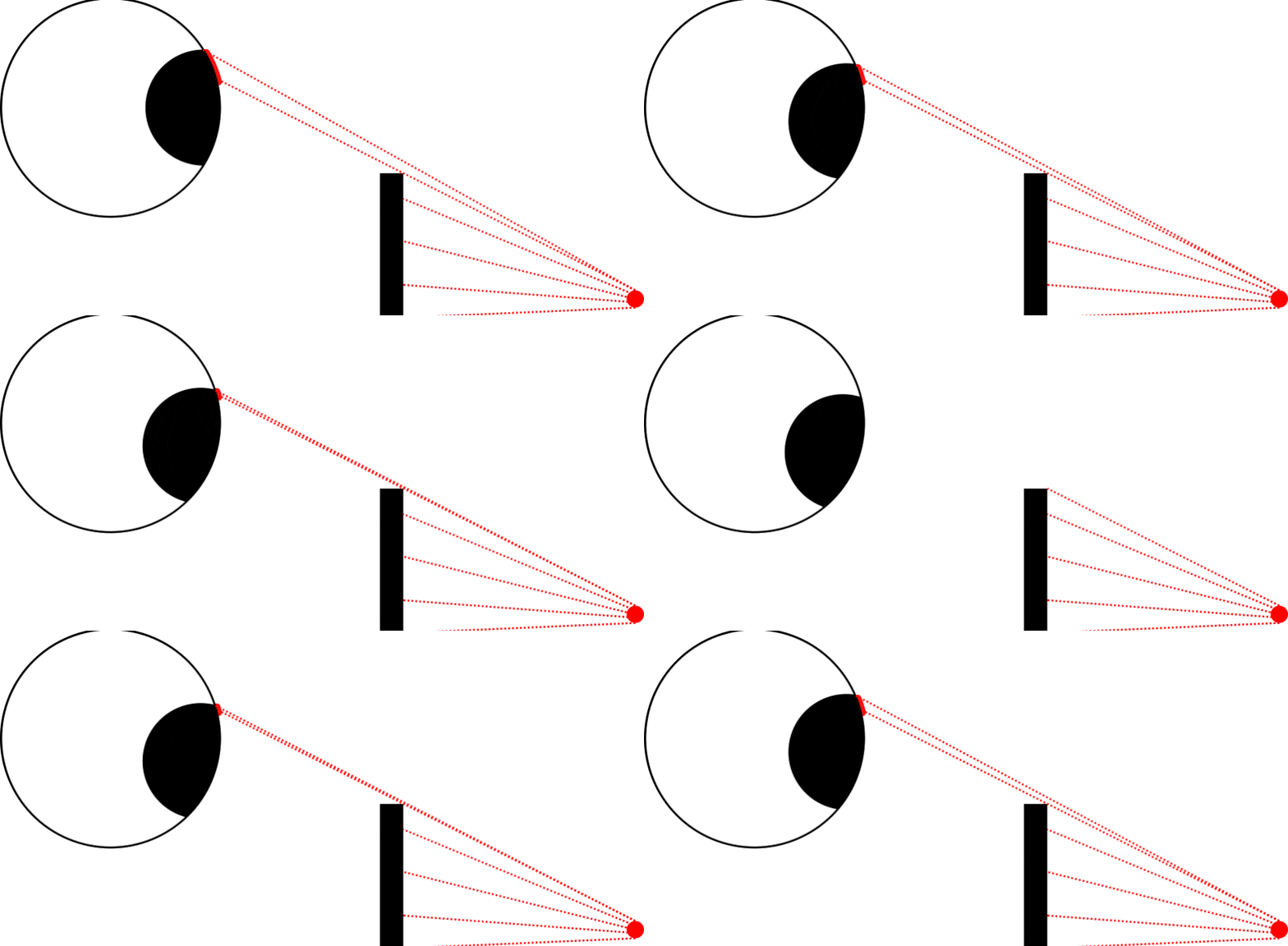
As I lay in bed the other night, I became aware of an unusually-bright LED, glowing in the corner of my room1. Lying still in the dark, I noticed that as I looked directly at the light meant that I couldn’t see it… but when I looked straight ahead – not at it – I could make it out.

Animated illustration showing how an eyeball that rotates to face a light source can have that light obstructed by an intermediary obstacle, but when it looks "away" some of the light can hit the pupil as a consequence of its curved shape now appearing "above the horizon" of the obstacle.
In my bedroom the obstruction was the corner of my pillow, not a nondescript black rectangle. Also: my eyeball was firmly within my skull and not floating freely in a white void.

This phenomenon seems to be most-pronounced when the thing you’re using a single eye to looking at something small and pointlike (like an LED), and where there’s an obstacle closer to your eye than to the thing you’re looking at. But it’s still a little spooky2.

It’s strange how sometimes you might be less-able to see something that you’re looking directly at… than something that’s only in your peripheral vision.

I’m now at six months since I started working for Firstup.3 And as I continue to narrow my focus on the specifics of the company’s technology, processes, and customers… I’m beginning to lose a sight of some of the things that were in my peripheral vision.

Dan, a white man with blue hair, wears headphones and a grey 'Firstup' hoodie, holding a 'Firstup'-branded shoebox.
I’ve not received quite so many articles of branded clothing and other swap from my new employer as I did from my previous, but getting useful ‘swag’ still feels cool.

I’m a big believer in the idea that folks who are new to your group (team, organisation, whatever) have a strange superpower that fades over time: the ability to look at “how you work” as an outsider and bring new ideas. It requires a certain boldness to not just accept the status quo but to ask “but why do we do things this way?”. Sure, the answer will often be legitimate and unchallengeable, but by using your superpower and raising the question you bring a chance of bringing valuable change.

That superpower has a sweet spot. A point at which a person knows enough about your new role that they can answer the easy questions, but not so late that they’ve become accustomed to the “quirks” that they can’t see them any longer. The point at which your peripheral vision still reveals where there’s room for improvement, because you’re not yet so-focussed on the routine that you overlook the objectively-unusual.

I feel like I’m close to that sweet spot, right now, and I’m enjoying the opportunity to challenge some of Firstup’s established patterns. Maybe there are things I’ve learned or realised over the course of my career that might help make my new employer stronger and better? Whether not not that turns out to be the case, I’m enjoying poking at the edges to find out!

Footnotes

1 The LED turned out to be attached to a laptop charger that was normally connected in such a way that it wasn’t visible from my bed.

2 Like the first time you realise that you have a retinal blind spot and that your brain is “filling in” the gaps based on what’s around it, like Photoshop’s “smart remove” tool is running within your head.

3 You might recall that I wrote about my incredibly-efficient experience of the recruitment process at Firstup.

× ×