This week, Parry Gripp and Nathan Mazur released Young Squirrel Talking About Himself.
You might recognise the tune (and most of the words) from an earlier Parry Gripp song. The original video for the older
version is no longer available on his channel, and that’s probably for the best, but I was really pleased to see the song resurrected in this new form because it’s fabulous. I’ve been
singing it all day.
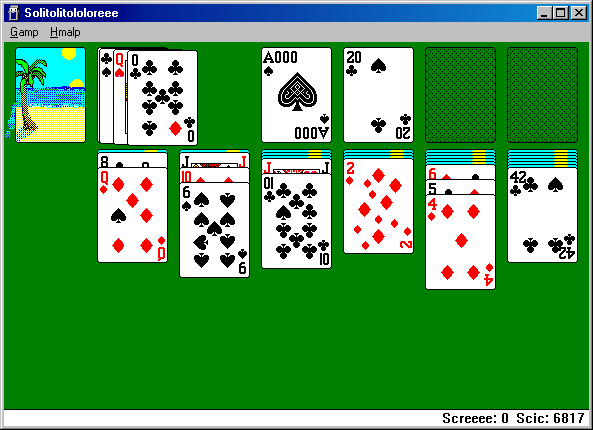
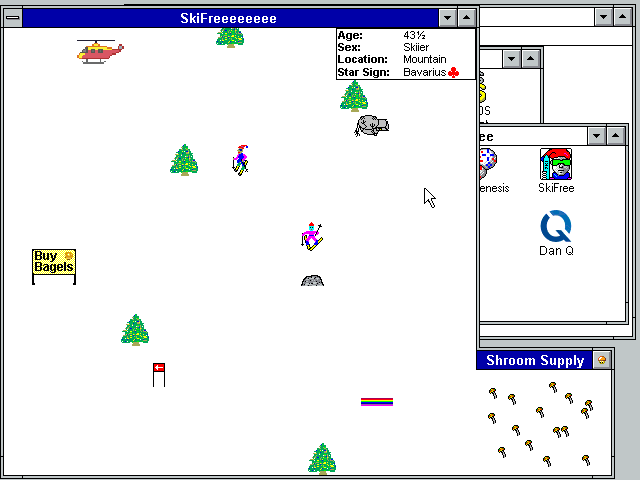
I was told Windows installation should take less than 20 minutes, but these ones have been sitting outside my house all day while the builders sit on the roof and listen to the radio.
Do I need a faster processor? #TechSupport
Brainfart moment this morning when my password safe prompted me to unlock it with a password, and for a moment I thought to myself “Why am I having to manually type in a password? Don’t
I have a password safe to do this for me?” 🤦
“Tank sleepy. But Tank listen your idea in case it tasty idea.”
I’ve tried to explain to our occasionally-anxious dog that, for example, the dog-and-human shaped blobs at the far end of the field includes a canine with whom she’s friendly and
playful. She can’t tell who they are because her long-distance vision’s not as good as mine1, and we’re too far away for her to be able to smell her
friend.
If this were a human meetup and I wasn’t sure who I’d be meeting, I’d look it up online, read the attendees’ names and see their photos, and be reassured. That’s exactly what I
do if I’m feeling nervous about a speaking engagement: I look up the other speakers who’ll be there, so I know I can introduce myself to people before or after me. Or if I’m attending a
work meet-up with new people: I find their intranet profiles and find out who my new-to-me colleagues are.
“Oh! Is you! Hurrah!” /buttsniffing intensifies/
Wouldn’t it be great if I could “show” my dog who she was going to meet, in smell-form.
I imagine a USB-C accessory you can attach to your computer or phone which can analyse and produce dogs’ unique scents, storing
and transmitting their unique fingerprint in a digital form. Your subscription to the service would cover the rental of the accessory plus refills of the requisite chemicals, and a
profile for your pooch on the Web-based service.
Now, you could “show” your dog who you were going to go and meet, by smell. Just look up the profile of the playmate you’re off to see, hold the device to your pupper’s nose,
and let them get a whiff of their furry buddy even before you get there. Dogs do pretty well at pattern-matching, and it won’t take them long to learn that your magical device
is a predictor of where they’re headed to, and it’ll be an effective anxiety-reducer.
Seeking investors for a genuinely terrible crazy business idea. Photo courtesy SHVETS production.
The only question is what to call my social-network-for-dogs. Facebutt? Pupper? HoundsReunited???
Footnotes
1 Plus: I get contextual clues like seeing which car the creature and its owner got out
of.
But more seriously, my mission – if I have such a thing, is:
Today’s my first day back at work after an decent length break (if you exclude the Friday after Christmas, when I did a little, I’ve
been away from my day job for over a fortnight), and I’ve got a lot to catch up on even before I kick off running a training course I’ve never delivered before, so that’s all
you get for today. But so long as my Bloganuary streak (which now almost makes it onto my leaderboard!)
continues, I’m counting this as a win.
If you had a freeway billboard, what would it say?
I always loved it when a book or exam paper or similar contained a page whose only content was the words “this space intentionally left blank”. It tickles a particular part of me: the
part that wonders how “keep of the grass” signs get there without anybody treading on the grass, or laughs whenever somebody says something like “nobody drives in Oxford, there’s too
much traffic.”
This is not the famous painting, The Treachery of Images.
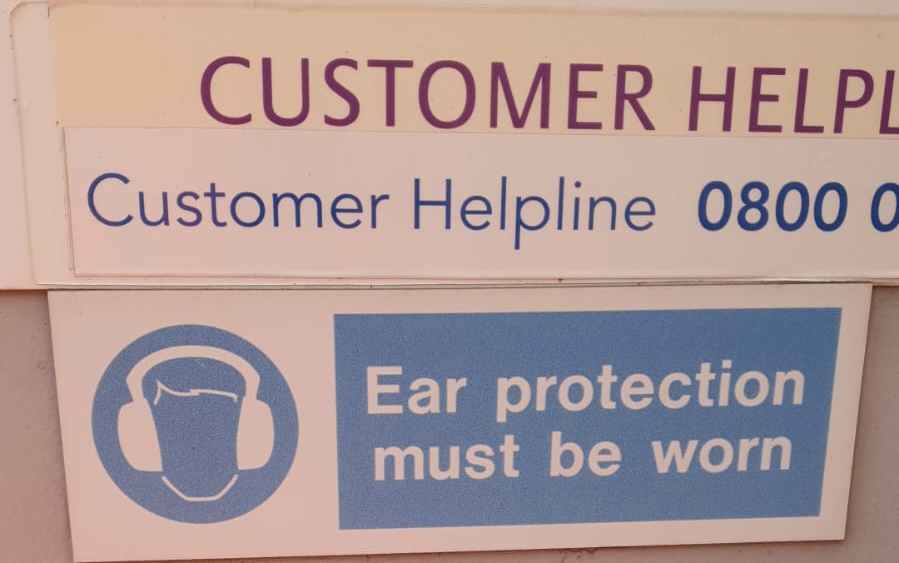
The programmers at British Gas are among the many who don’t believe that a surname can be only a single character, and their customer service agents have clearly worked around their
validations (or just left a note for themselves in the problematic field!)… leading to hilarious postal mail1:
Update
This is getting a lot of attention, so I just wanted to add:
I’ve already seen Falsehoods Programmers Believe About Names, thanks. I linked it above, but you probably didn’t see the link if you
found me via all the Mastodon boosts this post is getting.
In the parallel universe of last year’s Weird: The Al Yankovic Story, Dr. Demento encourages a young Al Yankovic (Daniel Radcliffe) to move away from song parodies and start writing
original songs of his own. During an LSD trip, Al writes “Eat It,” a 100% original song that’s definitely not based on any other song, which quickly becomes “the biggest hit by
anybody, ever.”
Later, Weird Al’s enraged to learn from his manager that former Jackson 5 frontman Michael Jackson turned the tables on him, changing the words of “Eat It” to make his own parody,
“Beat It.”
Your browser does not support the video tag.
This got me thinking: what if every Weird Al song was the original, and every other artist was covering his songs instead? With recent advances in A.I. voice cloning, I realized
that I could bring this monstrous alternate reality to life.
This was a terrible idea and I regret everything.
…
Everything that is wrong with, and everything that is right with, AI voice cloning, brought together in one place. Hearing
simulations of artists like Michael Jackson, Madonna, and Kurt Cobain singing Weird Al’s versions of their songs is… strange and unsettling.
Some of them are pretty convincing, which is a useful and accessible reminder about how powerful these tools are becoming. An under-reported story from a few years back identified what might be the first
recorded case of criminals using AI-based voice spoofing as part of a telephone scam, and since then the technology needed to
enact such fraud has only become more widely-available. While this weirder-than-Weird-Al project is first and foremost funny, for many it foreshadows darker things.
After “Monty Python’s Flying Circus” ended, Graham Chapman worked with an up-and-coming young writer named Douglas Adams on a new sketch comedy show for the BBC. It was called “Out of
the Trees,” and it bombed. Only one episode was made, and that aired only once, on January 10, 1976.
Once the Beeb gave up on “Out of the Trees,” they did to it what they did to so many other programs of that era: they erased it.
…
Chapman had recorded the show on one of the very earliest home videotape formats… it took two years to build a compatible player.
It’s neither Chapman nor Adams best work, and you can see how it got canned after only a pilot episode. But it’s not terrible.
But the lesson here is one about the challenge of archiving non-print media. Anything that needs a device to “play” it, whether it’s as simple as a vinyl record or as complex as a
videogame, is at greater risk of being lost forever. And the faster the pace of technology moves, the more stuff gets left behind as technology moves on. Is a digital dark age looming?
Are we already in it, but that won’t be known until some future date?