Of the handful of times I’ve seen people sharing their salary history, they are always very high. For context, a six-figure (£100,000) salary in the UK puts you in the top
4% of earners in the country.
This is where my concern starts – we only ever see these high outliers, so the sample size is incredibly skewed. Nobody is rushing to publish their £25,000 salary history, which
means the curmudgeon in me can’t help but feel that these pages can sometimes read more like a humble brag than genuine advocacy, even if the author’s intent was entirely pure.
For the reader, this can be deflating, rather than empowering. A developer earning a perfectly respectable £50k (which already puts them in the top 15% of UK earners) might look at
Jane Smith earning £105k and think, “Jesus, I’m doing terribly.”
But salary is highly subjective. It depends on where you live, the company you work for, the unique responsibilities of your role, what your peers earn, how hard you negotiate, and
how supportive your manager is.
When you strip all that context away and just publish a high number, what is the reader supposed to do with it? If our developer goes to their manager and asks for a 100% pay rise
because they saw Jane Smith online earning £105k, they’re going to be laughed out of the room. Because, without context, the raw numbers are useless.
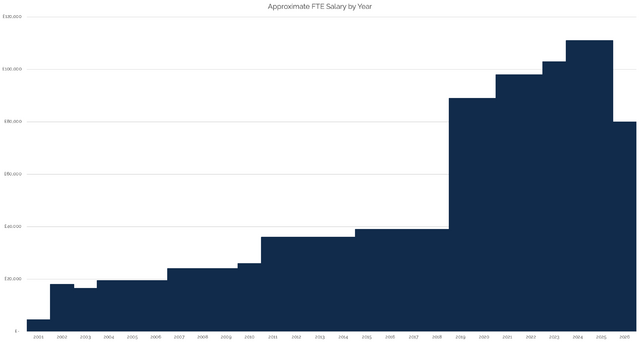
One thing I do to try to mitigate that is to publish my entire salary history for my current (i.e. software engineering) career. This shows progression, and development,
and the shape of different industries (in particular how the academic sector compares to “big tech”). There’s a noticeable “jump” in my salary history if you look for it!
But I don’t know how well that’s contextualised. Should I be saying more, like: what relevant qualifications I had by each point (it’s possible to argue that almost none of my
qualifications are “relevant”, because almost all the career-useful stuff I’ve ever learned didn’t come from my degrees etc… but some of my employers – and one in particular – attached
value to my academic achievements so maybe they opened some doors?). Or, as Callum Rollo does, perhaps I should be balancing it
against other factors (my salary, even when it was briefly ~£111,000, doesn’t seem so significant if you know how much I owe to the bank on our mortgage!).
I suppose what I’m saying is that I agree with Kev: context is everything here, and the picture’s distorted if only some subset of people publish their salaries. But I’m
going to keep on publishing mine, because I think that salary transparency is an good thing overall, and the labour market gains a sliver of their employers’ power when
they’re willing to talk openly about what they’re paid: whether pseudonymously via the likes of GlassDoor or openly on their publicly-accessible websites… every little helps, even where
it skews the picture a little.
But thanks, Kev, for the reminder that the situation’s more-nuanced than some would have you believe, and for challenging us all to frame our transparency with a little bit of context.
Yesterday I took a short trip. I began with a ride on the local Hyperloop, which ran through a tunnel dug by Boring Company. Then I used my neural implant to summon a fully
self-driving Tesla robotaxi. While enroute I read the latest news from the Mars colony.
OK, none of that actually happened, because those products don’t exist. There are no working Hyperloops. The Boring Company has not dug any commercial tunnels. Tesla has a few
self-driving — though not fully self-driving — taxis in Austin and nowhere else. (Google’s Waymo driverless taxis are operational in several major hubs.)Neuralink, which is purportedly pioneering brain implants, has tested its products in a handful of patients but done no more than
that. And of course there is no Mars colony: there have been no manned flights to Mars, nor the prospect of any for the foreseeable future.
Yet at various points over the past decade Elon Muskpromisedthat each of these services would be available by 2025 if not sooner.
a few unqualified successes (Tesla leading the charge on the EV rollout; Starlink providing widespread Internet), and
a lot more unfulfilled promises and vapourware (Twitter’s post-takeover nosedive, the failure to deliver anything-of-use by Neuralink, The Boring Company/Hyperloop, the
worse-than-pointless Grokipedia, all the things SpaceX hasn’t yet done…).
The vast majority of his wealth comes from investment, not from returns: people buy his stock if they buy his hype. I’m not saying he’s
producing nothing of value… but yeah: the “world’s first trillionaire” is… unfortunate.
But then again, I’d be quite happy for him to be the world’s last trillionaire, too.
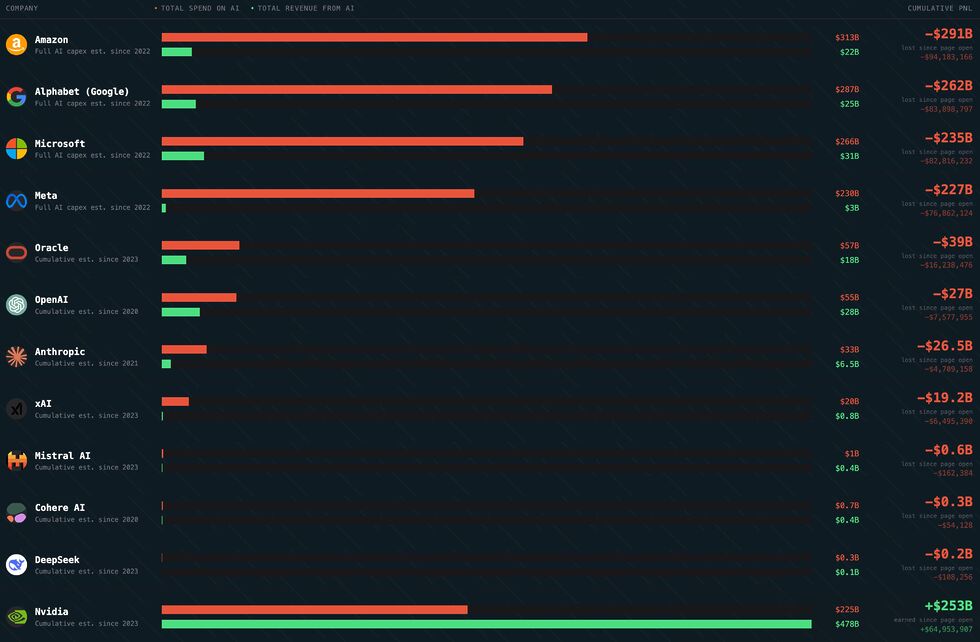
No surprises here, but it’s interesting/staggering to see quite how large the disparity between spending and profit is for some of these companies.
I enjoy the fact that there’s a real-time ticker on the site so you can watch Amazon (for example) burn five thousand dollars a second.
When I tell people that generative AI, as it’s currently used, is unsustainable, this is what I’m talking about. Unless there’s a quantum leap in AI efficiency (for which I’ve seen no
evidence of the feasibility) or a dramatic increase in the charged cost of LLM services (on the order of a tenfold increase assuming the increased cost does not drive any customers
away; more if it does), this whole thing looks like a house of cards.
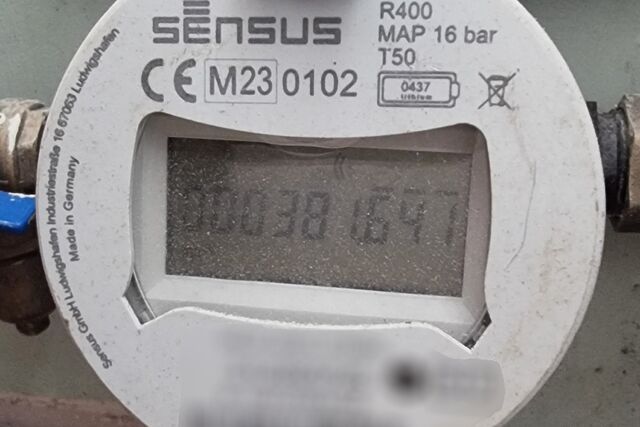
The Chicory House’s water meter, found in a cupboard, is so much easier to read than the one at our regular house, which is found down a frequently-flooded manhole on
the busy road outside.
Unfortunately, Thames Water had fucked-up1
and created an account for us already with the wrong information2,
so by the time I’d reached out to them they were already getting themselves into a pickle.
It turns out that, presumably because of some shortsightedness on the part of their software engineers, their computer systems wouldn’t let them change the information to
correct the problem. Nor could they simply delete the account and create a new one3.
Instead, the had to close the account they’d erroneously set up such that the start and end date of the contract was our moving-in date… and then set up
a new account starting from the day after.
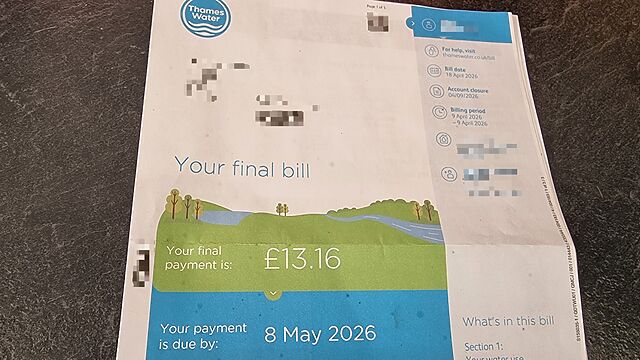
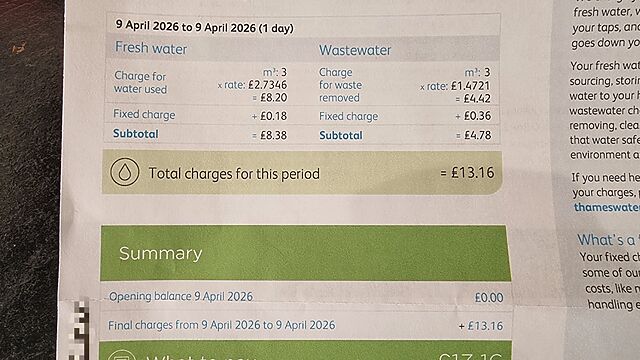
Sigh. Fine! So long as it’s sorted, I didn’t even care. Until, that is, the bill arrived for the one day of the first (incorrectly-created) contract:
This looks pretty low for a metered water bill, until you realise that it covers a period of literally only eleven hours from us moving in (and taking a meter reading) until
the end of that day. And that during most of that time the water was switched-off because a pair of plumbers were installing a new bathroom!
That bill:
is for £13.16.
covers “9 April 2026 through 9 April 2026”, i.e. one day.
(which means that our estimated annual bill would be £4,803.40 (£13.16 × 365) – about eight times
the national average)
states that our account closure was/will be “04/09/2026” – the only date on the letter that’s in “short” date format and which would appear to be 4 September (in UK date format)
even though 9 April would make more sense (but would require interpreting it in US date format, which would make no sense).
Let’s see how that breaks down:
The rates are standard, albeit a little on the high end: Thames Water need to raise funds right now to fix all of the leaks in their pipes, apparently. What’s odd is the volume of
water they claim has been used.
According to this bill, we used three cubic metres of water between collecting the keys (at around 1pm), moving in, and taking a meter reading… and the end of the
day. That’s three thousand litres of water.
Is it possible to achieve that level of water usage in the nine hours of billable time that this bill covers? I guess, if you really tried, you could:
completely fill and then drain our 100-litre bathtub, three times an hour, taking a five-and-a-half minute bath in each before draining it again, for the rest of
the day4;
or
run the kitchen tap – the highest-pressure tap in the house – continuously for six hours and forty minutes; or
repeatedly flush all three toilets, on “full-flush” mode, once every 79 seconds until midnight5, for example.
Some science was involved in the writing of this blog post.
Obviously this is all ridiculous. I’m being ridiculous.
But then again, so is this bill, which claims that three adults spent 11 hours in a house and somehow used the amount of water that’s the recommended amount to drink in a day… by 1,500
adults. Despite the water being shut-off to install a shower and toilet for some of that time.
But then again, so is Thames Water’s computer system, which disallows the correction of mistakes even by their own staff and instead requires the creation of one-day contracts.
And also can’t decide which country’s date format to use. And, possibly, doesn’t allow them to obey data protection laws.
The whole thing’s ridiculous. Which I’ll be letting Thames Water know. Let’s see if they agree.
Footnotes
1 This may be no surprise to anybody who’s ever dealt with Thames Water before, or who
follows the news about their seemingly endless inability to keep clean water in its pipes and raw sewage out of our rivers, for example, while taking out loans in order to pay bonuses
to their self-back-patting executives.
2 They used information provided to them by the estate agent and failed to connect it to
the information they already had for us… which thanks to quirks of their information systems resulted in bigger problems down the line. Amusingly – and for a change! – none
of the problems were related to my unusual name, this time around.
3 Curiously, these initial mistakes on the part of Thames Water left them processing
personal information about me – an email address – that I’d never given to them, and allegedly unable to delete or correct it for six months after being asked to. This is the kind of
thing that normally gives me an excuse for a field day of DPA2018-related letter writing, but this time around I’ve been too busy dealing with the bigger problems they’ve
created to have a chance to stop and think about that: that’s how much of a mess they’ve made.
4 It’s only barely possible to repeatedly fill the bath this quickly, you need to use both
hot and cold water: the cold inlet alone doesn’t have the pressure to fill it fast enough, but the hot water tank has its own separate inlet which makes all the difference.
Also, a cold bath would suck, even if you’re only allowed five minutes in it before it’s time to drain the tub and start filling it again.
5 I once had a really rough night after a particularly dodgy curry, but I’ve never needed
to be flushing a toilet twice a minute for eleven hours.
Jeremy Keith posted his salary history last week. I absolutely agree with him that employers exploit
the information gap created by opaque salary advertisement, and I think that our industry of software engineering is especially troublesome for this.
So I’m joining him (and others) in choosing to share my salary history. I’ve set up a new page for that purpose, but here’s the summary of its
initial state:
Understand
A few understandings and caveats:
For most of my career I’ve described myself as a “Full-Stack Web Applications Developer”, but I’ve worked outside of every one of those words and my job titles have often been more
like “CMS Developer” or “Senior Engineer (Security)”.
My specialisms and “hot areas” are security engineering, web standards, performance, and accessibility.
When I worked multiple roles in a year, I’ve tried to capture that, but there’ll be some fuzziness around the edges.
The salaries are rounded slightly to make nice readable numbers.
I’ve not always worked full-time; all salaries are translated into “full-time equivalent”1.
I’ve only included jobs that fit into my software engineering career2.
If the table below looks out-of-date then I’ve probably just forgotten to update it. Let me know!
Ad-hoc and hard to estimate.
Alongside full-time study.
What does that look like?
I drew a graph, but I don’t like it. Mostly because I don’t see my salary as a “goal” to aim for or some kind of “score”.
It’s gone up; it’s gone down; but I’ve always been more-motivated by what I’m working on, with whom, and for what purpose than I have been on how much I get paid for it3.
But if you want to see:
I’m not sure to what degree my career looks typical or not. But I guess I also don’t care! My motivations are probably different than most (a little-more idealistic, a little-less
capitalistic), I’d guess.
Footnotes
1 i.e. what I’d have earned if I had worked full-time
2 That summer back in college that I worked in a factory building striplight fittings
doesn’t appear, for example!
3 Pro-tip if you’re looking at my CV and pitching me an opportunity:
mention what you expect to pay, sure, but if you’re trying to win me over then tell me about the problems I’ll be solving and how that’ll make the world a better
place. That’s how you motivate me to accept your offer!
About twenty years ago, after a a tumultuouslife, Big.McLargeHuge – the shared server of several other Abnibbers and I – finally and fatally kicked the bucket. I spun up its replacement, New.McLargeHuge, on hosting company DreamHost, and this blog (and many other sites) moved over to it1.
Wow, I’d forgotten half of these websites existed.
I only stayed with DreamHost for a few years before switching to Bytemark, with whom I was a loyal customer right up until a few years
ago2, but in that time I took advantage of DreamHost’s “Refer & Earn” program, which
allowed me to create referral codes that, if redeemed by others who went on to become paying customers, would siphon off a fraction of the profits as a “kickback” against my server
bills. Neat!3
DreamHost’s referrals had a certain “pyramid scheme” feel in that you could get credit for the people referred by the people you referred.
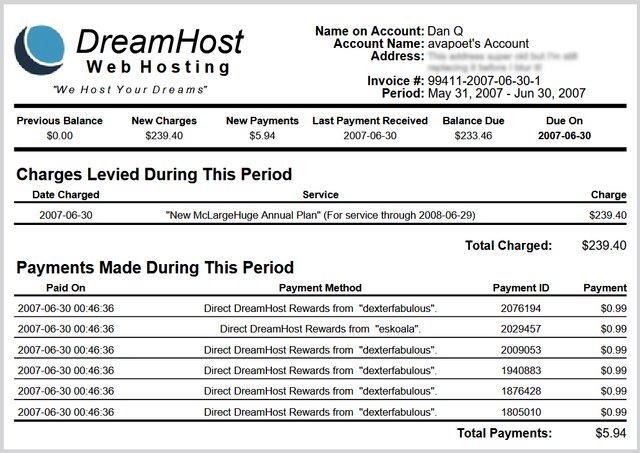
A year or so after I switched to ByteMark, DreamHost decided I owed them money: probably because of a
“quirk” in their systems. I disagreed with their analysis, so I ignored their request. They “suspended” my account (which I wasn’t using anyway), and that was the end of it.
Right?
But the referral fees continued to trickle in. For the last seventeen years, I’ve received a monthly email advising me that my account had been credited, off the back of a
referral.
I have no explanation as to why the amount of the referral reward fluctuates, but I can only assume that it’s the result of different people on different payment schedules?
About once a year I log in and check the balance. I was quite excited to discover that, at current rates, they’d consider me “paid-up” for my (alleged) debt by around Spring 2026!
I had this whole plan that I’d write a blog post about it when the time came. It could’ve been funny!
But it’s not to be: DreamHost emailed me last night to tell me that they’re killing their “Refer & Earn” program; replacing it with something different-but-incompatible (social media’s
already having a grumble about this, I gather).
So I guess this is the only blog post you’ll get about “that time DreamHost decided I owed them money and I opted to pay them back in my referral fees over the course of eighteen
years”.
No big loss.
Footnotes
1 At about the same time I moved Three
Rings over from its previous host, Easily, to DreamHost too, in order to minimise the number of systems I had to keep an eye on. Oh, how different things are now, when I’ve
got servers and domain registrations and DNS providers all over the damn place!
2 Bytemark have rapidly gone downhill since their acquisition by Iomart a while back, IMHO.
3 Nowadays, this blog (and several of my other projects) is hosted by Linode, whose acquisition by Akamai seems not to have caused any problems with, so that’s fab.
Today, for the first time ever, I simultaneously published a piece of content across five different media: a Weblog post, a video essay, a podcast episode, a Gemlog post, and a
Spartanlog post.
Must be about something important, right?
Nope, it’s a meandering journey to coming up with a design for a £5 coin that will never exist. Delightfully pointless. Being the Internet I want to see in the world.
This post is also available as a video. If you'd prefer to watch/listen to me
talk about this topic, give it a look.
1979
The novelisation of The Hitch-Hiker’s Guide to the Galaxy came out in 1979, just a smidge before I was born. There’s a well-known scene in the second chapter featuring Ford
Prefect, an alien living on Earth, distracting his human friend Arthur Dent. Arthur is concerned about the imminent demolition of his house by a wrecking crew, and Ford takes him
to the pub to get him drunk, in anticipation of the pair attempting to hitch a lift on an orbiting spacecraft that’s about to destroy the planet:
“Six pints of bitter,” said Ford Prefect to the barman of the Horse and Groom. “And quickly please, the world’s about to end.”
The barman of the Horse and Groom didn’t deserve this sort of treatment, he was a dignified old man. He pushed his glasses up his nose and blinked at Ford Prefect. Ford ignored him
and stared out of the window, so the barman looked instead at Arthur who shrugged helplessly and said nothing.
So the barman said, “Oh yes sir? Nice weather for it,” and started pulling pints.
He tried again.
“Going to watch the match this afternoon then?”
Ford glanced round at him.
“No, no point,” he said, and looked back out of the window.
“What’s that, foregone conclusion then you reckon sir?” said the barman. “Arsenal without a chance?”
“No, no,” said Ford, “it’s just that the world’s about to end.”
“Oh yes sir, so you said,” said the barman, looking over his glasses this time at Arthur. “Lucky escape for Arsenal if it did.”
Ford looked back at him, genuinely surprised.
“No, not really,” he said. He frowned.
The barman breathed in heavily. “There you are sir, six pints,” he said.
Arthur smiled at him wanly and shrugged again. He turned and smiled wanly at the rest of the pub just in case any of them had heard what was going on.
None of them had, and none of them could understand what he was smiling at them for.
A man sitting next to Ford at the bar looked at the two men, looked at the six pints, did a swift burst of mental arithmetic, arrived at an answer he liked and grinned a stupid
hopeful grin at them.
“Get off,” said Ford, “They’re ours,” giving him a look that would have an Algolian Suntiger get on with what it was doing.
Ford slapped a five-pound note on the bar. He said, “Keep the change.”
“What, from a fiver? Thank you sir.”
There’s a few great jokes there, but I’m interested in the final line. Ford buys six pints of bitter, pays with a five-pound note, and says “keep the change”, which surprises the
barman. Presumably this is as a result of Ford’s perceived generosity… though of course what’s really happening is that Ford has no use for Earth money any longer; this point is
hammered home for the barman and nearby patrons when Ford later buys four packets of peanuts, also asking the barman to keep the change from a fiver.
Beer’s important, but you also need to know where your towel is.
We’re never told exactly what the barman would have charged Ford. But looking at the history of average UK beer prices and assuming that the story is set in 1979, we can
assume that the pints will have been around 34p each1,
so around £2.04 for six of them. So… Ford left a 194% tip for the beer2.
1990
By the time I first read Hitch-Hikers, around 1990, this joke was already dated. By then, an average pint of bitter would set you back £1.10. I didn’t have a good
awareness of that, being as I was well-underage to be buying myself alcohol! But I clearly had enough of an awareness that my dad took the time to explain the joke… that is, to point
out that when the story was written (and is presumably set), six pints would cost less than half of five pounds.
But by the mid-nineties, when I’d found a friend group who were also familiar with the Hitch-Hikers… series, we’d joke about it. Like pointing out that by then if
you told the barman to keep the change from £5 after buying six pints, the reason he’d express surprise wouldn’t be because you’d overpaid…
In his defence, Ford’s an alien and might not fully understand human concepts of inflation. Or sarcasm.
1998
Precocious drinker that I was, by the late nineties I was quite aware of the (financial) cost of drinking.
Sure, this seems like a responsible amount of alcohol for a party thrown by a couple of tearaway teenagers. Definitely nothing going to go wrong here, no siree.
And so when it was announced that a new denomination of coin – the £2 coin –
would enter general circulation3
I was pleased to announce how sporting it was of the government to release a “beer token”.
With the average pint of beer at the time costing around £1.90 and a still cash-dominated economy, the “beer token” was perfect! And in my case, it lasted: the bars I was
drinking at in the late 1990s were in the impoverished North, and were soon replaced with studenty bars on the West coast of Wales, both of which allowed the price of a pint to do
battle with inflationary forces for longer than might have been expected elsewhere in the country. The “beer token” that was the £2 coin was a joke that kept on giving for some time.
The one thing I always hated about the initial design for the bimetallic £2 coin was – and this is the nerdiest thing in the world with which to take issue – the fact that it had a
ring of 19 cogs to represent British industry. But if you connect a circuit of an odd number of cogs… it won’t function. Great metaphor, there. Photo
courtesy of the late Andy Fogg, used under a Creative Commons license.
2023
As the cost of living rapidly increased circa 2023, the average price of a pint of beer in the UK finally got to the point where, rounded to the nearest whole pound, it was closer to £5
than it is to £44.
And while we could moan and complain about how much things cost nowadays, I’d prefer to see this as an opportunity. An opportunity for a new beer token: a general-release
of the £5 coin. We already some defined characteristics that fit: a large,
heavy coin, about twice the weight of the £2 coin, with a copper/nickel lustre and struck from engravings with thick, clear lines.
And the design basically comes up with itself. I give you… the Beer Token of the 2020s:
Wouldn’t this be much more-satisfying to give to a barman than a plasticky note or a wave of a contactless card or device?
It’s time for the beer token to return, in the form of the £5 coin. Now is the time… now is the last time, probably… before cash becomes such a rarity that little thought
is evermore given to the intersection of its design and utility. And compared to a coin that celebrates industry while simultaneously representing a disfunctional machine, this is a
coin that Brits could actually be proud of. It’s a coin that tourists would love to take home with them, creating a satisfying new level of demand for the sinking British
Pound that might, just might, prop up the economy a little, just as here at home they support those who prop up the bar.
I know there must be a politician out there who’s ready to stand up and call for this new coin. My only fear is that it’s Nigel Fucking Farage… at which point I’d be morally compelled
to reject my own proposal.
But for now, I think I’ll have another drink.
Footnotes
1 The recession of the 1970s brought high inflation that caused the price of beer to
rocket, pretty much tripling in price over the course of the decade. Probably Douglas Adams didn’t anticipate that it’d more-than-double again over the course of the 1980s
before finally slowing down somewhat… at least until tax
changes in 2003 and the aftermath of the 2022 inflation rate spike!
2 We do know that the four packets of peanuts Ford bought later were priced at 7p
each, so his tip on that transaction was a massive 1,686%: little wonder the barman suddenly started taking more-seriously Ford’s claims about the imminent end of the world!
3 There were commemorative £2 coins of a monometallic design floating around already, of
course, but – being collectible – these weren’t usually found in circulation, so I’m ignoring them.
4 Otherwise known as “two beer tokens”, of course. As in “Bloody hell, 2022, why does a
pint of draught cost two beer tokens now?”
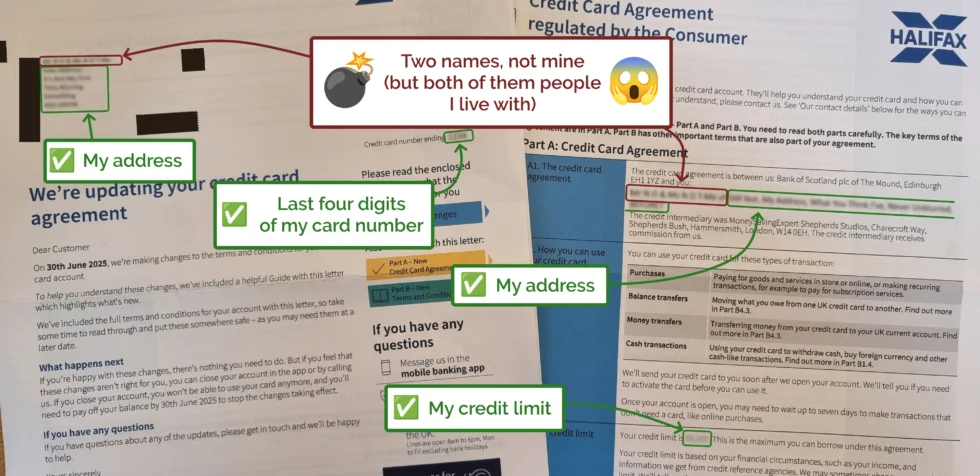
Today, Ruth and JTA received a letter. It told them about an upcoming change to the
agreement of their (shared, presumably) Halifax credit card.
Except… they don’t have a shared Halifax credit card. Could it be a scam? Some sort of phishing attempt, maybe, or perhaps somebody taking out a credit card in their names?
I happened to be in earshot and asked to take a look at the letter, and was surprised to discover that all of the other details – the last four digits of the card, the credit
limit, etc. – all matched my Halifax credit card.
Halifax sent a letter to me, about my credit card… but addressed it to… two other people I live with‽
I spent a little over half an hour on the phone with Halifax, speaking to two different advisors, who couldn’t fathom what had happened or how. My credit card is not (and has never
been) a joint credit card, and the only financial connection I have to Ruth and JTA is that I share a mortgage with them. My guess is that some person or computer at Halifax tried to
join-the-dots from the mortgage outwards and re-assigned my credit card to them, instead?
Eventually I had to leave to run an errand, so I gave up on the phone call and raised a complaint with Halifax in writing. They’ve promised to respond within… eight weeks. Just
brilliant.
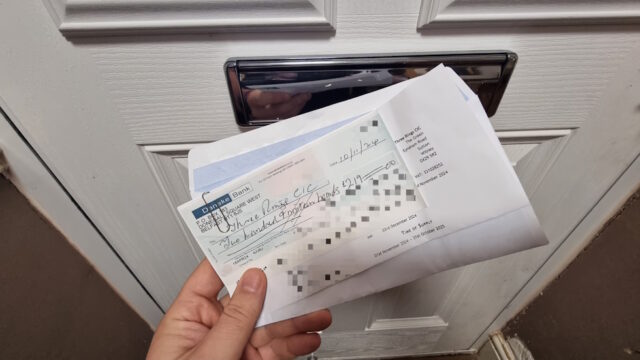
My Three Rings volunteering this International Volunteer Day isn’t all technical work. It’s also time to process the incoming postal mail.
Our time as volunteers may be free, but our servers aren’t, so the larger and richer charities that use our services help contribute to our hosting costs. Most send money digitally, but
some use dual-signatory accounts that require they send cheques.
eBay UK have changed their terms to (a) remove seller fees for most private sellers, but (b)
instead of paying-out immediately, payouts are four times a year (or on-demand).
That sounds like they’re trying to keep money in their ecosystem. The hope is, I guess, that by paying sellers in virtual “eBay Pounds” rather than actual money in the first instance
they’ll encourage those sellers to become buyers again (either of other listings, or of eBay’s postage and other services). You can cash out anytime you like, but you can never leave.
You see the same technique used e.g. by the National Lottery, who pay out “small” winnings into your online account, knowing that the vast majority of winnings are on the order of only
a few times more than the value of a ticket, and so players will be more-likely to “re-invest” if they’re not paid-out directly.
It became clear a good chunk of my Automattic colleagues disagreed with me and our actions.
So we decided to design the most generous buy-out package possible, we called it an Alignment Offer: if you resigned before 20:00 UTC on Thursday, October 3, 2024, you would receive
$30,000 or six months of salary, whichever is higher.
…
HR added some extra details to sweeten the deal; we wanted to make it as enticing as possible.
I’ve been asking people to vote with their wallet a lot recently, and this is another example!
…
This was a really bold move, and gave many people I know pause for consideration. “Quit today, and we’ll pay you six months salary,” could be a pretty high-value deal for some people,
and it was offered basically without further restriction2.
Every so often, though, I spend time with a company that is so original in its strategy, so determined in its execution, and so transparent in its thinking, that it makes my head
spin. Zappos is one of those companies
…
It’s a hard job, answering phones and talking to customers for hours at a time. So when Zappos hires new employees, it provides a four-week training period that immerses them in the
company’s strategy, culture, and obsession with customers. People get paid their full salary during this period.
After a week or so in this immersive experience, though, it’s time for what Zappos calls “The Offer.” The fast-growing company, which works hard to recruit people
to join, says to its newest employees: “If you quit today, we will pay you for the amount of time you’ve worked, plus we will offer you a $1,000 bonus.” Zappos actually bribes its
new employees to quit!
…
I’m sure you can see the parallel. What Zappos do routinely and Automattic did this week have a similar outcome
By reducing – not quite removing – the financial incentive to remain, they aim to filter their employees down to only those whose reason for being there is that they
believe in what the company does3. They’re trading money for
idealism.
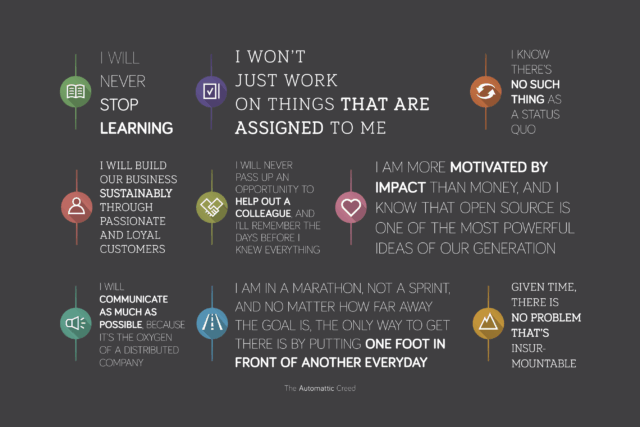
Buried about half way through the Creed is the line I am more motivated by impact than money, which seems
quite fitting. Automattic has always been an idealistic company. This filtering effort helps validate that.
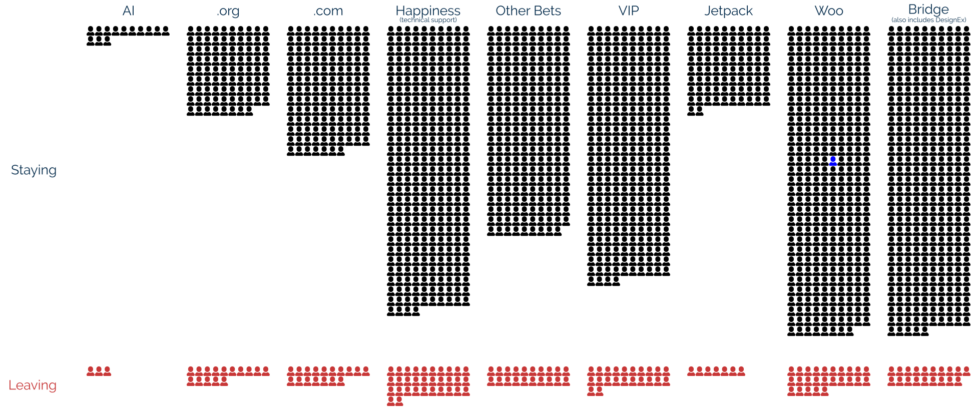
The effect of Automattic’s “if you don’t feel aligned with us, we’ll pay you to leave” offer has been significant: around 159 people – 8.4% of the company – resigned this week. At very
short notice, dozens of people I know and have worked with… disappeared from my immediate radar. It’s been… a lot.
I chose to stay. I still believe in Automattic’s mission, and I love my work and the people I do it with. But man… it makes you second-guess yourself when people you know, and respect,
and love, and agree with on so many things decide to take a deal like this and… quit4.
Departures have been experienced across virtually all divisions, but not always proportionally.
(These numbers are my own estimation and might not be entirely accurate.)
There’ve been some real heart-in-throat moments. A close colleague of mine started a message in a way that made me briefly panic that this was a goodbye, and it took until half way
through that I realised it was the opposite and I was able to start breathing again.
But I’m hopeful and optimistic that we’ll find our feet, rally our teams, win our battles, and redouble our efforts to make the Web a better place, democratise publishing (and
eCommerce!), and do it all with a commitment to open source. There’s tears today, but someday there’ll be happiness again.
Footnotes
1 For which the Internet quickly made me regret my choices, delivering a barrage of
personal attacks and straw man arguments, but I was grateful for the people who engaged in meaningful discourse.
2 For example, you could even opt to take the deal if you were on a performance
improvement plan, or if you were in your first week of work! If use these examples because I’m pretty confident that both of them occurred.
3 Of course, such a strategy can never be 100% effective, because people’s reasons for
remaining with an employer are as diverse as people are.
4 Of course their reasons for leaving are as diverse and multifaceted as others’ reasons
for staying might be! I’ve a colleague who spent some time mulling it over not because he isn’t happy working here but because he was close to retirement, for example.
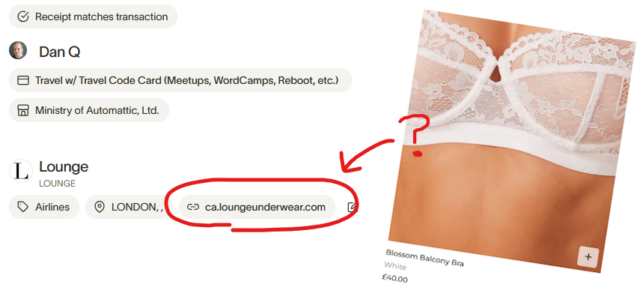
At work, we recently switched expenses system to one with virtual credit card functionality. I decided to test it out by buying myself lounge access for my upcoming work trip to Mexico.
Unfortunately the new system mis-detected my lounge access as being a purchase from lingerie company loungeunderwear.com. I’m expecting a ping
from Finance any moment to ask me why I’m using a company credit card to buy a bra.
One might ask why our expenses provider can (mis-)identify loungeunderwear.com from a transaction in the first place. Did somebody at some company that uses this provider
actually buy some ladies’ briefs on a company credit card at some point?
But if I ever happen to be somewhere that the lottery results are being announced, I sometimes like to play a game I call Not The Lottery.2
Here’s how you play:
Set aside the money it would have cost for a ticket.
Think of the numbers you’d have played.
When those numbers don’t come up, congratulations: you just won not-wasting-your-money!3
Want to play Not The Lottery retroactively? Cool. I’ve made and open-sourced a tool for that. Hopefully it’ll load below
and you can choose some numbers (or take a Lucky Dip) and have it played through the entirety of EuroMillions history and see how much money you’d have won if you’d only played them
every week. Or, to look at things from a brighter perspective, how much you’ve saved by not playing. It’s almost-certainly in the thousands.
Loading game… please wait… (if it
never loads, Dan probably broke it; sorry!)
Winning the lottery
But that’s not what the question’s really about, is it? We don’t ask people “what would they do if they won the lottery?” because we think it’s likely to happen4
We ask them because… well, because it’s fun to fantasise.
And I sort-of gave the answer away on day 20 of Bloganuary: I’d do my “dream job”. I’d work (for free) for Three Rings, like I already do, except instead of spending a couple of hours a week on it on average I’d spend about ten times that. I’d use the
luxury of not having to work to focus on things that I know I can do to make the world a better place.
If money was no object, I’d spend more time with these happy folks (and many more besides), making volunteering easier for everybody.
Sure, there’s other things I’d do. They’re mostly obvious things that I’d hope anybody in my position would do. Pay off the mortgage (and for all the works currently being done to
infuriate the dog improve the house). Arrange some kind of slow-access trust or annuity for the people closest to me so that
they need not worry about money, nor about having to work out how to spend, save, or invest a lump sum. Maybe a holiday or two. Certainly some charitable donations. Perhaps buy
really expensive ketchup: the finest dijon ketchup5.
But mostly I’d just want to be able to live as comfortably as I do now, or perhaps slightly more, and spend a greater proportion of my time than I already do making charities work
better.
I don’t know if that makes me insufferably self-righteous or insufferably simple-minded, but it’s probably one of those.
Footnotes
1 I’ve been caught describing it as “a tax on people who are bad at maths”, but I don’t
truly believe that (although I am concerned about how readily we let people get addicted to problematic gambling and then keep encouraging them to play with dark patterns that hide
how low the odds truly are). I’ve even been known to buy a ticket or two, some years.
2 While writing this, I decided to retroactively play for last Friday, having not seen
whatever numbers came up. I guessed only one of them. Hurrah! That means I saved £2.50 by not playing!
3 There are, of course, other possible outcomes. You could have missed out on winning a
small prize – the odds aren’t that low – but the solution to this is simple: just keep playing Not The Lottery and you, as the “house”, will come out on top in the end.
Alternatively, it’s just-about possible that you could pluck the jackpot numbers from thin air, in which case: well done! You’re doing better than Derren Brown when in 2009 he
performed a pretty good magic trick but then turned it into a turd when he
“explained” it using pseudoscience (why not just stick with “I’m a magician, duh”; when you play the Uri Geller card you just make yourself look like an idiot). Let’s find a way
to use those superpowers for good. Because what you’ve got is a superpower. For context: if you played Not The Lottery twice a week, every week, without fail, for
393 years… you’d still only have a 1% chance of having ever predicted a jackpot in your five-lifetimes.
4 What if we lived in a world where we did use statistics to think about the
hypothetical questions we ask people? Would we ask “what would you do if you were stuck by lightning?”, given that the lifetime chance of being killed by lightning is significantly
greater than the chance of winning the jackpot, even if you play every draw!



 RSS
RSS Spotify
 Pocket Casts
 Apple Podcasts
 YouTube