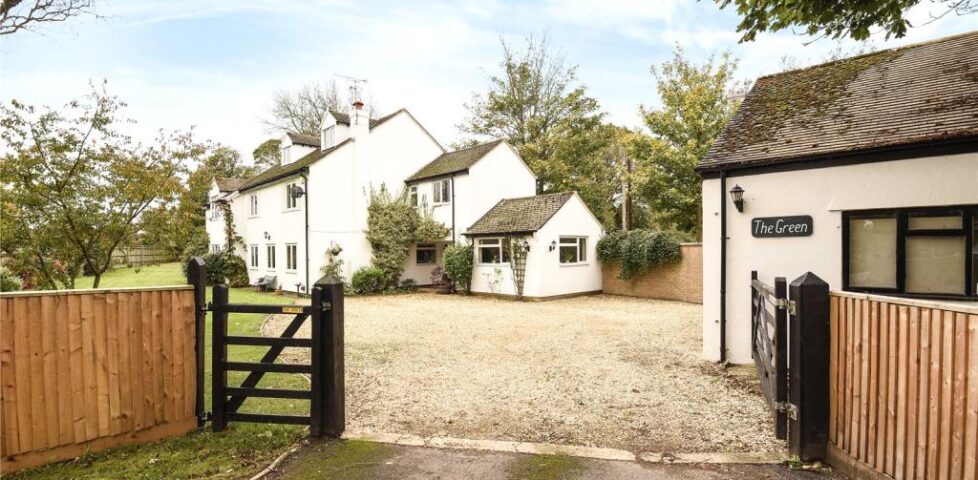
Towards the end of last week we picked up the keys to the Chicory House.1 We’ve now officially moved in to
the place we’ll be calling home for the next six months or so, while we wait for our Actual House to be repaired following our catastrophic flood in February.2
As part of my efforts to travel light, I use a pretty small
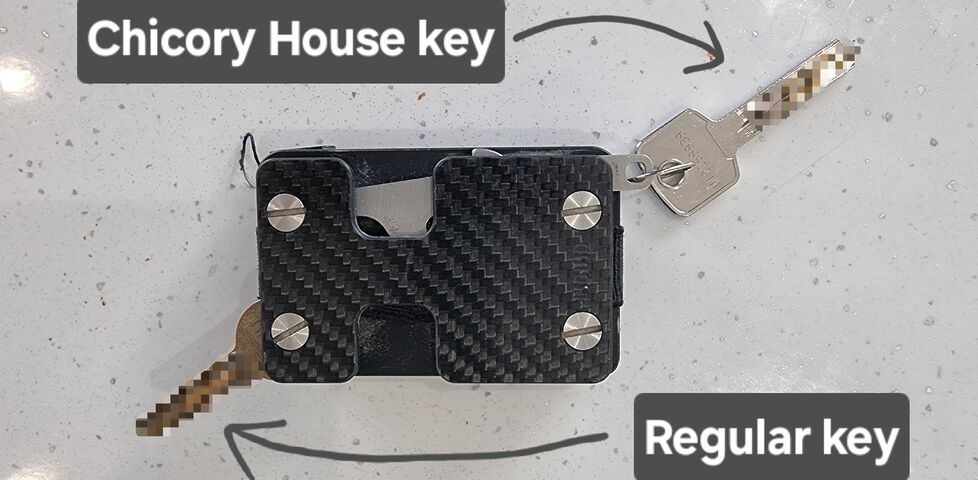
wallet – a lump of carbon fibre about the size of a deck of cards3 that contains my ID, bank cards, and – in pocket at the back – my essential keys.
Typically that’s my front door key and my bike lock key.
The keys tuck in around the back, but there’s a “hook” on the end to which additional keys can be ringed. Sometimes I hook up a second-factor hardware token to it when I’m travelling
with one.
And so when I received my front door key to the Chicory House, I had to decide: where does this key belong?
The obvious answer would have been to remove the front door key for my actual home from its special place within my wallet and replace it with the Chicory House’s front
door key. That’s the one I’ll need most-often for the foreseeable future, right? My regular front door key can move to the supplementary hook, on a ring, and/or be removed entirely and
taken with me only when I need to visit my uninhabitable home.
But that’s not what I did.
I didn’t even think about what I was doing until I noticed, afterwards, that I’d chosen to put the Chicory House key on the “supplementary keys” hook rather than in the “primary keys”
spot.
This made sense as an instinctive move: it’s where I’d clip on the key to any of the half-dozen or so AirBnBs I’ve lived in for the last couple of months, after all! But for a house I’m
going to live in for half a year or more it doesn’t seem so rational.
But I haven’t put it back. I think I’m keeping it this way. My regular key gets to keep its special spot because it represents the lost status quo and the aspiration to return. Sure,
it’s less-practical for me to keep it there, but its position is symbolic, not sensible.
Swapping the two over would feel like giving in: like caving to the inevitability of us being out of our home for an extended period. Keeping the key where it is means that every time I
put my hand in my pocket I’m reminded that the current arrangement is temporary; things will go back to normal. And that’s nice.4
2 The flood was exactly two months ago today, which makes today “F-Day plus 60”. We’ve
spent most of the intervening time hopping from AirBnB to AirBnB.
3 As somebody who often carries a deck of cards, this is a pretty-convenient size to me!
4 That said, the Chicory House is way better than most of the AirBnB’s we’ve
been living in, and I’m especially loving being able to sleep on my own familiar mattress again! While I wouldn’t want to live here forever like I’d be happy to in
the place we’ve called home since 2020, it’ll certainly suffice for the
immediate future. A stepping-stone back towards the lives we’d built before.
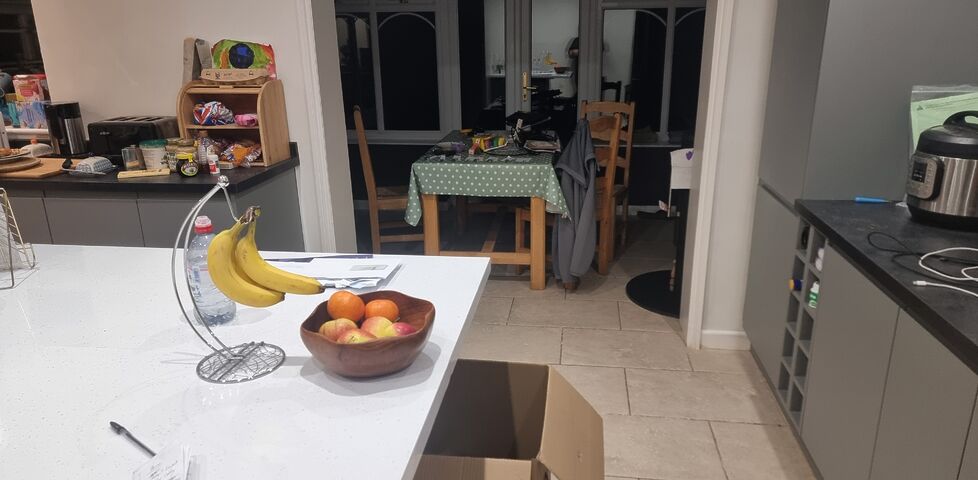
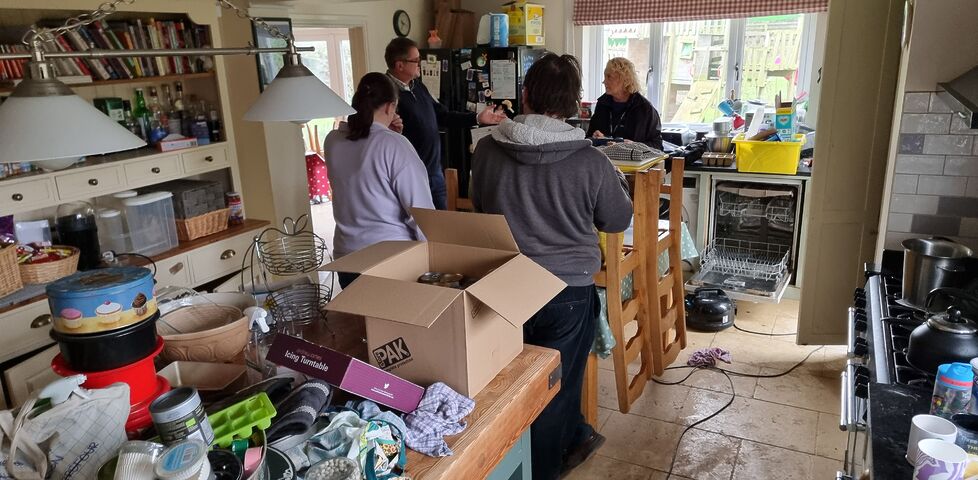
Today’s mission in what we’re calling the Chicory House – our home while our actual house gets repaired – was to unpack the kitchen. I think it’s looking pretty good!
The cardboard box you can see contains pans we brought with us that turn out to be incompatible with the induction hobs at the Chicory House, boo!
Next weekend’s mission will be to set myself up a workspace that isn’t the conservatory dining table. 😬
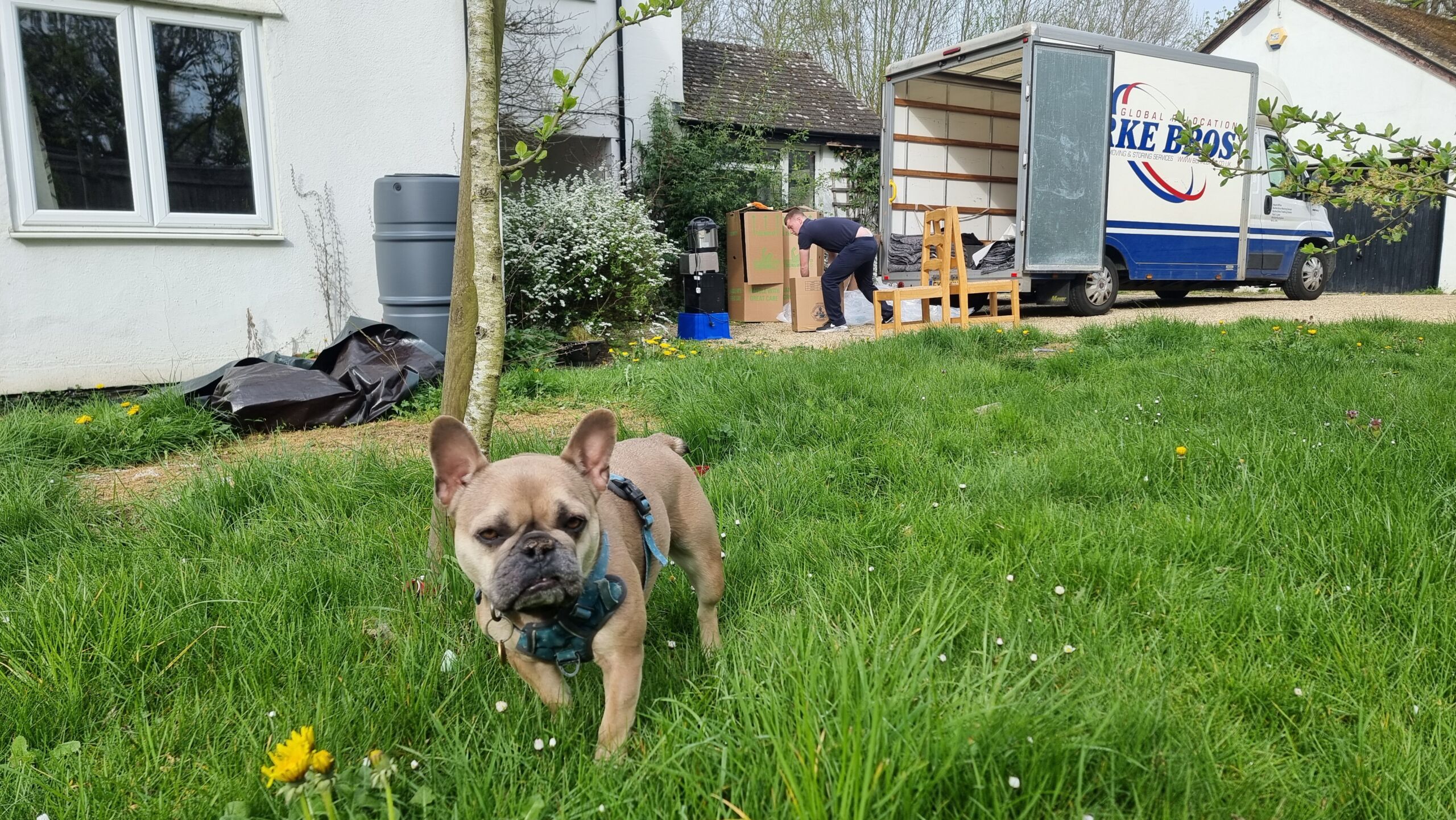
It’s fifty-five days since my house flooded. Since then, I’ve lived in hotels, with friends, on volunteering retreats and – mostly – in a series of one- or two-week AirBnB-style
short-term lets. It’s been wild. It’s also been wildly disruptive. To our work. To our kids. To our general stability.
Today, we make a change. Today we’re moving into a medium-term let: sonewhere we can stay for the… say… six months or so it’ll take to actually repair our house so we can move back in.
We’ll have our own space again in a way we haven’t in a couple of months.
I know the hard work isn’t done. Our house is still a wreck! But it feels like, perhaps, we’re beginning the second act of the three-act play “The Year Of The Flood”. And that feels
like progress.
Right, I’d better go move house! (for like the seventh time this year…)
It’s F-Day plus 35, and I’m spending a few hours working in the habitable part of our flood-damaged house while I’m “between” two AirBnBs.
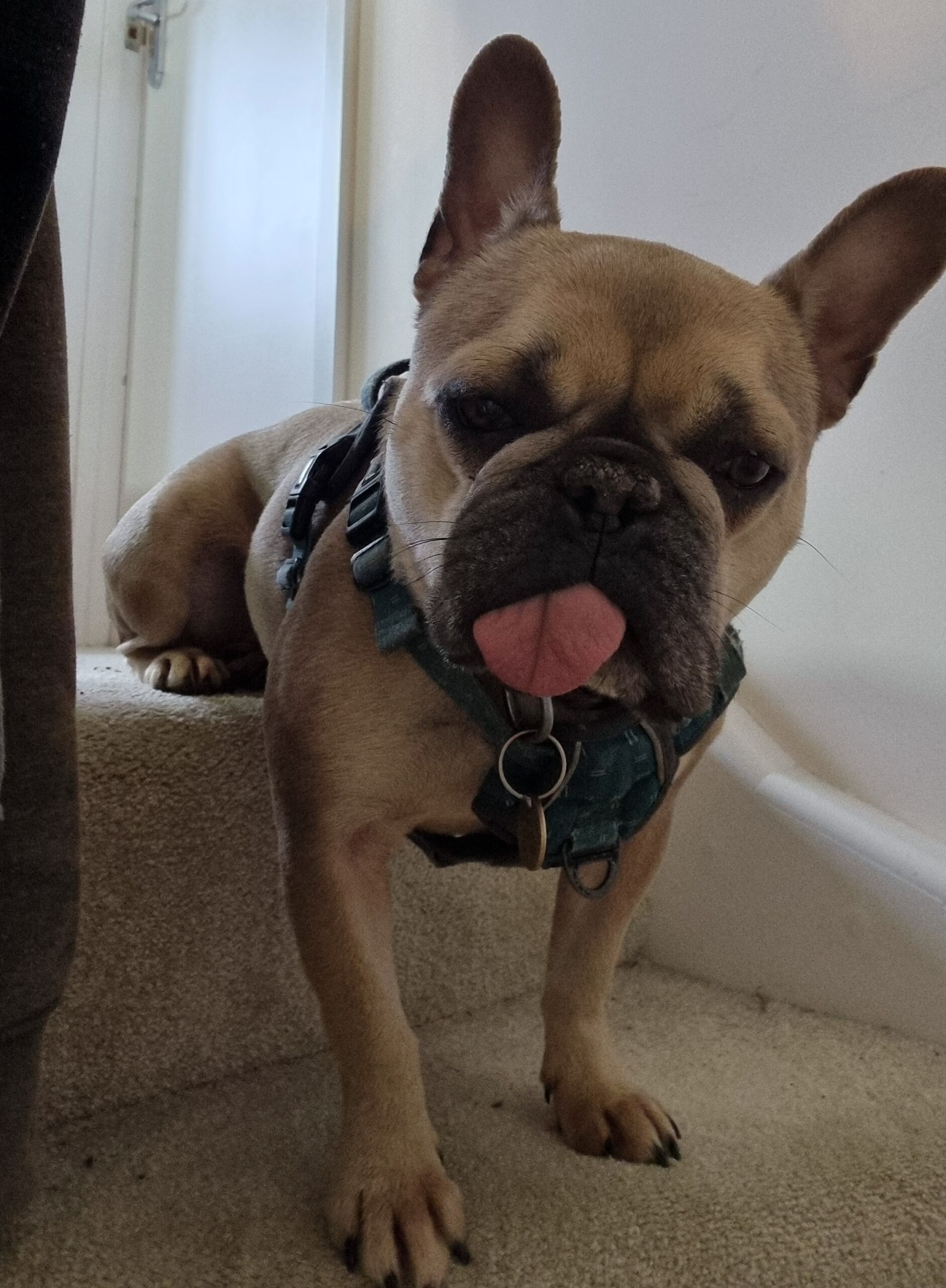
The dog, who doesn’t normally get to come upstairs, is sitting with me on the landing. Except she also wants to keep an eye on what’s happening downstairs.
The result? Her back legs are sitting and her front legs are standing as she peers blepfully down the stairs.
The insurance loss adjusters came around this morning, accompanied by damage assessors and electricians and whatnot.
The process continues to feel painfully slow. We’re still one to two weeks from confirmation that the insurance company will accept liability and be ready to start paying for, y’know,
the immediate concerns like where we’re going to live.
“How long should we plan on renting another house to live in?” I asked, warily.
“Six to twelve months?” guessed the loss adjusters.
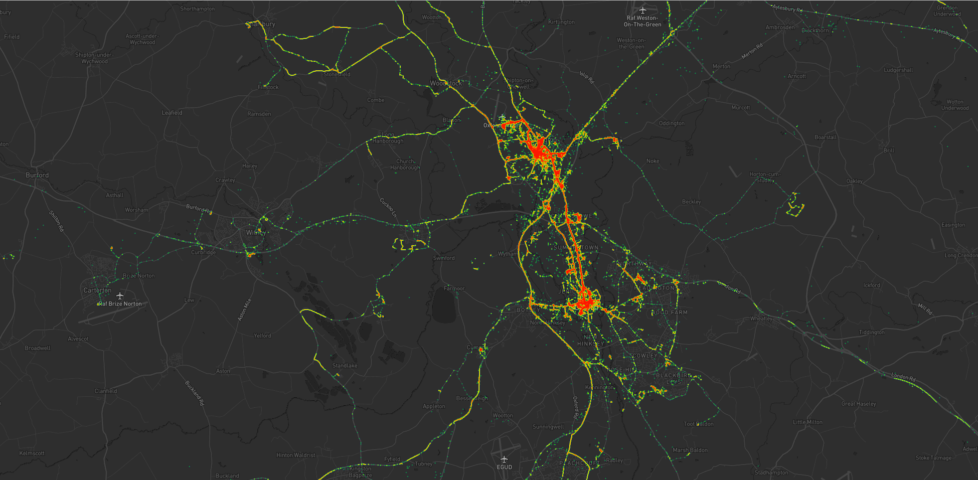
As I mentioned last year, for several years I’ve collected pretty complete historic location data from GPSr devices I carry with me everywhere, which I collate in a personal μlogger server.
Going back further, I’ve got somewhat-spotty data going back a decade, thanks mostly to the fact that I didn’t get around to opting-out of Google’s location tracking until only a few years ago (this data is now
also housed in μlogger). More-recently, I now also get tracklogs from my smartwatch, so I’m managing to collate more personal
location data than ever before.
The blob around my house, plus some of the most common routes I take to e.g. walk or cycle the children to school.
A handful of my favourite local walking and cycling routes, some of which stand out very well: e.g. the “loop” just below the big blob represents a walk around the lake at Dix Pit;
the blob on its right is the Devils Quoits, a stone circle and henge that I thought were sufficiently interesting that
I made a virtual geocache out of them.
The most common highways I spend time on: two roads into Witney, the road into and around Eynsham, and routes to places in Woodstock and North Oxford where the kids have often had
classes/activities.
I’ve unsurprisingly spent very little time in Oxford City Centre, but when I have it’s most often been at the Westgate Shopping Centre,
on the roof of which is one of the kids’ favourite restaurants (and which we’ve been able to go to again as Covid restrictions have lifted, not least thanks to their outdoor seating!).
One to eight years ago
Let’s go back to the 7 years prior, when I lived in Kidlington. This paints a different picture:
For the seven years I lived in Kidlington I moved around a lot more than I have since: each hotspot tells a story, and some tell a few.
This heatmap highlights some of the ways in which my life was quite different. For example:
Most of my time was spent in my village, but it was a lot larger than the hamlet I live in now and this shows in the size of my local “blob”. It’s also possible to pick out common
destinations like the kids’ nursery and (later) school, the parks, and the routes to e.g. ballet classes, music classes, and other kid-focussed hotspots.
I worked at the Bodleian from early 2011 until late in 2019, and so I spent a lot of time in
Oxford City Centre and cycling up and down the roads connecting my home to my workplace: Banbury Road glows the brightest, but I spent some time on Woodstock Road too.
For some of this period I still volunteered with Samaritans in Oxford, and their branch – among other volunteering hotspots
– show up among my movements. Even without zooming in it’s also possible to make out individual venues I visited: pubs, a cinema, woodland and riverside walks, swimming pools etc.
Less-happily, it’s also obvious from the map that I spent a significant amount of time at the John Radcliffe Hospital, an unpleasant reminder of some challenging times from that
chapter of our lives.
The data’s visibly “spottier” here, mostly because I built the heatmap only out of the spatial data over the time period, and not over the full tracklogs (i.e. the map it doesn’t
concern itself with the movement between two sampled points, even where that movement is very-guessable), and some of the data comes from less-frequently-sampled sources like Google.
Eight to ten years ago
Let’s go back further:
Back when I lived in Kennington I moved around a lot less than I would come to later on (although again, the spottiness of the data makes that look more-significant than it is).
Before 2011, and before we bought our first house, I spent a couple of years living in Kennington, to the South of Oxford. Looking at
this heatmap, you’ll see:
I travelled a lot less. At the time, I didn’t have easy access to a car and – not having started my counselling qualification yet – I
didn’t even rent one to drive around very often. You can see my commute up the cyclepath through Hinksey into the City Centre, and you can even make out the outline of Oxford’s Covered
Market (where I’d often take my lunch) and a building in Osney Mead where I’d often deliver training courses.
Sometimes I’d commute along Abingdon Road, for a change; it’s a thinner line.
My volunteering at Samaritans stands out more-clearly, as do specific venues inside Oxford: bars, theatres, and cinemas – it’s the kind of heatmap that screams “this person doesn’t
have kids; they can do whatever they like!”
Every map tells a story
I really love maps, and I love the fact that these heatmaps are capable of painting a picture of me and what my life was like in each of these three distinct chapters of my life over
the last decade. I also really love that I’m able to collect and use all of the personal data that makes this possible, because it’s also proven useful in answering questions like “How
many times did I visit Preston in 2012?”, “Where was this photo taken?”, or “What was the name of that place we had lunch when we got lost during our holiday in Devon?”.
There’s so much value in personal geodata (that’s why unscrupulous companies will try so hard to steal it from you!), but sometimes all you want to do is use it to draw pretty heatmaps.
And that’s cool, too.
How these maps were generated
I have a μlogger instance with the relevant positional data in. I’ve automated my process, but the essence of it if you’d like to try it yourself is as follows:
First, write some SQL to extract all of the position data you need. I round off the latitude and longitude to 5 decimal places to help “cluster” dots for frequency-summing, and I raise
the frequency to the power of 3 to help make a clear gradient in my heatmap by making hotspots exponentially-brighter the more popular they are:
This data needs converting to JSON. I was using Ruby’s mysql2 gem to
fetch the data, so I only needed a .to_json call to do the conversion – like this:
db =Mysql2::Client.new(host: ENV['DB_HOST'], username: ENV['DB_USERNAME'], password: ENV['DB_PASSWORD'], database: ENV['DB_DATABASE'])
db.query(sql).to_a.to_json
Approximately following this guide and leveraging my Mapbox
subscription for the base map, I then just needed to include leaflet.js, heatmap.js, and leaflet-heatmap.js before writing some JavaScript code
like this:
body.innerHTML ='<div id="map"></div>';
let map = L.map('map').setView([51.76, -1.40], 10);
// add the base layer to the map
L.tileLayer('https://api.mapbox.com/styles/v1/{id}/tiles/{z}/{x}/{y}?access_token={accessToken}', {
maxZoom:18,
id:'itsdanq/ckslkmiid8q7j17ocziio7t46', // this is the style I defined for my map, using Mapbox
tileSize:512,
zoomOffset:-1,
accessToken:'...'// put your access token here if you need one!
}).addTo(map);
// fetch the heatmap JSON and render the heatmap
fetch('heat.json').then(r=>r.json()).then(json=>{
let heatmapLayer =new HeatmapOverlay({
"radius":parseFloat(document.querySelector('#radius').value),
"scaleRadius":true,
"useLocalExtrema":true,
});
heatmapLayer.setData({ data: json });
heatmapLayer.addTo(map);
});
As always seems to happen when I move house, a piece of computer hardware broke for me during my recent house move. It’s always
exactly one piece of hardware, like it’s a symbolic recognition by the universe that being lugged around, rattling around and butting up against one another, is not the natural
state of desktop computers. Nor is it a comfortable journey for the hoarder-variety of geek nervously sitting in front of them, tentatively turning their overloaded vehicle around each
and every corner. UserFriendly said it right in this comic from 2003.
This time around, it was one of the hard drives in Renegade, my primary Windows-running desktop, that failed. (At least I didn’t break
myself, this time.)
Here’s the victim of my latest move. Rest in pieces.
Fortunately, it failed semi-gracefully: the S.M.A.R.T. alarm went off about a week before it actually started causing real problems, giving me at least a little time to prepare, and
– better yet – the drive was part of a four-drive RAID 10 hot-swappable array, which means that every single byte of data on that drive was already duplicated to a second drive.
Incidentally, this configuration may have indirectly contributed to its death: before I built Fox, our new household NAS, I used Renegade for many of the same purposes, but WD Blues are not really a “server grade” hard
drive and this one and its siblings will have seen more and heavier use than they might have expected over the last few years. (Fox, you’ll be glad to hear, uses much better-rated
drives for her arrays.)
Set up your hard drives like this and you can lose at least one, and up to half, of the drives without losing data.
So no data was lost, but my array was degraded. I could have simply repaired it and carried on by adding a replacement similarly-sized hard drive, but my needs have changed now that Fox
is on the scene, so instead I decided to downgrade to a simpler two-disk RAID 1 array for important data and an
“at-risk” unmirrored drive for other data. This retains the performance of the previous array at the expense of a reduction in redundancy (compared to, say, a three-disk RAID 5 array which would have retained redundancy at the expense of performance). As I said: my needs have changed.
Fixing Things… Fast!
In any case, the change in needs (plus the fact that nobody wants watch an array rebuild in a different configuration on a drive with system software installed!) justified a
reformat-and-reinstall, which leads to the point of this article: how I optimised my reformat-and-reinstall using Chocolatey.
Not this kind of chocolatey, I’m afraid. Man, I shouldn’t have written this post before breakfast.
Chocolatey is a package manager for Windows: think like apt for
Debian-like *nices (you know I do!) or Homebrew for MacOS. For previous Windows system
rebuilds I’ve enjoyed the simplicity of Ninite, which will build you a one-click installer for your choice of many of your favourite tools, so you can
get up-and-running faster. But Chocolatey’s package database is much more expansive and includes bonus switches for specifying particular versions of applications, so it’s a clear
winner in my mind.
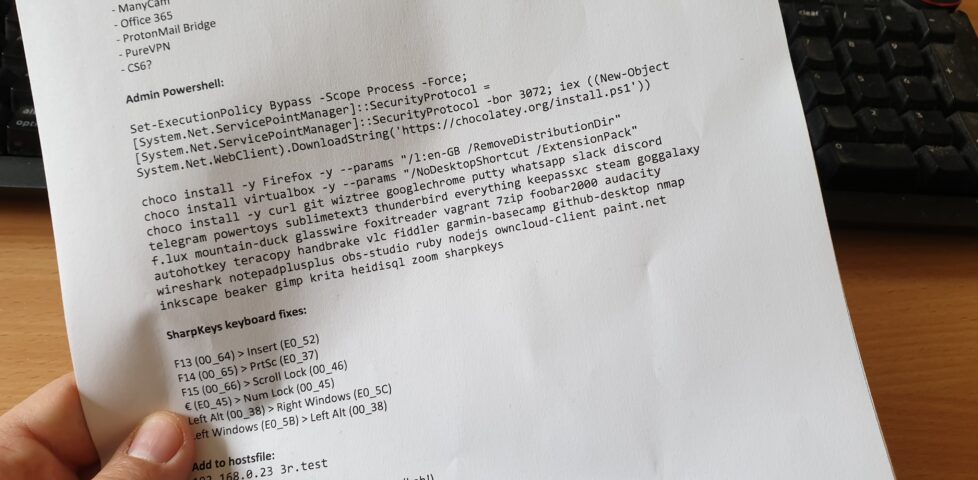
If you learn only one thing about me from this post, let it be that I’m a big fan of redundancy. Here’s the printed version of my reinstallation list. Y’know, in case the copy on a
pendrive failed.
So I made up a Windows installation pendrive and added to it a “script” of things to do to get Renegade back into full working order. You can read the full script here, but the essence of it was:
Reconfigure the RAID array, reformat, reinstall Windows, and create an account.
Configuration (e.g. set up my unusual keyboard mappings, register software, set up remote connections and backups, etc.).
By scripting virtually all of the above I was able to rearrange hard drives in and then completely reimage a (complex) working Windows machine with well under an hour of downtime; I can
thoroughly recommend Chocolatey next time you have to set up a new Windows PC (or just to expand what’s installed on your existing one). There’s a GUI if you’re not a fan of the command line, of course.
A second quick geocache find while the 6 year-old and I took a stroll around the village, which – as of yesterday – became our home! Nice to see the lights here that’ll help protect her
during our “school runs”!
We’ve only got a couple of days left before we move to our new house. In order that she and her little brother might better remember our
old house, I encouraged our 6 year-old to record a video tour.
Seven years ago, I wrote a six-part blog series (1, 2, 3, 4, 5, 6) about our Ruth, JTA and I’s experience of buying our first house. Now, though, we’re moving again, and it’s brought up all the same kinds of challenges and
stresses as last time, plus a whole lot of bonus ones to boot.
Our old house – seen here in 2013 – has served its purpose. It’s time for us to move on.
In particular, new challenges this time around have included:
As owners, rather than renters, we’ve had both directions on the ladder to deal with. Not only did we have to find somewhere to move to that we can afford but we needed to find
somebody who’d buy our current house (for enough money that we can afford the new place).
The first letting agents we appointed were pretty useless, somehow managing to get us no viewings whatsoever. Incidentally their local branch
got closed soon after we ditched them and the last time I checked, the building was still up for sale: it doesn’t bode well for them that they can’t even sell their own
building, does it?
The replacement letting agents (who sold us this house in the first place) were much better, but it still took a long time before we started
getting offers we could act on.
We finally selected some buyers, accepting a lower offer because they were cash buyers and it would allow us to act quickly on the property we wanted to buy, only for the
coronavirus lockdown to completely scupper our plans of a speedy move. And make any move a logistical nightmare.
Plus: we’re now doing this with lots more stuff (this won’t be a “rally some friends and rent a van” job like
last time!), with two kids (who’re under our feet a lot on account of the lockdown), and so on.
We added significant value to our old house during the time we owned it, for example by installing solar panels which continue to generate income as well as “free” energy. As well as being now conveniently close to a train line to London which I suppose would be good
for commuters even though we’ve mostly used it for fun.
But it’s finally all coming together. We’ve got a house full of boxes, mind, and we can’t find anything, and somehow it still doesn’t feel like we’re prepared for when the
removals lorry comes later this week. But we’re getting there. After a half-hour period between handing over the keys to the old place and picking up the keys to the new place (during
which I guess we’ll technically be very-briefly homeless) we’ll this weekend be resident in our new home.
Our new home’s pretty delightful. I’ll vlog you a tour or something once we’re moved in, under the assumption that a housewarming party is still likely to be rendered impossible by
coronavirus.
Our new house will:
Be out in the fabulous West Oxfordshire countryside.
Have sufficient rooms to retain an office and a “spare” bedroom while still giving the kids each their own bedroom.
Boast a fabulously-sized garden (we might have already promised the kids a climbing frame).
Have an incredible amount of storage space plus the potential for further expansion/conversion should the need ever arise. (On our second-to-last visit to the place with discovered
an entire room, albeit an unfinished one, that we hadn’t known about before!)
Get ludicrously fast Internet access.
We lose some convenient public transport links, but you can’t have everything. And with me working from home all the time, Ruth –
like many software geeks – likely working from home for the foreseeable future (except when she cycles into work), and JTA working from
home for now but probably returning to what was always a driving commute “down the line”, those links aren’t as essential to us as they once were.
Sure: we’re going to be paying for it for the rest of our lives. But right now, at least, it feels like what we’re buying is a house we could well live in for the rest of our
lives, too.
This blog post is the sixth and final part in a series about buying our first house.
In the fifth post, we finally exchanged contracts with the sellers after a long-running disagreement about who was going to repair the
front door…
A series of days flew by in a cardboard-box-filled blur, and suddenly it was the last Friday in July – the day upon which our sale was completed. I’d run out of spare days of annual
leave, so I was only able to justify taking the afternoon off to pick up a van, scoop up Ruth and Matt, get the keys to the new house, and meet JTA
there.
The first mission was to collect a van from Europcar, so that we’d be able to spend the entire weekend going up and down the A34.
The estate agents were conveniently just two doors down from a locksmith, so we got some keys cut to what we believed
to be the new front door, while we were there. It’s also sandwiched between a funeral home and a florist, which makes it sort of a one-stop street when somebody dies and you want to put
their house on the market.
The great thing about getting champagne as a housewarming gift, from your estate agent, is that you don’t need to unpack the corkscrew to open it.
We soon discovered that the “fix” that had ultimately been applied to the broken front door was simply to swap it for a different exterior door, from the inner porch. A little cheeky,
and a little frustrating after all the fighting we’d done, but not the end of the world: we still had a perfectly good front door and – as we planned to use the annex as part of the
main house, anyway, we were happy to take the door down and leave an open doorway, anyway.
We gave JTA the honour of being the first to open the door to our new home. After some fiddling with what turned out to be the wrong key, the door turned out to be already unlocked.
A vacant house feels big and empty. Our new – large! – living room felt enormous. Meanwhile, packing up our old house – with its painted walls and wooden floors – was beginning to sound
echoey as it became emptier.
Lounging in the living room. (or is she living in the lounge?)
We spent a long time working out which of the many keys we had fit which of the locks, as there were quite so many: there’s the front door, the inner front door, the other
inner front door, the back door, the outer conservatory door, the inner conservatory door, the gate lock, the shed lock, the window locks, and a good handful of keys besides that we
still haven’t identified the purpose of. It’s was like the previous owners just bought a pile of additional keys, just as a prank.
Our old house – New Earth – became emptier and yet more-chaotic as the stacks of boxes were gradually loaded into the van.
We’d rented a van over a long weekend in which to do the majority of the move, and we’d hired some burly men with a bigger van to move some of the heaviest furniture, and to collect a
piano that we’d bought (yes, we have a piano now; booyah).
“Pack the living room into the van,” I said. “Okay,” said JTA, putting the kettle on.
Very helpfully, Alec came and joined us, and helped run an enormous amount of boxes and furniture down and out of the three-stories of our old house, and in and up the three-stories of
our new house. Why do we keep torturing ourselves with these tall buildings? At least our new staircases are a better shape for carrying mattresses up.
Now that I’ve discovered that I can hire muscular men on-demand, I’m not sure that I’ll ever do anything else.
The weather stayed good, with only occasional showers (and thankfully, never when we were carrying soft furnishings between a van and a building) and one brief but wild thunderstorm
(that we managed to avoid only with a quick re-arrangement of the van contents, slamming the doors, and sprinting for cover), and we worked hard, and we ended up a day ahead of schedule
before we were finished.
Alec helped out with lots of heavy lifting, but also with ‘testing’ the piano. Which, before it had been tuned, wasn’t the best of experiences for anybody involved.
In order to minimise the amount of the deposit that we might otherwise lose, from our old place, and because we rightly anticipated being too exhausted from the move to do all of the
requisite cleaning ourselves, we’d hired some professionals. By this point, we weren’t even able to think in terms of money like normal people – by the time you’re spending five figures
on tax and lawyers, you find it pretty easy to shrug off the cost of a team of cleaners!
I’m pretty sure that the local ice cream van driver was following us around, because on each day of the move, he’d arrive on the scene right after we’d finished unloading a van and
could really do with an ice cream break.
This did mean that Ruth and I had to each work from home, from the old house, for one last day while we let the cleaners, gardener etc. in. We left in the old house an absolute minimum
of furniture: a single desk, chair, laptop computer, cup (for water), router, and cables.
One desk, one chair, one laptop, one router… in a five bedroom house. It’s a lonely life.
As I left the house for the last time, as empty and quiet as it was the day we
first moved in, I felt a sense of serenity; a calm that came from a number of simultaneous realisations… that this was probably the last house move I’d have to do in a long while…
that I finally lived somewhere that I didn’t (theoretically, at least) have to ask for somebody’s permission before I put a picture hook up or painted a wall… and that at long last I
was paying off my own mortgage, rather than somebody else’s. It was the beginning of a new era.
The first box that we unpacked was the one containing Alec, of course.
Changing tack from the theme by which our houses have been named since 2010, our new home is called Greendale. And yes, there’s a
website (albeit a little sparse, for now). There’s always a website.
Susan didn’t help much with the packing and moving, but I’m not sure I’ve put a photo of her and Matt online yet. So now I have.
There’ll be a housewarming party on 22nd September: if you’re a friend of one or more of us, you’ve probably received an invitation already. But if you haven’t – and
it’s not impossible, because we weren’t sure of everybody’s best email addresses these days – and you expect you should have, let me know. It’s not that we don’t love you: we just don’t
love you enough to remember to invite you to stuff, that’s all.
In Godzilla’s fourth Family Vlog, a lost cat is recovered from under the floorboards and the secret history of Godzilla and Zara is uncovered. Here’s my review, hastily and belatedly
put together during my recent house move.
This blog post is the third in a series about buying our first house. In the
third post, Ruth, JTA and I had acquired some
lawyers and started the conveyancing process…
We’re moving house! And we want your help!
There’ve been… a few hitches with the house move. A few little hurdles. And then a few big hurdles. It’s been a little challenging, is what I’m trying to say. I’ll write about that in
Part 5, but for now: we need your help!
Here’s what we’ve got:
A weekend in which we want to move (27th – 28th July).
A van (probably).
A lot of furniture, piles of boxes, and all the board games in the
known universe. – a lot of stuff!
A couple of extra pairs of hands who are willing to load and unload vans in exchange for:
Pizza
All the booze you can eat
Being among the first to see our new home!
(cynical folks might notice that pizza, booze, rental vans and friends are a lot cheaper than professional removals companies, especially for short hops across to the other side of
a city)
Simply put: we need you!
Can you help? Can you be free for some or all of the weekend of 27th & 28th of July, to come and shift boxes in exchange for good times, booze and snacks? If you are, we’d love to have
you over. Ruth has written more about the wonderful perks that
you’ll enjoy if you can help us, so – if you’re free and can get to Oxford – please come! And it’ll be lovely to see you, too!