Roald Dahl does not use fronted adverbials for time and coordinating conjunctions, he deliberately makes his work simple and frenetic, the stream of consciousness of a curious child
, the turbocharged imagination of youth in prose it can easily understand.
…
To Tories, Art Is Not Proper. Grammar is Proper.
Of course, this handily explains the move towards metrics obsession in the UK, but this is a long term phenomenon that predates Michael Gove. Our education system was advocated for
and partially financed by industrialists, who saw that teaching the necessary mathematical and numerical skills to perform middle management tasks could be funded by the taxpayer.
This is in the bones of our education system, the set structure. Metrics obsession isn’t just a class thing, it’s factory floor thinking. Everything must be quantified in terms of
output, you are performing mock standardised tests every 6 weeks from the age of 8.
…
A political but fair look at the mass-production standardisation of English-language education in British schools. In an effort to make work measurable and objectively assessable, it
argues, we’re stripping the joy out of the art of writing.
Having seen the kinds of things our children are assessed on at school, it’s a reasonable hypothesis.
Yesterday I took a short trip. I began with a ride on the local Hyperloop, which ran through a tunnel dug by Boring Company. Then I used my neural implant to summon a fully
self-driving Tesla robotaxi. While enroute I read the latest news from the Mars colony.
OK, none of that actually happened, because those products don’t exist. There are no working Hyperloops. The Boring Company has not dug any commercial tunnels. Tesla has a few
self-driving — though not fully self-driving — taxis in Austin and nowhere else. (Google’s Waymo driverless taxis are operational in several major hubs.)Neuralink, which is purportedly pioneering brain implants, has tested its products in a handful of patients but done no more than
that. And of course there is no Mars colony: there have been no manned flights to Mars, nor the prospect of any for the foreseeable future.
Yet at various points over the past decade Elon Muskpromisedthat each of these services would be available by 2025 if not sooner.
a few unqualified successes (Tesla leading the charge on the EV rollout; Starlink providing widespread Internet), and
a lot more unfulfilled promises and vapourware (Twitter’s post-takeover nosedive, the failure to deliver anything-of-use by Neuralink, The Boring Company/Hyperloop, the
worse-than-pointless Grokipedia, all the things SpaceX hasn’t yet done…).
The vast majority of his wealth comes from investment, not from returns: people buy his stock if they buy his hype. I’m not saying he’s
producing nothing of value… but yeah: the “world’s first trillionaire” is… unfortunate.
But then again, I’d be quite happy for him to be the world’s last trillionaire, too.
🚫 Regrettably you have been locked out of diamond geezer
pending age verification protocols.
You may be UNDER 16 YEARS OF AGE and therefore you must not read anything here UNTIL YOU CAN PROVE THAT YOU’RE
NOT.
The government is taking urgent action to ensure that children are no longer able to access harmful social media apps. At the personal behest of the Prime Minister a raft of
carefully thought-through definitely-not-rushed non-kneejerk policies designed to restrict inappropriate content is to be introduced forthwith.
There is some absolutely terrible stuff online, much of which has already tarnished the minds of innocent youth. It is therefore imperative that all potentially terrible stuff must
now be wrapped in a secure plain cover and placed on the digital top shelf. It’s for everyone’s own good.
…
Despite being parody, diamond geezer’s new age-gating – which e.g. asks for personal information but, obviously, doesn’t actually block access to the site – somehow perfectly
straddles the line between “invasive” and “ineffective”… in exactly the same way that I expect the UK’s legal implementation will manage in a year or two.
To celebrate the site’s 25th birthday this year, Wikipedia is encouraging/challenging
people to read one Wikipedia article a day for 25 consecutive days. I felt that I could do one better than that: not only reading an article but – where I found one that was
particularly interesting – to write a blog post or record a podcast episode for each of those days, sharing what I learned. For each entry, I’ll hit
“random article” a few times until something catches my interest, start reading, and then start writing! Everything I’ve written below came from Wikipedia… so you should check other
sources before you use it to do your homework. Happy birthday, Wikipedia!
Just sometimes when you’re playing the “hey, Wikipedia, give me a random page” game, you get a hole in one. That’s what happened today when I landed on the article for… Carl Person.
Whatever else you can say about him, he looks pretty dapper in a suit. Photo courtesy Carl Person, used under a Creative Commons license. Knowing that he has a Wikipedia
account (which he used to upload this photo), I took the time to browse the article history and check for any obvious signs of tampering, sockpuppetry, or other foul play, but it
looks reasonably clean.
Yes, Person is his actual surname. Speaking as a person with a stupid name, it pleases me to find people whose names probably cause them at least as much
trouble as mine does. Wikipedia wasn’t any help at understanding where the surname Person comes from (and Carl himself isn’t
even noteworthy enough to appear on the list of “notable people with that surname”, it seems).
However I did enjoy discovering jazz saxophonist Houston Person (which sounds like the beginning of a news headline about
somebody from Houston!) who once released an album called… Person to Person! Excellent. Also, actress and
filmmaker Marina Person whose documentary about her father, filmmaker Luis Sérgio Person, was titled simply Person. I think the name might be related to Swedish
surname Persson – literally, “son of Per” – where Per is a Scandinavian
variant of Peter. This probably means that there’s a “Per Person” somewhere in the world, and I want to meet him.
Anyway: back to Carl. He trained as a lawyer and spent the 1960s working in a variety of corporate law firms. These included the one for which Richard Nixon was a partner, during that period after Nixon failed to get elected as Governor of California and announced that he was
retiring from politics… only to come back six years later to be elected president and, well, you know the rest.
Paralegals! All of the work; a fraction of the pay!
Anyway: other things he did as part of his legal career were –
Represented other members of The Teenagers (then The Premiers, because confusingly the band changed their name to “The
Teenagers” when they got older) in their efforts to reclaim shared copyright of their 1956 hit Why
Do Fools Fall in Love from lead singer Frankie Lymon and Gee Records.
Represented playwright Mark Dunn in his successful claim that The Truman Show was based upon his 1992 play, Frank’s Life, whose script he’d previously attempted to sell to
Paramount.
Helped Ralph Anspach (whose book I read before writing this 2013 blog post!) in his
appeal against a ruling that Anspach’s board game Anti-Monopoly was derivative of Parker Brothers‘ stake
in Monopoly: the appeal was successful at least in part because Person and Anspach were able to prove that Monopoly was, itself, derived from Lizzie Magie‘s The Landlord’s Game. (Fun fact: this was
the second time Carl successfully took on Parker Brothers; the first being the Masterpiece case,
representing Christian Thee!)
NHS England has issued new guidance to staff, which has been shared with New Scientist, that demands existing and future software be pulled from public view and kept behind closed
doors. “All source code repositories must be private by default. Repositories must not be public unless there is an explicit and exceptional need, and public access has been
formally approved,” says the new guidance. The deadline for making code private is 11 May.
Last month, an AI created by Anthropic called Mythos was widely reported to be capable of discovering flaws in virtually any software, potentially allowing hackers to break into
systems running it.
NHS England’s guidance specifically points to Mythos as the cause for the new measures.
…
Yet again, “AI” is the reason why we can’t have nice things on an open and transparent Web.
This is bad, of course. But the worst part is the illusion it helps feed that closed-source software is necessarily more-secure than open-source software. Obviously it’s all
much more-complex than that. Indeed, the article goes on to quote Terence Eden thoroughly debunking the entire line of thought:
“Is it possible that Mythos will scan a repository and find a bug? Yes, 100 per cent likely. Is that going to be a bug that causes a security issue in a live NHS service
somewhere? Almost certainly not,” says Eden. “I think it’s someone in NHS England buying into the hype that Mythos is going to cause the end of security as we know it and
getting a bit panicked.”
He’s right. This policy change is unlikely to improve the security of any of the affected pieces of NHS software (for much of which, the code is already out-there and archived, and so
removing it from the Internet now is pretty pointless). If it’s going to be attacked, it’ll be attacked, and the resources that the bad guys have for probing a whole
database worth of CVEs or fuzz-testing the extremities makes the availability of vulnerability-scanning AI pretty-close to irrelevant.
At least if it were open source then the good guys would have a chance of helping out… as well as we, the taxpayers who made the software possible, being able to see where our money was
going!
As I’ll demonstrate, it’s surprisingly easy to spin up your own VPN provider on a virtual machine hosted by your choice of the cloud providers. You pay for the hours you need
it2,
and then throw it away afterwards.
If you’d prefer to use GCP, AWS Azure, or whomever else you like: all you need is a Debian 13 VM with a public IP address (the cheapest one available is usually plenty!)
and this bash script.
If you prefer the command-line, Linode’s got an API. But we’re going for ‘easy’ today, so it’ll all be clicking buttons and things.
First, spin up a VM and run my script3.
If you’re using Linode, you can do this by going to my StackScript and clicking ‘Deploy New Linode’.
You might see more configuration options than this, but you can ignore them.
Choose any region you like (I’m putting this one in Paris!), select the cheapest “Shared CPU” option – Nanode 1GB – and enter a (strong!) root password, then click Create Linode.
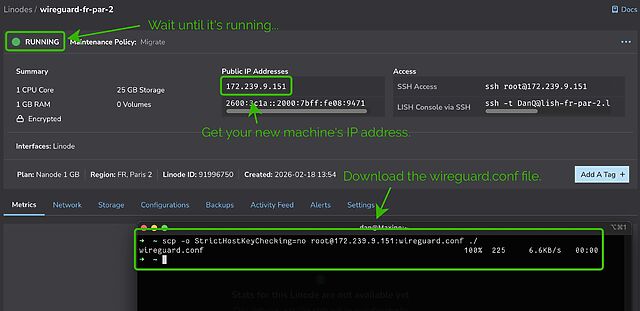
It’ll take a few seconds to come up. Watch until it’s running.
Don’t like SCP? You can SSH in and ‘cat’ the configuration or whatever else you like.
My script automatically generates configuration for your local system. Once it’s up and running you can use the machine’s IP address to download wireguard.conf locally. For
example, if your machine has the IP address 172.239.9.151, you might type scp -o StrictHostKeyChecking=no root@172.239.9.151:wireguard.conf ./ – note that I
disable StrictHostKeyChecking so that my computer doesn’t cache the server’s SSH key (which feels a bit pointless for a “throwaway” VM that I’ll never connect to a second time!).
If you’re on Windows and don’t have SSH/SCP, install one. PuTTY remains a solid choice.
File doesn’t exist? Give it a minute and try again; maybe my script didn’t finish running yet! Still nothing? SSH into your new VM and inspect
stackscript.log for a complete log of all the output from my script to see what went wrong.
Not got WireGuard installed on your computer yet? Better fix that.
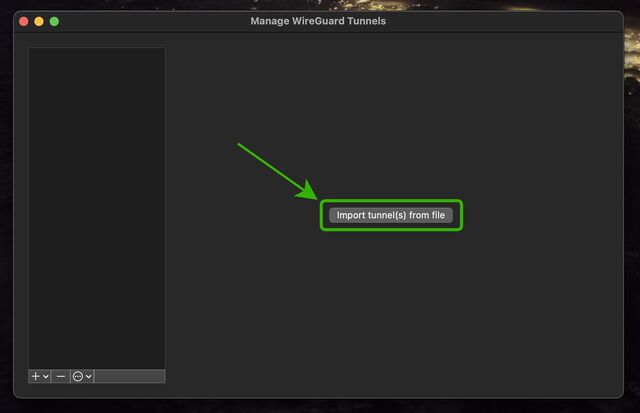
Open up WireGuard on your computer, click the “Import tunnel(s) from file” button, and give it the file you just downloaded.
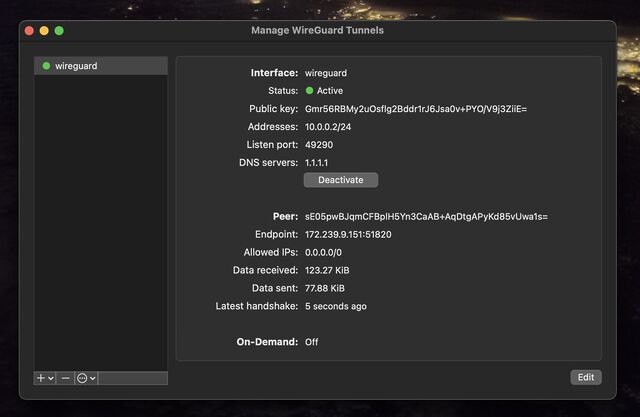
You can optionally rename the new connection. Or just click “Activate” to connect to your VPN!
If you see the ‘data received’ and ‘data sent’ values changing, everything’s probably working properly!
You can test your Internet connection is being correctly routed by your VPN by going to e.g. icanhazip.com or ipleak.net: you should see the IP address of your new virtual machine and/or geolocation data that indicates that you’re in your selected region.
When you’re done with your VPN, just delete the virtual machine. Many providers use per-minute or even per-second fractional billing, so you can easily end up spending only a handful of
cents in order to use a VPN for a reasonable browsing session.
Again, you can script this from your command-line if you’re the kind of person who wants a dozen different locations/IPs in a single day. (I’m not going to ask why.)
When you’re done, just disconnect and – if you’re not going to use it again immediately – delete the virtual machine so you don’t have to pay for it for a minute longer than you
intend4.
I stopped actively paying for VPN subscriptions about a decade ago and, when I “need” the benefits of a VPN, I’ve just done things like what I’ve described above. Compared to a
commercial VPN subscription it’s cheap, (potentially even-more) private, doesn’t readily get “detected” as a VPN by the rare folks who try to detect such things, and I can enjoy my
choice of either reusable or throwaway IP addresses from wherever I like around the globe.
And if the government starts to try to age-gate commercial VPNs… well then that’s just one more thing going for my approach, isn’t it?
Footnotes
1 If you’re a heavy, “always-on” VPN user, you might still be best-served by one of the
big commercial providers, but if you’re “only” using a VPN for 18 hours a day or less then running your own on-demand is probably cheaper, and gives you some fascinating
benefits.
2 Many providers have coupons equivalent to hundreds of hours of free provision, so as
long as you’re willing to shuffle between cloud providers you can probably have a great and safe VPN completely for free; just sayin’.
3 Obviously, you shouldn’t just run code that strangers give you on the Internet unless
you understand it. I’ve tried to make my code self-explanatory and full of comments so you can understand what it does – or at least understand that it’s harmless! – but if you don’t
know and trust me personally, you should probably use this as an excuse to learn what you’re doing. In fact, you should do that anyway. Learning is fun.
4 Although even if you forget and it runs for an entire month before your billing cycle
comes up, you’re out, what… $5 USD? Plenty of commercial VPN providers would have charged you more than that!
It’s February, which means that (here in the UK) it’s LGBT+ History Month.1
And it feels like this year, it’s more important than ever to remember our country’s queer history.
By the time Western European countries traditionally seen as ‘socially conservative’ like Ireland and Switzerland are outranking the UK in LGBT+ rights rankings… it’s a clue that
something’s gone wrong, right?
This stuff affects everybody. When you build a community that is a safe space for queer people, and trans
people,6 everybody benefits7. So even if you’re
somehow not compelled by the argument that we should treat everybody fairly and with compassion, you should at least accept that it helps you, too,
when we do.
In many ways, queer rights in the UK have been a success story in recent decades. Within my lifetime, we’ve seen the harmonisation of the age of consent (2001), civil partnerships
(2004), the Gender Recognition Act (2004), the Equality Act (2010), same-sex marriage (2013; I was genuinely surprised this bill passed!) and the mass-pardoning of people previously
convicted under discriminatory sex act laws (2017). These are enormous and important steps and it’s little wonder that the UK topped ILGA Europe’s scoreboard for a while there.
But as recent developments have shown: we can’t rest on our laurels. There’s more to do. History shows us what’s possible; it’s up to us to decide whether we keep moving forward or let
it unravel.
So this LGBT+ History Month, don’t just remember the past: pay attention to the present, and push back where it’s slipping.
3 Georgia’s backslide is superficially similar to Hungary’s except that one can’t help but
feel the influence of partial occupier Russia – a frequent bottom-scorer in ILGA’s list – in that.
4 By the way: I just looked back at my own blog posts tagged
‘sexuality’, and man, that shit is on fire! Some fun things there if you’re new to my blog and just catching-up, if I may toot my own horn a little! (Is “toots own horn” a
protected identity? ‘Cos I do it a lot.)
The Internet, the interconnection of most of the computers in the world, has existed since the late sixties. But no protocol existed to actually exploit that network, to explore and
search for information. At the time, you needed to know exactly what you wanted and where to find it. That’s why the USA tried to develop a protocol called “Gopher.”
At the same time, the “World Wide Web,” composed of the HTTP protocol and the HTML format, was invented by a British citizen and a Belgian citizen who were working in a European
research facility located in Switzerland. But the building was on the border with France, and there’s much historical evidence pointing to the Web and its first server having been
invented in France.
It’s hard to be more European than the Web! It looks like the Official European Joke! (And, yes, I consider Brits Europeans. They will join us back, we miss them, I promise.)
…
Google, Microsoft, Facebook may disappear tomorrow. It is even very probable that they will not exist in fourty or fifty years. It would even be a good thing. But could you imagine
the world without the Web? Without HTML? Without Linux?
Those European endeavours are now a fundamental infrastructure of all humanity. Those technologies are definitely part of our long-term history.
…
There are so many ways in which the UK has had to choose – and continues to have to choose – which side of the Atlantic it belongs on: the North American side, or the European side.
Legally, politically, financially, culturally… And every time we swing away from Europe, it saddens me.
This wonderful article by Lionel Dricot encapsulates one of many reasons why. European tech culture, compared to that in the USA, leans more open-source, more
open-standards, more collaborative. That’s the culture I want more of.
“OK,” the young man said, “but what can we do about the crash?” He was clearly very worried.
“I don’t think there’s anything we can do about that. I think it’s already locked in. I mean, maybe if we had a different government, they’d fund a jobs guarantee to pull us out of
it, but I don’t think Trump’ll do that, so –”
“But what can we do?“
We went through a few rounds of this, with this poor kid just repeating the same question in different tones of voice, like an acting coach demonstrating the five stages of grieving
using nothing but inflection. It was an uncomfortable moment, and there was some decidedly nervous chuckling around the room as we pondered the coming AI (economic) apocalypse, and
the fate of this kid graduating with mid-six-figure debts into an economy of ashes and rubble.
I firmly believe the (economic) AI apocalypse is coming.
…
I’m not sure I entirely agree with Doctorow on this one. I’ll probably read his upcoming book on the subject, though.
I agree that, based on the ways in which AI is being used, financed, and marketed… we’re absolutely in an unsustainable bubble. There’s a lot of fishy
accounting, dubious business models, and overpromised marketing. I’m not saying AI’s useless: it’s not! But it’s yet proven
itself to be revolutionary, nor even on the path to being so, and it’s so expensive that it seems unlikely that the current “first dose is free” business model is
almost-certainly unsustainable.
But I’m not convinced that a resulting catastrophic economic collapse is inevitable. Maybe I’m over-optimistic, but I like to imagine that the bubble can
fizzle-out gradually and the actually-valuable uses of AI can continue to be used in a sustainable way. (I’m less-optimistic that we’ll find a happy-solution to prevent AI from being
used to rip off artists, but that’s another story.)
This post is also available as a video. If you'd prefer to watch/listen to me
talk about this topic, give it a look.
1979
The novelisation of The Hitch-Hiker’s Guide to the Galaxy came out in 1979, just a smidge before I was born. There’s a well-known scene in the second chapter featuring Ford
Prefect, an alien living on Earth, distracting his human friend Arthur Dent. Arthur is concerned about the imminent demolition of his house by a wrecking crew, and Ford takes him
to the pub to get him drunk, in anticipation of the pair attempting to hitch a lift on an orbiting spacecraft that’s about to destroy the planet:
“Six pints of bitter,” said Ford Prefect to the barman of the Horse and Groom. “And quickly please, the world’s about to end.”
The barman of the Horse and Groom didn’t deserve this sort of treatment, he was a dignified old man. He pushed his glasses up his nose and blinked at Ford Prefect. Ford ignored him
and stared out of the window, so the barman looked instead at Arthur who shrugged helplessly and said nothing.
So the barman said, “Oh yes sir? Nice weather for it,” and started pulling pints.
He tried again.
“Going to watch the match this afternoon then?”
Ford glanced round at him.
“No, no point,” he said, and looked back out of the window.
“What’s that, foregone conclusion then you reckon sir?” said the barman. “Arsenal without a chance?”
“No, no,” said Ford, “it’s just that the world’s about to end.”
“Oh yes sir, so you said,” said the barman, looking over his glasses this time at Arthur. “Lucky escape for Arsenal if it did.”
Ford looked back at him, genuinely surprised.
“No, not really,” he said. He frowned.
The barman breathed in heavily. “There you are sir, six pints,” he said.
Arthur smiled at him wanly and shrugged again. He turned and smiled wanly at the rest of the pub just in case any of them had heard what was going on.
None of them had, and none of them could understand what he was smiling at them for.
A man sitting next to Ford at the bar looked at the two men, looked at the six pints, did a swift burst of mental arithmetic, arrived at an answer he liked and grinned a stupid
hopeful grin at them.
“Get off,” said Ford, “They’re ours,” giving him a look that would have an Algolian Suntiger get on with what it was doing.
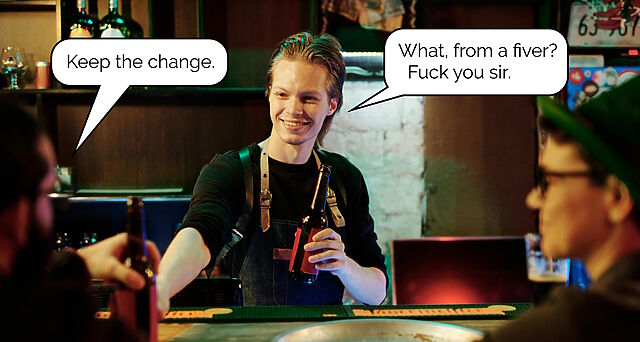
Ford slapped a five-pound note on the bar. He said, “Keep the change.”
“What, from a fiver? Thank you sir.”
There’s a few great jokes there, but I’m interested in the final line. Ford buys six pints of bitter, pays with a five-pound note, and says “keep the change”, which surprises the
barman. Presumably this is as a result of Ford’s perceived generosity… though of course what’s really happening is that Ford has no use for Earth money any longer; this point is
hammered home for the barman and nearby patrons when Ford later buys four packets of peanuts, also asking the barman to keep the change from a fiver.
Beer’s important, but you also need to know where your towel is.
We’re never told exactly what the barman would have charged Ford. But looking at the history of average UK beer prices and assuming that the story is set in 1979, we can
assume that the pints will have been around 34p each1,
so around £2.04 for six of them. So… Ford left a 194% tip for the beer2.
1990
By the time I first read Hitch-Hikers, around 1990, this joke was already dated. By then, an average pint of bitter would set you back £1.10. I didn’t have a good
awareness of that, being as I was well-underage to be buying myself alcohol! But I clearly had enough of an awareness that my dad took the time to explain the joke… that is, to point
out that when the story was written (and is presumably set), six pints would cost less than half of five pounds.
But by the mid-nineties, when I’d found a friend group who were also familiar with the Hitch-Hikers… series, we’d joke about it. Like pointing out that by then if
you told the barman to keep the change from £5 after buying six pints, the reason he’d express surprise wouldn’t be because you’d overpaid…
In his defence, Ford’s an alien and might not fully understand human concepts of inflation. Or sarcasm.
1998
Precocious drinker that I was, by the late nineties I was quite aware of the (financial) cost of drinking.
Sure, this seems like a responsible amount of alcohol for a party thrown by a couple of tearaway teenagers. Definitely nothing going to go wrong here, no siree.
And so when it was announced that a new denomination of coin – the £2 coin –
would enter general circulation3
I was pleased to announce how sporting it was of the government to release a “beer token”.
With the average pint of beer at the time costing around £1.90 and a still cash-dominated economy, the “beer token” was perfect! And in my case, it lasted: the bars I was
drinking at in the late 1990s were in the impoverished North, and were soon replaced with studenty bars on the West coast of Wales, both of which allowed the price of a pint to do
battle with inflationary forces for longer than might have been expected elsewhere in the country. The “beer token” that was the £2 coin was a joke that kept on giving for some time.
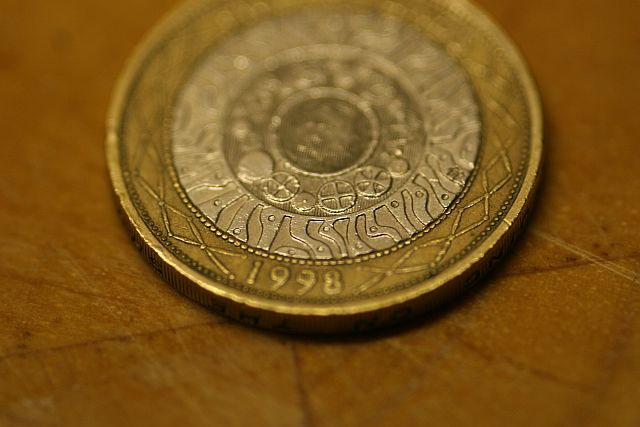
The one thing I always hated about the initial design for the bimetallic £2 coin was – and this is the nerdiest thing in the world with which to take issue – the fact that it had a
ring of 19 cogs to represent British industry. But if you connect a circuit of an odd number of cogs… it won’t function. Great metaphor, there. Photo
courtesy of the late Andy Fogg, used under a Creative Commons license.
2023
As the cost of living rapidly increased circa 2023, the average price of a pint of beer in the UK finally got to the point where, rounded to the nearest whole pound, it was closer to £5
than it is to £44.
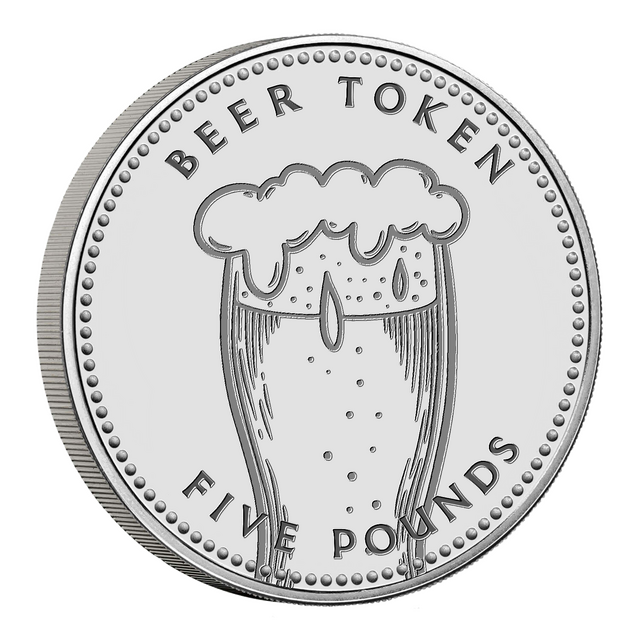
And while we could moan and complain about how much things cost nowadays, I’d prefer to see this as an opportunity. An opportunity for a new beer token: a general-release
of the £5 coin. We already some defined characteristics that fit: a large,
heavy coin, about twice the weight of the £2 coin, with a copper/nickel lustre and struck from engravings with thick, clear lines.
And the design basically comes up with itself. I give you… the Beer Token of the 2020s:
Wouldn’t this be much more-satisfying to give to a barman than a plasticky note or a wave of a contactless card or device?
It’s time for the beer token to return, in the form of the £5 coin. Now is the time… now is the last time, probably… before cash becomes such a rarity that little thought
is evermore given to the intersection of its design and utility. And compared to a coin that celebrates industry while simultaneously representing a disfunctional machine, this is a
coin that Brits could actually be proud of. It’s a coin that tourists would love to take home with them, creating a satisfying new level of demand for the sinking British
Pound that might, just might, prop up the economy a little, just as here at home they support those who prop up the bar.
I know there must be a politician out there who’s ready to stand up and call for this new coin. My only fear is that it’s Nigel Fucking Farage… at which point I’d be morally compelled
to reject my own proposal.
But for now, I think I’ll have another drink.
Footnotes
1 The recession of the 1970s brought high inflation that caused the price of beer to
rocket, pretty much tripling in price over the course of the decade. Probably Douglas Adams didn’t anticipate that it’d more-than-double again over the course of the 1980s
before finally slowing down somewhat… at least until tax
changes in 2003 and the aftermath of the 2022 inflation rate spike!
2 We do know that the four packets of peanuts Ford bought later were priced at 7p
each, so his tip on that transaction was a massive 1,686%: little wonder the barman suddenly started taking more-seriously Ford’s claims about the imminent end of the world!
3 There were commemorative £2 coins of a monometallic design floating around already, of
course, but – being collectible – these weren’t usually found in circulation, so I’m ignoring them.
4 Otherwise known as “two beer tokens”, of course. As in “Bloody hell, 2022, why does a
pint of draught cost two beer tokens now?”
It’s so emblematic of the moment we’re in, the Who Cares Era, where completely disposable things are shoddily produced for people to mostly ignore.
…
In the Who Cares Era, the most radical thing you can do is care.
In a moment where machines churn out mediocrity, make something yourself. Make it imperfect. Make it rough. Just make it.
At a time where the government’s uncaring boot is pressing down on all of our necks, the best way to fight back is to care. Care loudly. Tell others. Get going.
…
Smart words, well-written by Dan Sinker.
I like the fact that he correctly identifies that the “Who Cares Era” – illustrated by the bulk creation of low-effort, low-quality media, for a disheartened audience that no longer has
a reason to give a damn – isn’t about AI.
I mean… AI’s certainly not helping! AI slop dominates social media (especially in right-wing
spaces, for retrospectively-obvious reasons) and bleeds out into the mainstream. LLM-generated content, lacking even the slightest human input, is becoming painfully ubiquitous.
It’s pretty sad out there.
So while the “Who Cares Era” might be exemplified by the proliferation of AI slop… it’s much bigger than that. It’s a sociological change, tied perhaps to a growing dissatisfaction with
our governments and the increasing feeling of powerlessness to change the unjust social systems we’re locked into?
I don’t know how to fix it. I don’t even know if it’s fixable. But I agree with Dan’s argument that a great starting point is to care.
And I, for one, am going to continue to create things I care about, giving them the time and attention they deserve. And maybe if enough of us can do that, just that, then
maybe that’ll make the difference.
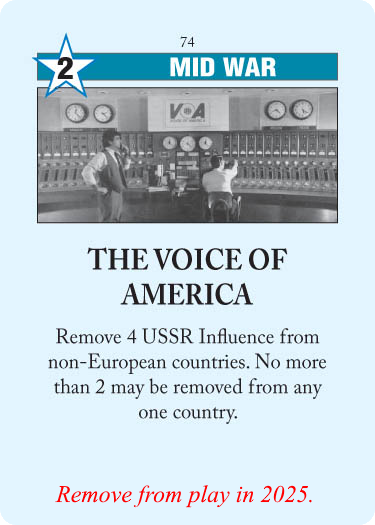
In light of Trump’s attempts to axe Voice of America, because it is, he claims,
“anti-Trump” (and because he’s so insecure that he can’t stand the thought that taxpayer dollars might go to anybody who disagrees with him in any way, for any reason), I’ve produced a
suggested update to the rules of Twilight Struggle for the inevitable 9th
printing:
I guess the Russian player gets to stretch their influence unchecked, anywhere they want, from 2025 onwards.
In the game, I mean.
Yet another blow to US soft power in order to appease the ego of convicted felon Donald Trump. Sigh.
 RSS
RSS Spotify
 Pocket Casts
 Apple Podcasts
 YouTube