Wikipedia @ 25: Lake Baikal

Duration

Podcast Version

This post is also available as a podcast. Listen here, download for later, or subscribe wherever you consume podcasts.

To celebrate the site’s 25th birthday this year, Wikipedia is encouraging/challenging people to read one Wikipedia article a day for 25 consecutive days. I felt that I could do one better than that: not only reading an article but – where I found one that was particularly interesting – to write a blog post or record a podcast episode for each of those days, sharing what I learned. For each entry, I’ll hit “random article” a few times until something catches my interest, start reading, and then start writing! Everything I’ve written below came from Wikipedia… so you should check other sources before you use it to do your homework. Happy birthday, Wikipedia!


Today’s random article: Baikal seal
Today’s topic: Lake Baikal

The Baikal seal is a species of “earless” seal that lives exclusively in Lake Baikal in Siberia. It’s one of only a tiny number of species of seal that spends its life only in freshwater: others, like the much more-widespread harbour seal (that I’ve occasionally seen around the UK), for example, can and will swim up rivers to hunt but mostly live in saltwater. But not the Baikal seal.

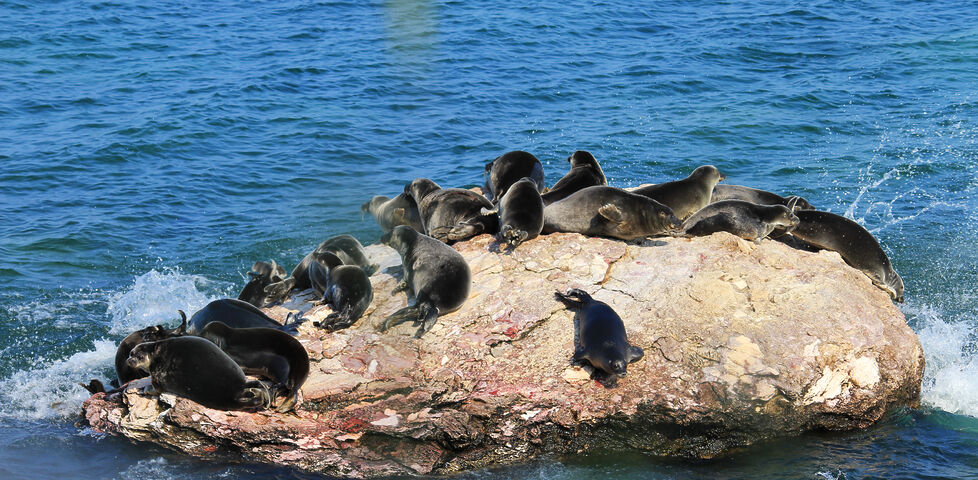
A group of Baikal seals bask on a rock.
These Baikal seals are just chilling on a rock near the Ushkan Islands. Photograph courtesy Nina Zhavoronkova, used under a Creative Commons license.

The Baikal seal is confined just to this one lake. Which sounds like a small area until you realise quite how large Lake Baikal is. The seventh-largest lake in the world, Lake Baikal is just a little larger than Belgium, but that really doesn’t do justice to its true volume, because it also happens to be the deepest lake in the world. It’s so deep that a fifth to a quarter of all the surface freshwater in the world is found in this one lake.

If you count frozen water in the ice caps and glaciers too, then Lake Baikal still contains about fifth of all the fresh water on Earth. That’s just amazing.

It’s quite so deep because it’s a rift lake: it sits close to the boundary between the Eurasian and Amur tectonic plates, which are shearing away from one another. For the same reason, there are volcanic hot springs deep in the lake (although the lake itself is so massive that they have no measurable effect on its overall temperature). There’s a lot of not-fully-understood geology going on in the region, despite active research going back over a century.

Clear water over a pebblebed.
The clarity of the water in the lake is also noteworthy, getting up to 40m of visibility in the winter. Photo courtesy Xchgall, used under a Creative Commons license.

The Baikal seal isn’t the only species unique to the lake. It’s also home to a kind of fish called the omul, a salmon-like fish that’s long been part of the cuisine of the area.

It’s used to make raskolotka (known as stroganina elsewhere in Russia): thin slices of the meat cut almost to the entire length of the fish’s body and served as frozen curls. The particular shape of a traditional skinning Yakutian knife, which is sharpened to a curve on one-side and left flat on the other, is especially suited to this task, apparently:

Slices of a large fish being whittled off with a traditional knife.
You can see how the shape of the knife is particularly suited to making these long, thin strips. Photo courtesy Cholbon, used under a Creative Commons license.

Lake Baikal also hosts the Baikal Deep Underwater Neutrino Telescope, whose acronym BDUNT makes me think of bundt cakes. Which – Wikipedia tells me – nobody’s certain of the etymology of!

Anyway, the neutrino telescope is an SK-variety neutrino detector, spotting neutrinos zipping through the Earth when they just-ocassionally interact with the water, resulting in the creation of a high-energy electron or muon and the resulting short burst of Cherenkov radiation. Operated from the surface of the winter ice, the experiment aims to search for evidence of relic dark matter in the sun, among other astronomical phenomena.

Scientists work around cranes atop a frozen lake.
I wonder what impact all the fish and seals have on the detection equipment? Photo courtesy Bair Shaybonov, used under a Creative Commons license.

It’s all interesting, but if there’s one thing I’ll take away from this daily deep-dive into a random Wikipedia topic, it’s this photo of a cute young Baikal seal:

A young seal with large eyes lies on its belly on an ice sheet.
Those big eyes! 😍 Photo courtesy Per Harald Olsen, used under a Creative Commons license.

I wonder what tomorrow’s random Wikipedia article will bring me! If it’s interesting, I’ll share it with you!

The next time we want to import a horse to Russia it will be a doddle

This is a repost promoting content originally published elsewhere. See more things Dan's reposted.

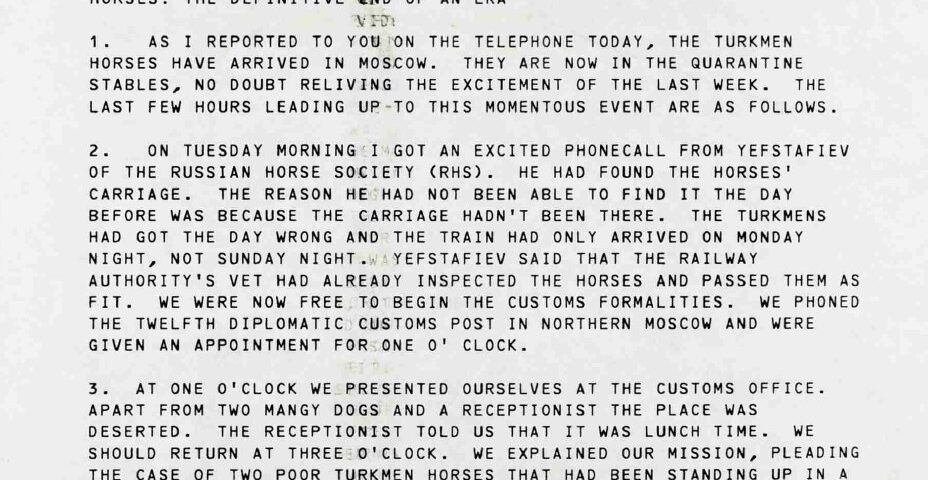
This is the best diplomatic report I’ve read in a long time. A real gem. Recounts the story of the horses gifted by Saparmurat Niyazov (Turkmenbashi) to the British government. A fantastic snapshot of life in the FSU in the early 1990s. Posting the whole thing – enjoy the read.

Telegram page 1.Telegram page 2Telegram page 3Telegram page 4

Also worth seeing: (then Prime Minister) John Major’s official response.

×

The last Soviet citizen: The cosmonaut who was left behind in space – Russia Beyond

This is a repost promoting content originally published elsewhere. See more things Dan's reposted.

Alexander Mokletsov/Sputnik

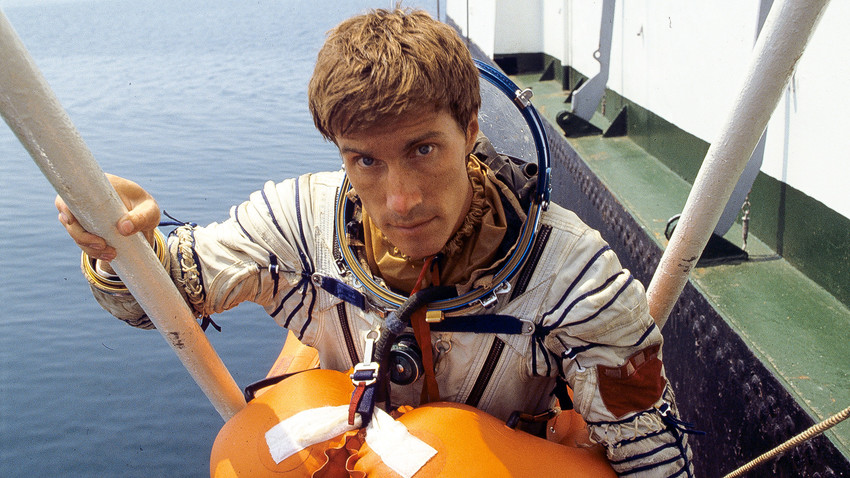
Sergei Krikalev was in space when the Soviet Union collapsed. Unable to come home, he wound up spending two times longer than originally planned in orbit. They simply refused to bring him back.

While tanks were rolling through Moscow’s Red Square, people built barricades on bridges, Mikhail Gorbachev and the Soviet Union went the way of history, Sergei Krikalev was in space. 350 km away from Earth, the Mir space station was his temporary home.

He was nicknamed “the last citizen of the USSR.” When the Soviet Union broke apart into 15 separate states in 1991, Krikalev was told that he could not return home because the country that had promised to bring him back home no longer existed.

How Russia’s Hilarious, Homoerotic “Satisfaction” Became a Nationwide Meme of Solidarity

This is a repost promoting content originally published elsewhere. See more things Dan's reposted.

How Russia’s Hilarious, Homoerotic “Satisfaction” Became a Nationwide Meme of Solidarity (The New Yorker)

Masha Gessen writes about a series of recent recent Russian parody videos, started by air-transport cadets as a spoof of the music video for “Satisfaction,” by Benny Benassi, from 2002.

A few weeks ago, fourteen Russian first-year air-transport cadets made a parody of a fifteen-year-old music clip, and now it’s all a lot of Russians can talk about. This is a story of spontaneous solidarity, self-organization, and, ultimately, just possibly, the triumph of freedom over bureaucracy.

The original clip, set to the 2002 track “Satisfaction,” by the Italian d.j. Benny Benassi, is itself a parody: of music videos, erotica, and advertising. It features a series of scantily clad young women working with tools, starting with a hammer and graduating to a masonry drill, a belt sander, and an angle grinder. The screen features names and technical descriptions of the tools while the women pose with their bodies contorted and their mouths open, as though they were in a Victoria’s Secret catalogue. In their parody, the air-transport cadets used an all-male cast, the interior of a well-worn student dorm, and the kinds of tools that are found there: a broom, a clothes iron, a spray jar of glass cleaner. Mostly, though, they used their own very young bodies, dressed in underwear, with belts, neckties, and military caps arranged in apparent homage to Tom of Finland.

Diary

This is a repost promoting content originally published elsewhere. See more things Dan's reposted.

The time capsule was buried in a secluded square in Murmansk in 1967 on the eve of the fiftieth anniversary of the Russian Revolution. Inside was a message dedicated to the citizens of the Communist future. At short notice, the authorities brought forward the capsule’s exhumation by ten days, to coincide with the city’s 101st birthday. With the stroke of an official’s pen, a mid-century Soviet relic was enlisted to honour one of the last acts of Tsar (now Saint) Nicholas II, who founded my hometown in October 1916. From socialism to monarchism in ten days. Some of the city’s pensioners accused the local government of trying to suppress the sacred memory of the revolution. ‘Our forefathers would be turning in their graves,’ one woman wrote in a letter to the local paper. The time capsule ‘is not some kind of birthday present to the city; it’s a reminder of the centenary of the great October Revolution and its human cost.’

My father had watched the time capsule being buried. He came to Murmansk aged 17. From his remote village, he had dreamed of the sea but he failed the navy’s eye test. In October 1967, he was a second-year student at the Higher Marine Engineering Academy, an elite training school for the Soviet Union’s massive fishing fleet. As a year-round warm water port, Murmansk – the largest human settlement above the Arctic Circle – is a major fishing and shipping hub, home to the world’s only fleet of nuclear-powered ice-breakers…

The Man Who Knew Too Much

This is a repost promoting content originally published elsewhere. See more things Dan's reposted.

His nuclear research helped a judge determine that former Russian spy Alexander Litvinenko had been assassinated – likely on Putin’s orders. Just months after the verdict, the scientist himself was found stabbed to death with two knives. Police deemed it a suicide, but US intelligence officials suspect it was murder…