Just want to know how to ‘fix’ Steam’s password field? Scroll down to “How to Fix It”
Steam & Security Theatre
You’re a smart guy. You’re not stupid about computer security. And that’s why you always make sure that you use a different password for every service you use, right? You might even use a different password for every account, even when you have different passwords on the same service. You know that there are really, really good reasons why it’s simply not good enough to, for example, have “high-security”, “general use” and “low security” passwords, and re-use each of them in several places. And if you don’t know that: well, take my word for it and I’ll explain it in detail later.
It’s no great hardship to have lots of long, complex, effectively-random passwords, these days. Tools like SuperGenPass, LastPass, and KeePass, among others, mean that nowadays it’s so easy to use a different password for every
service that there’s no excuse not to. So you probably use one of those (or something similar), and everything’s great.
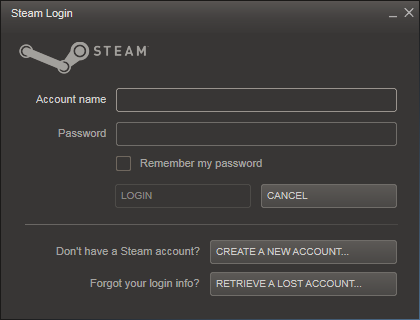 Except for that one
application – Steam. I have Steam save my password on my desktop PC (by the time somebody steals my
desktop PC and breaks into the encrypted partition on which my data files lie, I have bigger problems than somebody stealing my Just Cause 2 achievements), but it forgets the password every time that Ruth uses her Steam account on my computer. No problem, I think: I can easily copy-paste it from my password
manager… nope: Steam won’t let you paste in to the password field.
Except for that one
application – Steam. I have Steam save my password on my desktop PC (by the time somebody steals my
desktop PC and breaks into the encrypted partition on which my data files lie, I have bigger problems than somebody stealing my Just Cause 2 achievements), but it forgets the password every time that Ruth uses her Steam account on my computer. No problem, I think: I can easily copy-paste it from my password
manager… nope: Steam won’t let you paste in to the password field.
What? If you ask Valve (Steam’s creators) about this, they’ll say that it’s a security feature, but that’s bullshit: it’s security theatre, at best. And at worst, it means that people like me are inclined to use less-secure passwords because it’s harder to memorize and to type out that a more-secure password would be.
How to Fix It
Well, obviously the best way to fix it would be to successfully persuade Valve that they’re being stupid: others are already trying that. But what would be nice in the meantime would be a workaround. So here is is:
- Edit
Program FilesSteamPublicSteamLoginDialog.res(Program FilesSteamPublicSteamLoginDialog.reson 64-bit Windows, somewhere else entirely on a Mac) using your favourite text editor (or Notepad if you don’t have a favourite). Take a backup of the file if you’re worried you’ll break it. - In the
"PasswordEdit"section (starting at about line 42), you’ll see name/value pairs. Make sure that the following values are set thusly:
-
"tabPosition" "1" -
"textHidden" "0" -
style="TextEntry"
The next time you load Steam, you’ll be able to paste passwords into the password field. The passwords won’t be masked (i.e. you’ll see the actual passwords, rather than asterisks), but the dialog never loads with a password pre-populated anyway, so as long as you make sure that nobody’s looking over your shoulder while you type, you’re set!
Update: let’s face it, Valve’s security policies suck in other ways, too. Please read the tale of a friend-of-a-friend who’s desperate to change her Steam username.
Forcing people to have deliveries sent to their registered address cuts down on card fraud, which is moderately freqent at mail order computer hardware stores on account of the high value, discreetness, and availability of the goods. It’s not possible to accurately perform such checks on credit cards, but it’s easy to with debit cards.
Many banks give special dispensation on their student accounts; allowing them to – for example – submit two addresses which they will automatically switch between throughout the year – or allow two registered addresses to function for card checks (while still delivering the statements to one). Ask your bank if they can do this, and, if they can’t, write a letter to inform them that there are banks that can. If you’re not willing to let your feet do the talking, there’s no way to let these large organisations listen to you.
There’s no reason not to own a credit card unless you feel you cannot trust yourself to do so – or the banks won’t give you one! For many such cards, there is no interest if you pay them off immediately each month (which can be automated thanks to wonderful schemes like Direct Debit): this increases the flexibility of your purchasing power (particularly when purchasing from overseas) without costing you a penny. On a side note, owning one that you only ever use in this fashion increases your credit rating (which is checked when buying a contract mobile phone, getting a mortgage, applying for credit on a car, or whatever). Just for examples’ sake; if you owned an unused credit card, you could have ordered these computer parts and – odds are – immediately transferred the money from the bank account to the card, thereby giving you the bits sooner.
All of that said, I think I’ve quite aptly (and almost entirely) undermined the sense in preventing expensive goods being delivered only to the registered cardholder’s address, because as we’ve just seen there’s always a way to circumvent such checks by routing the money other ways: this leaves a longer paper-trail (banks and credit companies are, by law, required to keep better records for longer than companies that happen to process card transactions), but is otherwise a sensible way to commit fraud without triggering the little alarm bells that debit cards have hanging from them. So yeah; perhaps Scan should be a little less draconian.
Now Chip-And-PIN in the UK: there’s a flawed, insecure, badly-implemented system.