The other Three Ringers and I are working hard to wrap up Milestone:
Jethrik, the latest version of the software. I was optimising some of the older volunteer availability-management code when, by coincidence, I noticed this new bug:
Well, at least she’s being rational about it.
I suppose it’s true: Lucy (who’s an imaginary piece of test data) will celebrate her birthday in 13/1 days. Or 13.0 days, if you prefer. But most humans seem to be happier
with their periods of time not expressed as top-heavy fractions, for some reason, so I suppose we’d better fix that one.
They’re busy days for Three Rings, right now, as we’re also making arrangements for our 10th
Birthday Conference, next month. Between my Three Rings work, a busy stretch at my day job, voluntary work at Oxford Friend, yet-more-executor-stuff, and three different courses, I don’t have much time for anything else!
But I’m still alive, and I’m sure I’ll have more to say about all of the things I’ve been getting up to sometime. Maybe at half term. Or Christmas!
Those of you who’ve been following Three Rings over the last decade (either
because you’ve volunteered somewhere that used it, or because you’ve listened to me rave about it over the years) might be interested in this new post on the Three Rings blog. It’s about how Three Rings has evolved
over the last 10+ years of its life from a tiny system designed specifically for the needs of Aberystwyth
Nightline into the super-powerful charity management tool that it is today, and how it’ll continue to evolve to meet the needs of the helplines and other charities that use it
for the next ten years.
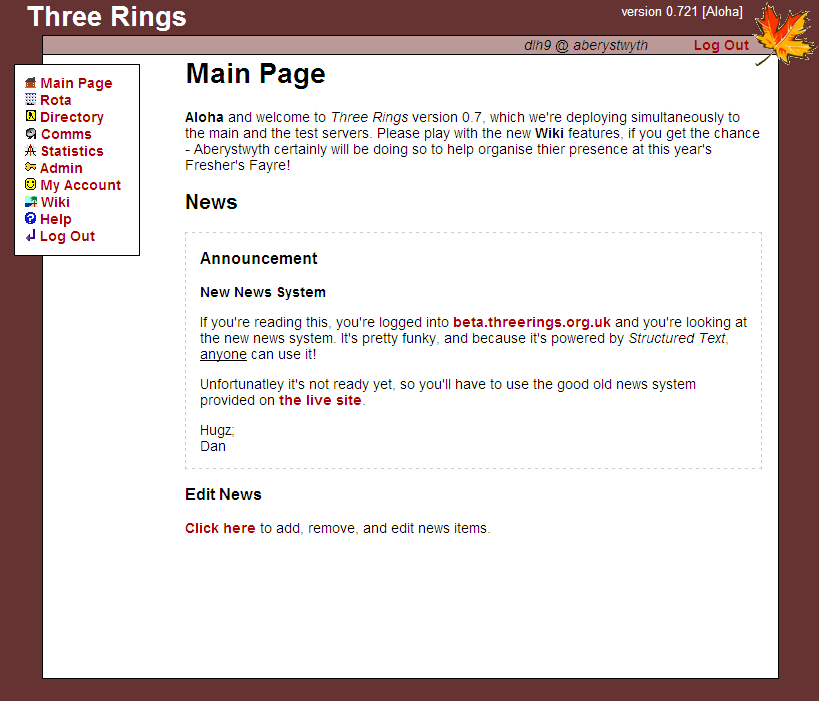
Three Rings as it appeared about seven years ago. Do you remember this?
It still blows my mind that something that began as a bedroom project has come to support over 13,000 volunteers around the UK, Ireland, and further afield (we’ve recently been getting
started with supporting Samaritans branches in New Zealand and Australia). Now, of course, Three Rings is a volunteer-driven company with a “core” team of half a dozen or so… as well as
tens of others who help with testing. It’s eaten tens of thousands of development hours and it’s become bigger and more-important than I’d ever dreamed. Of all of the volunteer work
I’ve been involved with, it’s easily the one that’s helped the most people and had the biggest impact upon the world, and it still excites me to be part of something so huge.
As a trainee counsellor, I’ve had plenty of opportunity of late for
self-analysis and reflection. Sometimes revelations come at unexpected times, as I discovered recently.
A counselling session in progress.
I was playing the part of a client in a role-play scenario for another student on my course when I was struck by a realisation that I didn’t feel that my “counsellor” was able to
provide an effective and empathetic response to the particular situations I was describing. It didn’t take me long to spot that the reason I felt this way was her age. Probably the
youngest in our class – of whose span of ages I probably sit firmly in the middle – her technical skill is perfectly good, and she’s clearly an intelligent and emotionally-smart young
woman… but somehow, I didn’t feel like she would be able to effectively support me.
And this turned out to be somewhat true: the session ended somewhat-satisfactorily, but there were clear moments during which I didn’t feel that a rapport had been established.
Afterwards, I found myself wondering: how much of this result was caused by her approach to listening to me… and how much was caused by my perception of how she would
approach listening to me? Of the barriers that lay between us, which had I erected?
Since then, I’ve spent a little time trying to get to the bottom of this observation about myself, asking: from where does my assumption stem that age can always be associated
with an empathic response? A few obvious answers stand out: for a start, there’s the fact that there probably is such a trend, in general (although it’s still
unfair to make the outright assumption that it will apply in any particular case, especially with somebody whose training should counteract that trend). Furthermore, there’s the
assumption that one’s own experience is representative: I know very well that at 18 years old, my personal empathic response was very weak, and so there’s the risk that I project that
onto other young adults.
However, the most-interesting source for this prejudice, that I’ve found, has been Nightline training.
The Nightline Association, umbrella body representing student Nightlines around the UK and overseas
Many years ago, I was a volunteer at Aberystwyth Nightline. I worked there for quite a while, and even after
I’d graduated and moved on, I would periodically go back to help out with training sessions, imparting some of what I’d learned to a new generation of student listeners.
As I did this, a strange phenomenon began to occur: every time I went back, the trainees got younger and younger. Now of course this isn’t true – it’s just that I was older
each time – but it was a convincing illusion. A second thing happened, too: every time I went back, the natural aptitude of the trainees, for the work, seemed to be less
fine-tuned than it had the time before. Again, this was just a convincing illusion: through my ongoing personal development and my work with Samaritans, Oxford Friend, and others, I was always learning new skills to apply to helping
relationships, but each new batch of trainees was just getting off to a fresh start.
This combination of illusions is partly responsible for the idea, in my mind, that “younger = less good a listener”: for many years, I’ve kept seeing people who are younger and younger
(actually just younger than me, by more) and who have had less and less listening experience (actually just less experience relative to me, increasingly). It’s completely false, but
it’s the kind of illusion that nibbles at the corners of your brain, if you’ll let it.
Practicing good self-awareness helps counsellors to find the sources of their own prejudices and challenge them. But it’s not always easy, and sometimes the realisations come when you
least expect them.
I mentioned back in October that I’ve returned to education
and am now studying counselling, part-time. I thought I’d share with you an update on how that’s going.
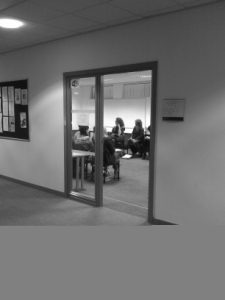
The classroom at Aylesbury College where the practical parts (and some of the theory) of my course are taught.
The short answer: it’s going well.
I’m finding myself challenged in fun and new ways, despite my
volunteering experience, which has included no small amount of work on emotional support helplines of one kind of another. For example, we’ve on two occasions now done role-play
sessions in which the “helper” (the person acting in the role of a counsellor) has been required to not ask any questions to the “helpee” (their client). Depending on your
theoretical orientation and your background, that’s either a moderately challenging or a very challenging thing – sort of like the opposite of a game of Questions, but with the added challenge
that you’re trying to pay attention to what the other participant is actually saying, rather than thinking “Don’t ask a question; don’t ask a question; don’t ask a
question…” the whole damn time.
It’s an enjoyable exercise, and works really well to help focus on sometimes-underused skills like paraphrasing and summarising, as well as of course giving you plenty of opportunity to
simply listen, attend to the helpee, and practice your empathic response. The first time I did it I was noticed (by my observer) to be visibly uncomfortable, almost “itching to ask
something”, but by the second occasion, I’d cracked it. It’s like climbing with one arm tied behind your back! But as you’d expect of such an exercise, it leaves you with far more care,
and control… and one enormous muscular arm!
Amidst all of the “fluffy” assessment, I was pleased this semester to be able to cut my teeth on some theoretical stuff, as a break. The practical side is good, but I do enjoy the
chance to get deep into some theory once in a while, and my reading list has spiraled out of control as each thing I read leads me to find two other titles that I’d probably enjoy
getting into next. I’ve recently been reading Living with ‘The Gloria Films’: A Daughter’s Memory, by Pamela J Burry, whose existence in itself takes a
little explanation:
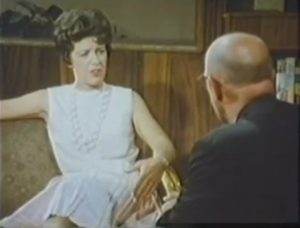
Gloria with Carl Rogers, from the film "Three Approaches to Psychotherapy"
In 1964, three psychotherapists walked into a bar. They were Carl
Rogers, Albert Ellis and Fritz Perls. They had a few drinks, and then they had an argument about
whose approach to psychotherapy was the best.
“I respect you both deeply,” began Perls, “But surely it is clear to see that your rejection of Gestalt therapy is rooted in your attempts to pretend to be accepting of it. It is clearly the superior approach.”
“You don’t need to get emotional over this,” said Ellis, “Let’s just go back and find the event that first inspired your prejudice against my rational emotive therapy, and re-examine it: there
should be no doubt that it is the best way to treat disorders.”
“It feels like you’re being quite cold to one another,” said Rogers, father of the humanistic approach, after a moment’s pause. “I wonder what we could do to explore this disagreement that we’re having… and perhaps
come to an answer that feels right to us all?”
And so the three agreed to a test: they would find a subject who was willing to undergo a single therapy session from all three of them, and then it’d be clear who was the winner.
They’d film the whole thing, to make sure that there could be no denying the relative successes of each approach. And the losers would each pay for all of the winner’s drinks the next
time they went out to the Rat And Bang, their local pub.
Albert Ellis wraps up at the end of his section of "Three Approaches to Psychotherapy".
Now that story is complete bullshit, but it’s far more-amusing than any true explanation as to why these three leading counsellors were filmed, each in turn, talking to a client by the
name of Gloria – a 30-year-old divorced mother of three concerned with being a good parent and how she presents herself to men. I’ll leave you to find and watch the films for yourself
if you want: they’re all available on video sharing sites around the web, and I’d particularly recommend Carl Rogers’ videos if you’re looking for something that almost
everybody will find quite watchable.
Gloria died fifteen years later, but her daughter “Pammy” (whose question about sex, when she was nine years old, gave so much material to Gloria’s session with Carl Rogers) wrote a
biography of their lives together, which was published in 2008. The focus of “The Gloria Films” was on the therapeutic methodologies of the practitioners, of course. But Gloria herself
was intelligent and compelling, and I was genuinely interested to get “the rest of the story” after she left that film studio (made up to look like a psychotherapist’s office) and got
on with her life.
Hence the book.
And so hence, my example of how I keep reading (or in this case watching) things, which lead me to find more things to read, which in turn give me yet more things to read.
Since last year, I’ve been volunteering at a helpline called Oxford Friend, providing emotional support
and information to the LGBT community in Oxfordshire (those who are aware of my volunteering background are unlikely
to find this surprising). More-recently, though, I became a trustee of that charity, and that’s what I thought I’d tell you about.
Every helpline and similar service I’ve volunteered with has had it’s… quirks. They’ve all
got their own unique personality and identity, their own strange policies and practices, and Oxford Friend is no exception. One thing that I always found unusual about them – and still
do – is the peculiar way they differentiate between trainee and “full” members: once they’re done as a trainee and become a full member, volunteers become trustees of the charity.
At first, this seemed like a lot of paperwork with little benefit, but the idea has grown on me a little. By becoming a trustee, you’re becoming responsible for (and liable for!) the
actions of the charity, which should encourage one to have it’s best interests at heart (as if that were ever a concern!). It fosters a sense of ongoing shared responsibility, making a
charity that’s less like a corporation and more like a co-operative.
It’s only feasible, I think, because the charity is so small: a few dozen volunteers collectively running a helpline, email service, and providing external outreach and training on LGBT
issues. It’s a very communal approach to the management of the operation of the charity, and it seems to work perfectly well: they’ve been running for 30 years now! But I
don’t think it would work for a larger charity like either of the Samaritans branches I’ve worked with.
I’ll be interested to see if the addition of my unusual name to the record at the Charity Commission goes to plan (Companies House always seem to have difficulty with it!). But
regardless: for now, I’m proud to be able to support Oxford Friend and the remarkably valuable work that they do.
On this day in 2003 I first juggled with flaming
clubs! But first, let’s back up to when I very first learned to juggle. One night, back in about 1998, I had a dream. And in that dream, I could juggle.
I’d always been a big believer in following my dreams, sometimes in a quite literal sense: once I dreamed that I’d been writing a Perl computer program to calculate the frequency pattern of consecutive months which both have a Friday 13th in them. Upon
waking, I quickly typed out what I could remember of the code, and it worked, so it turns out that I really can claim to be able to program in my sleep.
In this case, though, I got up and tried to juggle… and couldn’t! So, in order that nobody could ever accuse me of not “following my dreams,” I opted to learn!
About three hours later, my mother received a phone call from me.
“Help!” I said, “I think I’m going to die of vitamin C poisoning! How much do I have to have before it becomes fatal?”
“What?” she asked, “What’s happened?”
“Well: you know how I’m a big believer in following my dreams.”
“Yeah,” she said, sighing.
“Well… I dreamed that I could juggle, so I’ve spent all morning trying to learn how to. But I’m not very good at it.”
“Okay… but what’s that got to do with vitamin C?”
“Well: I don’t own any juggling balls, so I tried to find something to use as a substitute. The only thing I could find was this sack of oranges.”
“I think I can see where you’re going wrong,” she said, sarcastically, “You’re supposed to juggle with your hands, Dan… not with your mouth.”
“I am juggling with my hands! Well; trying to, anyway. But I’m not very good. So I keep dropping the oranges. And after a few drops they start to rupture and burst, and I can’t
stand to waste them, so I eat them. I’ve eaten quite a lot of oranges, now, and I’m starting to feel sick.”
I wasn’t overdosing on vitamin C, it turns out – that takes a quite monumental dose; perhaps more than can be orally ingested in naturally-occuring forms – but was simply
suffering from indigestion brought on as a result of eating lots and lots of oranges, and bending over repeatedly to pick up dropped balls. My mother, who had herself learned to juggle
when she was young, was able to give me two valuable tips to get me started:
Balled-up thick socks make for great getting-started juggling balls. They bounce, don’t leak juice, and are of a sensible size (if a little light) for a beginning juggler.
Standing with your knees against the side of a bed means that you don’t have to bend over so far to pick up your balls when you inevitably drop them.
I became a perfectly competent juggler quite quickly, and made a pest of myself in many a supermarket, juggling the produce.
So: fast forward five years to 2003, when Kit, Claire, Paul, Bryn and I decided to have a fire on the beach, at Aberystwyth. We’d… acquired… a large solid
wooden desk and some pallets, and we set them up and ignited them and lounged around drinking beer. After a little while, a young couple came along: she was swinging flaming poi around, and he was juggling flaming clubs!
Fire poi! They look fantastic when they're flying around you; scary when they're flying towards you.
I asked if I could have a go with his flaming clubs. “Have you ever juggled flaming clubs before?” he asked. “I’ve never even juggled clubs before,” I
replied. He offered to extinguish them for me, first, but I insisted on the “full experience.” I’d learn faster if there existed the threat of excruciating pain every time I fucked up,
surely. Right?
Juggling clubs, it turns out, is a little harder than juggling balls. Flaming clubs, even more so, because you really can’t get away with touching the “wrong” end. Flaming
clubs at night, after a few drinks, is particularly foolhardy, because all you can see is the flaming end, and you have to work backwards in your mind to interpret
where the “catching end” of the stick must be, based on the movement of the burning bit. In short: I got a few minor singes.
But I went home that night with the fire still burning in my eyes, like a spark in my mind. I couldn’t stop talking about it: I’d been bitten by the flaming-clubs-bug.
Looking Forward
I ordered myself a set of flaming clubs as soon as I could
justify the cost, and, after a couple of unlit attempts in the street outside my house, took them to our next beach party a few days later. That’s when I learned what really makes flaming clubs dangerous: it’s
not the bit that’s on fire, but the aluminium rod that connects the wick to the handle. Touching the flaming wick; well – that’ll singe a little, but it won’t leave a burn so long as
you pull away quickly. But after they’ve been lit for a while – even if they’ve since been put out – touching the alumium pole will easily leave a nasty blister.
Me juggling flaming clubs at the barbecue I mentioned, in 2007. I almost look like I know what I'm doing. And more importantly, I feel like a badass.
Still: I learned quickly, and was still regularly flinging them around (and teaching others) at barbecues many years later.
Once, a Nightline training ended up being held at an unusual location, and the other trainers and I were
concerned that the trainees might not be able to find it. So we advertised on the email with the directions to the training room that trainees who can’t find it should “introduce
themselves to the man juggling fire outside the students union”, who would point them in the right direction: and so I stood there, throwing clubs around, looking for lost people all
morning. Which would have worked fine if it weren’t for the fact that I got an audience, and it became quite hard to discreetly pick out the Nightline trainees from the
students who were just being amused by my juggling antics.
Nowadays, I don’t find much time for juggling. I keep my balls to-hand (so to speak) and sometimes toss them about while I’m waiting for my computer to catch up with me, but it’s been a
long while since I got my clubs out and lit them up. Maybe I’ll find an excuse sometime soon.
This blog post is part of the On This Day series, in which Dan periodically looks back on years gone
by.
Despite all the fun last night brought, the alcohol evidently went to my head somewhat and I had a particularly awful nightmare. I dreamt
that, later this month (on the 29th, in fact), Claire dies of a terminal illness. I don’t remember much of it; only that we were
making preparations for Halloween when she died (we were buying face paint in a shop not unlike a cross between Stars [strange ‘alternative’ goodies in Aberystwyth] and the Post Office
around the corner from my Dad’s house [as I remember it as a kid]).
Fucking frightening. Not a good start to the day.
Right – a few more things to do at work, then I’m off to help talk to some Freshers about volunteer work.
[this post was lost during a server failure on Sunday 11th July 2004]
[an image in this post was recovered on Thursday 30th December 2004]
Here’s some photos of my trip to Malawi, as the group have now started uploading photos to me at last!
Dan looks down on Lake Malawi.
Dan on the descent.
Two baboons, at Vwasa National Park.
Livingstonia Hospital: This woman and her baby have both been diagnosed with AIDS
Thanks to ARVs, the woman’s condition is improving. Her baby cannot be treated and will die.
Beautiful waterfall, on a river running from Livingstonia to Lake Malawi.
Will post more when I can be bothered. Meanwhile, photos are continuously being uploaded to Scatmania’s Malawi Album[update: link killed 2006]
I’ve registered for modules this year which better than last year reflect my individual interests within my field – an emphasis on telecommunications and the internet and on software
engineering practice, and away from artificial intelligence and from hardware-layer stuff. Some of my new modules – many of which were not available as courses last year – look quite
stimulating.
As the end of the week approached I helped Nightline to lay their new carpet – the benefit to the organisation that the money we raised by selling
hot dogs – in their office. This involved first removing their old carpet, laying it out on the road, and using it as a stencil for the new one, such that the new one fit almost exactly
before we began to stick it down (an important consideration when laying flooring in a room no larger than 11 by 11 feet). I made hats for us all out of the offcuts of the carpet and
masking tape.
Saturday Night’s Troma Night saw Liz bringing a date along, Rob (or was it Bob?), who we managed to scare off before the opening credits of the
first film had finished rolling or any pizza had been consumed. Apparently all is well, though.
Aberystwyth’s first sex shop, part of the Little Amsterdam chain, is due for it’s delayed opening on Wednesday. I’m arranging for a party
to go and visit on it’s opening day to applaud it on it’s success over the efforts of many members of the council, and for it’s manager’s success so far in court in another (possibly related) case.
Update: 25 October 2017 – fixed a minor spelling mistake.
I learn today that the funding may be cut *again* to the Nightline here is Aberystwyth. I don’t care what the reasoning is – cutting the funding anymore is plain dangerous.
Its lie after lie in the Union. I have seen little in five long years that has actually impressed me about the way it operates or the people involved (bar a few notable
exceptions). Its a lie and an illusion to sit and pretend that cutting all budgets evenly is fair. Its actually lazy. That’s all – its the simplest “no brainer” approach to
finance ever. I mean look at it another way – would a company do that? I know some have – but clever ones do not. They look where the money is being spent, and they look toward
efficiencies. They also look for people who are misusing, under-using or inappropriately / inefficiently using their funds. You don’t simply hack money from everyone and expect
them to cope.
Until now we have simply been a soft target. Time and time again they have cut our funds and received nothing but us working harder and harder to make ends meet. We have ended up
funding things ourselves, supplying our own resources or equipment. This has to stop here and now. We are going to have to fight and push this back. The tide needs stopping here
and now – as else we are simply not going to exist anymore.
Words are easy, action more difficult – but we have a load of strengths the union hasn’t got. We need to persuade them to cut somewhere else instead of us – yes its that bad, but
I am afraid I see an even straight line cut as being an insult to the 2600 hours of open time (let alone meeting and organisational time) we put in. No other club and society is
open *anything* like that long, or does anything for every other student.
I am bloody annoyed.
Current Mood:infuriated
Current Music: My fishtank filtration units
From my understanding, Nightline provides a listening ear to every student at the university for at least 12 hours, every night during termtime, run entirely by volunteer students – the
money is spent on such necessities as a phone bill and publicity materials. No other student-run organisation on campus: the sports teams, the clubs and societies, etc., provides a
service which is accessible to all, and saves lives. It’s outrageous that the Union don’t see the importance of things like this until they’re gone.
Cool And Interesting Thing Of The Day To Do At The University Of Wales, Aberystwyth, #27:
(1) What with being excessivley busy, and a network failure last weekend, fail to get out a “Cool Things”. Feel the need to apologise to everybody (SORRY!), and give them three “Cool
Things” to help make up for it.
(2) Be elected Communications Officer for a confidential telephone listening and advice service.
(3) Take your first exam. Gulp. Still – 20 questions, and only 36% required to pass. From the results of people in my class who’ve done it earlier this week, marks range from 30% –>
80%. Remain confident. My result is out on Monday.
The ‘cool and interesting things’ were originally published to a location at which my “friends back home” could read them, during the first few months of my time at the University
of Wales, Aberystwyth, which I started in September 1999. It proved to be particularly popular, and so now it is immortalised through the medium of my weblog.








 infuriated