
When my house flooded 149 days ago, a lot of things were damaged. The oak floors, for one, were completely wrecked, as the ground floor electrical ring, the skirting boards, one internal wall, a few hundred books and small items, and a load of furniture. Since then we've lived in a few places - but mostly at the "Chicory House" - while the insurance company has been working on repairing and replacing everything that we've lost.
This week, we got back the piano.
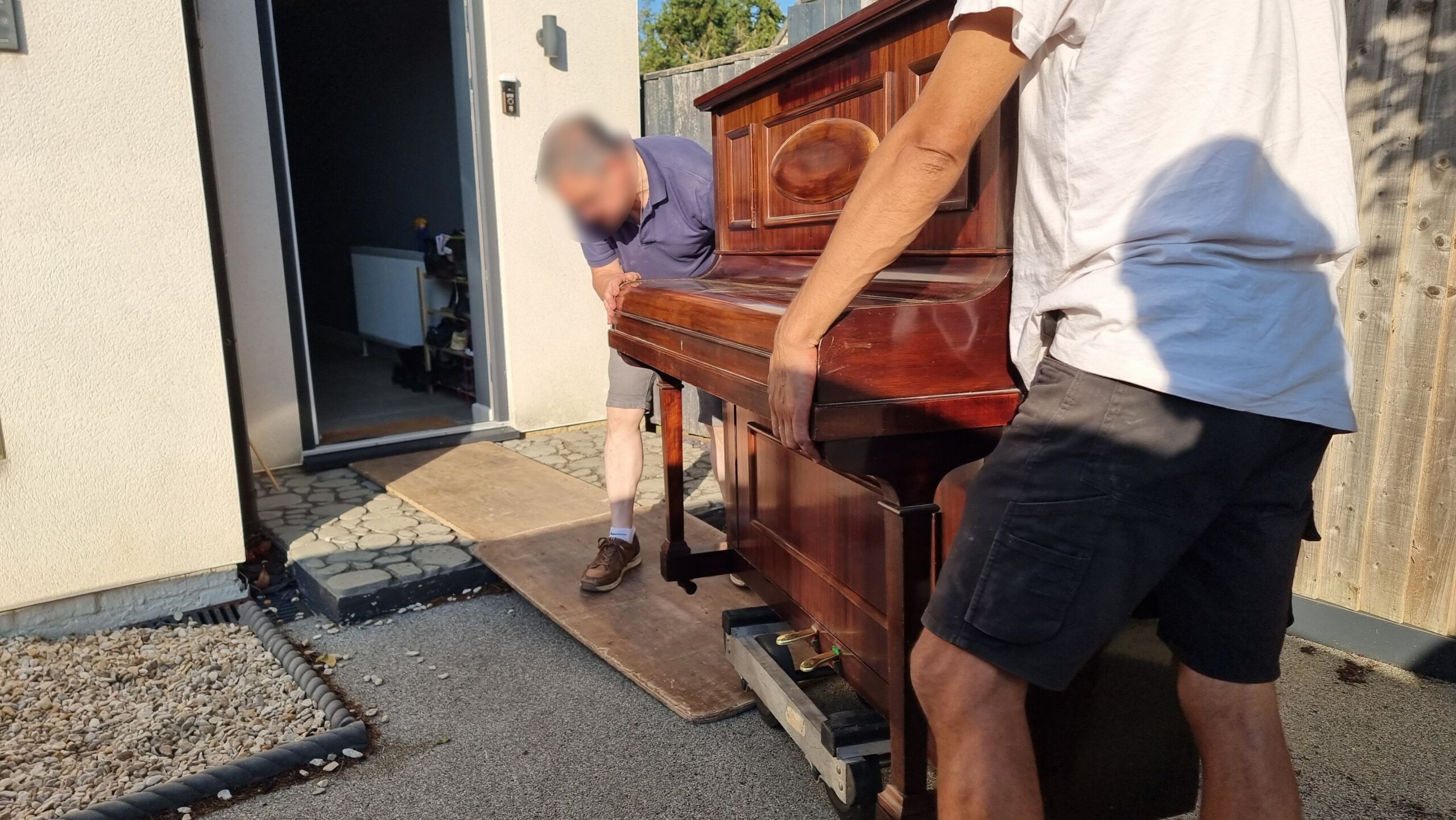
Alt
Two men move an upright piano across a driveway and through a door, with the help of a small trolley and some boards.
Our insurance policy is "new for old", but we own a handful of pieces of furniture whether it's impractical or impossible to replace them like-for-like and we've instead petitioned for restoration. For example: our dining table is a bit of a family heirloom, a mahogany reading room desk formerly from the libraries of the University of Cambridge, adapted by Ruth's (carpenter) father into a dining table1.
Another example turns out to be our upright piano, which turns out to be a bit of a musical oddity: it's got features, like it's peculiar gravity-controlled overdampers that, among other characteristics, are pretty distinct to the Edwardian or perhaps inter-war construction techniques that were in vogue at the time2.
Alt
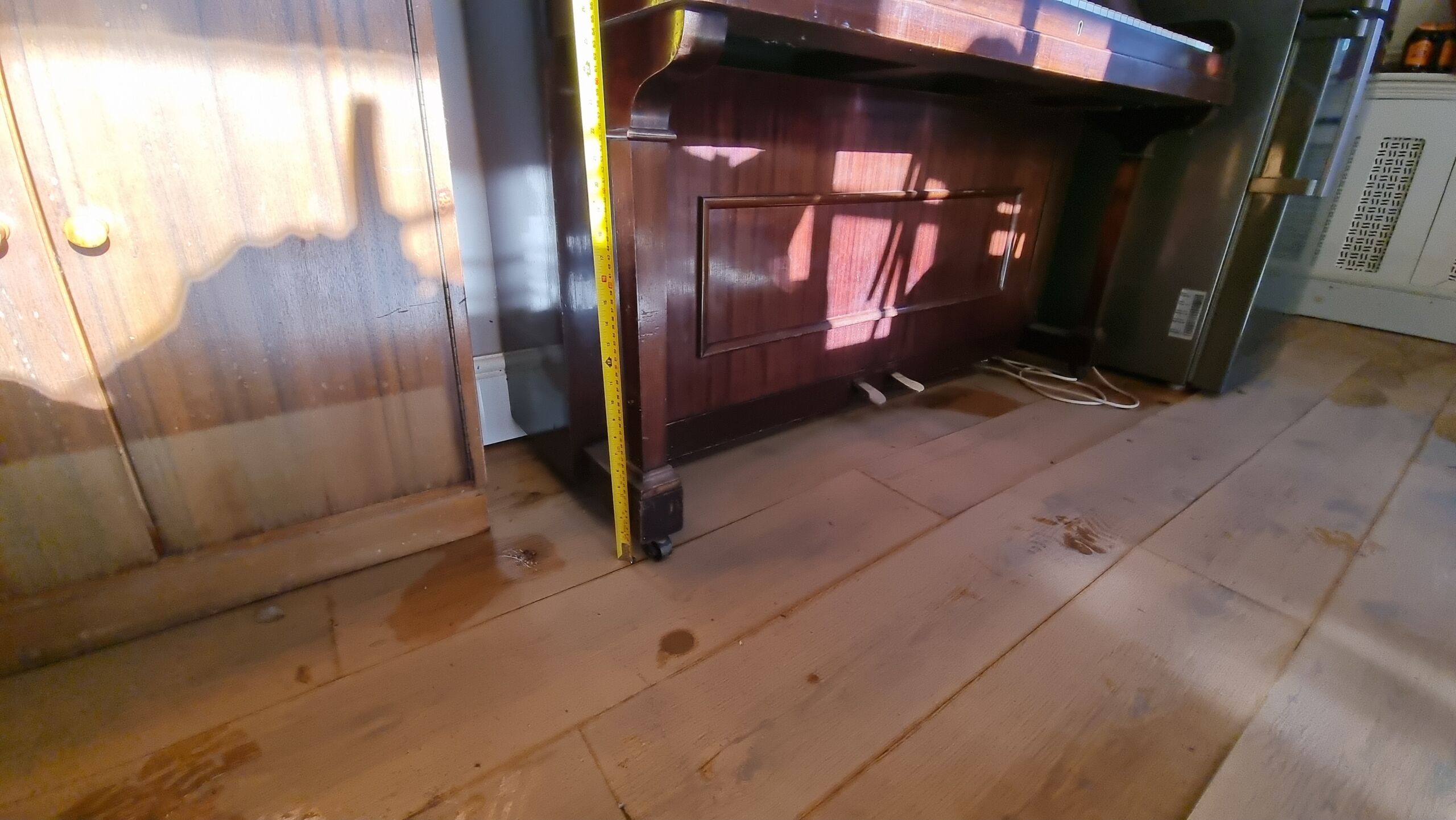
Post-flood photo of the body of an upright piano alongside a cabinet with a clear tide mark up to about a foot from the ground.
In any case: after a piano specialist wrote us a statement explaining that it simply wasn't possible to "new-for-old" this because they don't make them like this any more, the insurance company signed-off on us sending it away to what I lovingly called a "piano hospital", where she's enjoyed a complete overhaul.
And now, at last, it's back with us: we could have kept it in storage until we're ready to move back "home" (there's still a lot of repair work to be done!), but having it moved twice is cheaper... plus it means we get it back sooner.
Alt
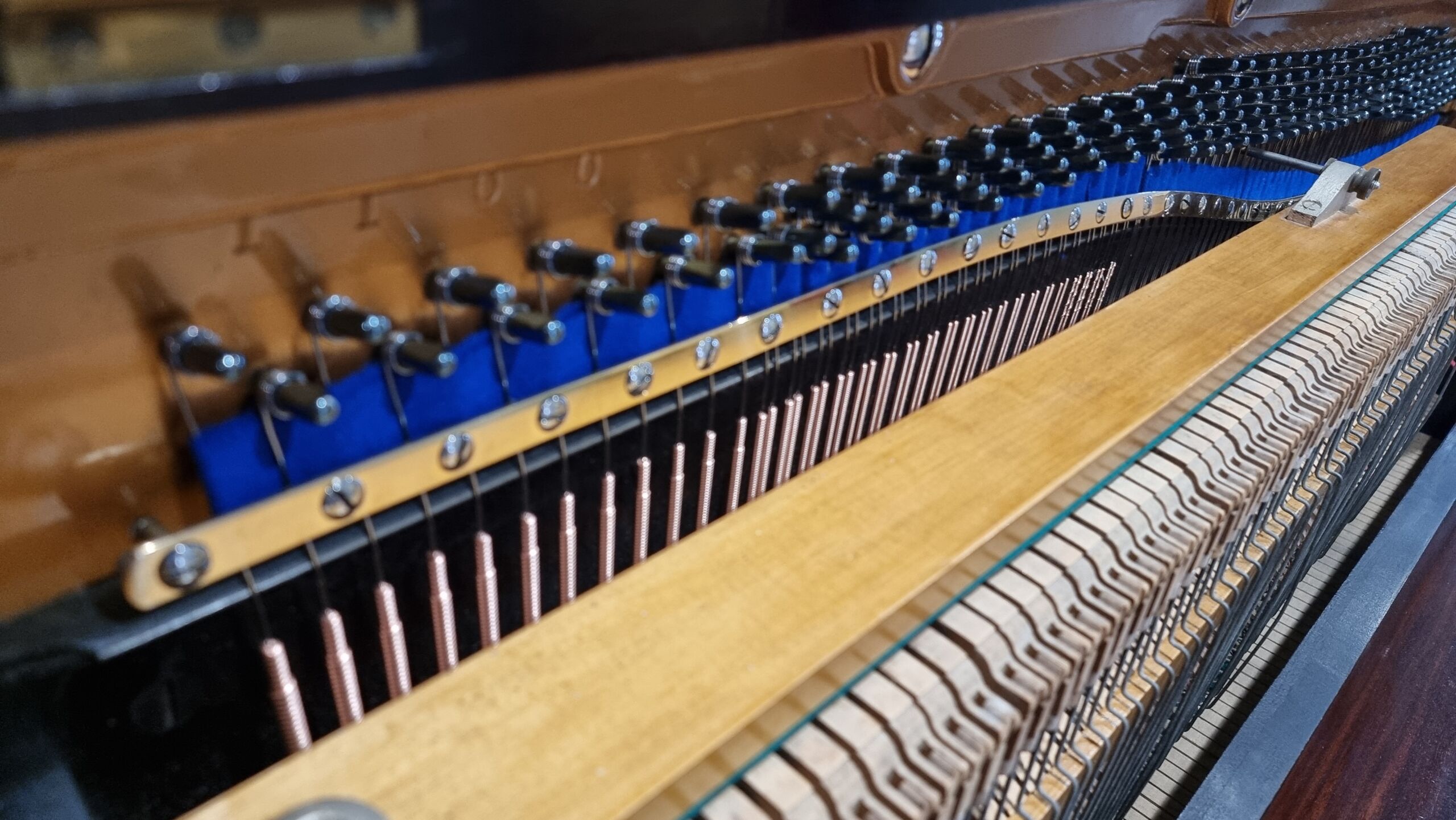
The pristine inside of an upright piano.
Personally, I've found it an enormous psychological relief to have the piano back, because I've missed it!
I started teaching myself to play the piano during the second Covid lockdown, looking for something to distract me from my inability to go outdoors and do things, and wanting to try to engage a different part of my brain. I was quickly hooked: I'd never learned any musical instrument before3, and I enjoyed having something I was (and still am!) pretty bad at which I could make slow incremental progress.
And so for several years, most days, I'd play about 10 minutes of piano. Not much: just a little each day usually while my lunch warmed up. But slowly but surely I reached the point that I could tolerate - or even enjoy! - hearing myself play4.
And then after the flood... I couldn't. I'd get up from work to stretch my legs and my fingers would twitch in anticipation of fulfilling a routine that... I just didn't get to, any more. I tried playing the electric piano at the local library but its headphones were damaged and the action didn't feel right and... it just wasn't the same. I wanted our piano back!
Alt
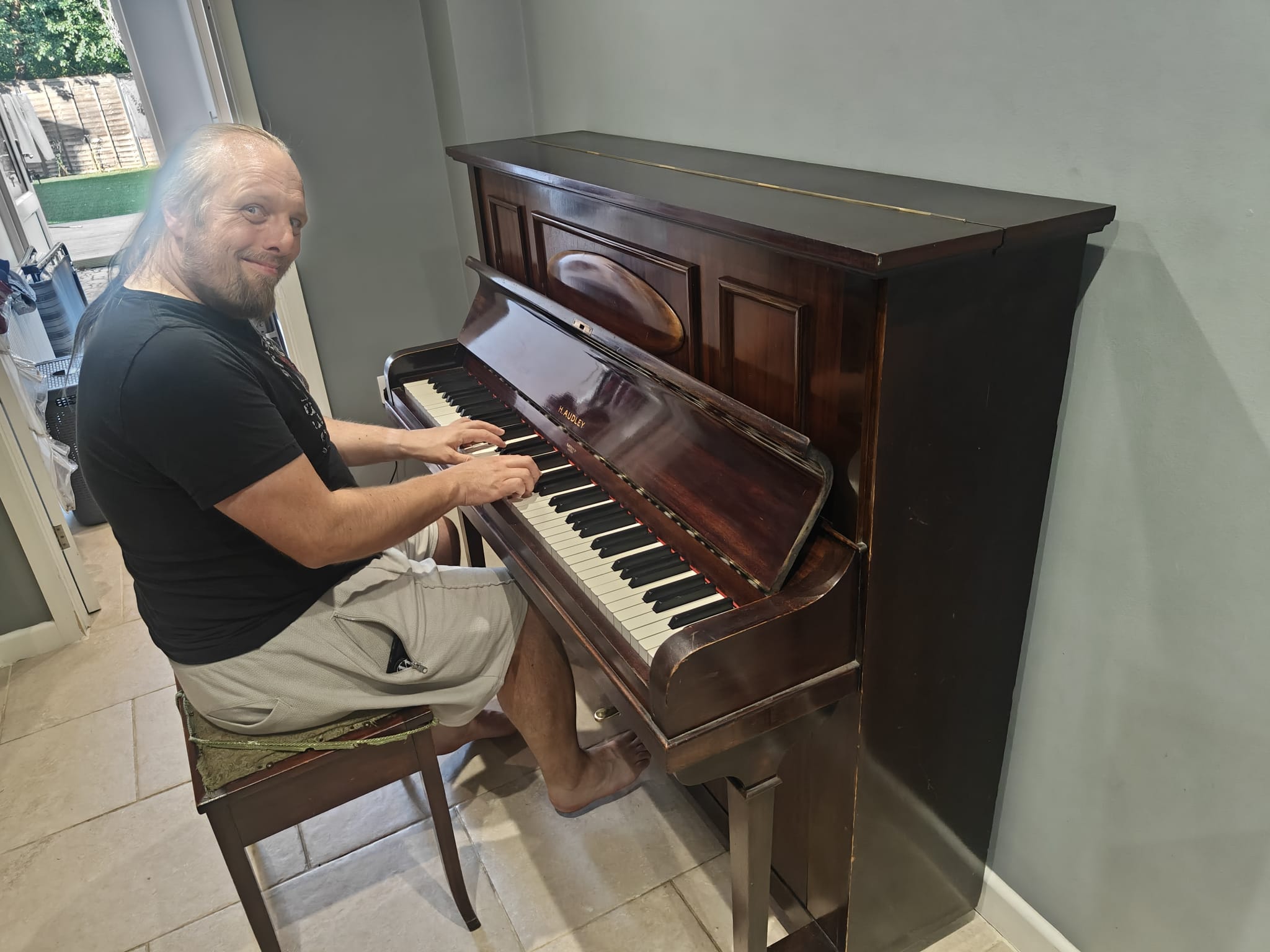
Dan, a white man with a beard and a blue-dyed ponytail, sits in a plain hallway at a polished upright piano, looking happy.
And now I've got it. And it feels fantastic. It's a little different - the sustain pedal's response is a lot better, but more nuanced, and I'm not used to it yet, for example. But it's still a wonderful thing: like a family member coming home after a long period away.
Also: it feels like a small victory to have something back, following the flood, because the entire insurance/assessment/repair process continues to be so slow.
Our house may still be stuck with no floors and missing walls... but, five months later, the first things to be repaired are coming back to us. Maybe soon we'll have, I don't know, a working kitchen or the plumbing re-connected. Here's hoping!
Footnotes
1 The transformation of the reading room desk - which once sported integrated reading lights - into a general-purpose table has been done so-effectively that you wouldn't know to look at it that our largest piece of furniture had ever had another life... unless you lift the secret panel in its centre foot, at which point you'd discover a BS 546 plug still wired-in to it!
2 Don't ask me to enumerate the particular features or how we know: JTA, plus our piano tuner, did the research that ultimately underpinned the argument that you couldn't possibly acquire a like-for-like replacement for it. I just know how it feels and sounds.
3 I didn't even play a recorder at school!
4 I fully appreciate that I will never be as good a pianist as, say, the average 8-year old who plays for their YouTube channel. I am fine with this. Like my blogging, my piano-playing is, first and foremost, for me and not for anybody else.
I've been teaching myself piano over the last year, and it has become one of the things I go to when i need something to do for a short amount of time. I have an electric piano.
> Don’t ask me to enumerate the particular features or how we know: JTA, plus our piano tuner, did the research that ultimately underpinned the argument that you couldn’t possibly acquire a like-for-like replacement for it...
For the benefit of the people who care (if there are any) - she's a straight-strung, overdamped upright, what's also sometimes known as a "birdcage" design because with the top front panel off the run of overdamper connectors looks like the wire bars of a birdcage.
Our piano guy diverged a bit here and was happy to just sign it off as "pre-1940s" which is already enough to indicate, "Nah, they don't make them like that no more", but I did a whole stack of digging and I am pretty confident I can pin her down to about 1905-10 on that basis: after about 1910 overstringing (in which the strings go at a drunken / angle instead of going | as god intended) became increasingly common on the grounds that it let you get more string length into your limited cabinet size, and therefore a fuller sound. Overstring designs actually turned up *really early*, like pre-1850, but didn't make it to mid-range instruments until at least the Edwardian era.
In an Overdamped piano the little felt damper hammers that tell the string to shut up now are near the top of the string, just under the tuning pins, which means that the damping is less effective because the middle of the string is still miles away from the actual damping impact; top notes in particular aren't damped as effectively. On the other hand, it's much cheaper to overdamp than to underdamp, and *for most purposes* it doesn't matter: these pianos are from the great era of the piano as Aspirational Furniture, more or less 1880 - 1914* designed to sit in nice middle class parlours and be played *okay*, rather than to flood an Opera House with high-fidelity sound.
Now, strictly speaking because straight-strung overdamped machines were cheaper to produce they remained available on cheaper instruments through to the late 1920s, but there's a change in piano style as we move into the 1930s and they start to get smaller (because the sitting room of an inter-war semi is smaller than the front room of a Victorian terraced house, but also because cross-stringing meant you could get the same sound quality from a smaller cabinet - note that this completely ruins the point that overstringing *improves sound quality*, it simply keeps it the same as people are used to, but cheaper to make: shrinkflation in action); worse, there were some monsters in the 20s and 30s and 40s who took Edwardian pianos and *ground them down*, lopping off, for example, the overhangs of the top lid etc, to give them more "streamlined" modern proportions. Ours survived that, thank goodness, and remains of solidly Edwardian proportions.
Also, upright pianos also - from around the early 1900s but almost universally by the 1920s, started to get a middle pedal on upright pianos - this is the "Damper" or "Practice" pedal, and pushing it acts as a toggle: it drops in *an extra layer of felt* between the strings and the hammers, which makes the whole instrument much quieter. Again - smaller houses, and thinner walls. Customers started to want pianos with, essentially, a volume control, so they started making them.
So - Molly's Piano. Upright, straight-strung, overdamped, two-pedal piano of pre-1920s *size* but post-Victorian *style* - extremely Edwardian cabinetwork, relatively plain dark mahogony, no built-in candle sconces (big pre-1900 because the player would block the lamplight but still want to see their score, but of course rapidly declining as electric lighting came in - people didn't want their instruments to look old-fashioned!). There's some restrained decoration on the cabinet but not the kind of baroque style you'd expect from the Late Victorian era, and straight, fairly unadorned, squared-off front legs.
It's branded "Wm. Whiteley" but that's just Whiteley's Universal Department store in Bayswater, a place that sold *literally* everything - in the Great Piano Era stores did this kind of thing, rebadging instruments in literally the same way that a dishwasher from one shop sometimes get a product code like DWSH260CG but the exact same bloody machine will show up as DWSHB60AG elsewhere. Makes it harder to compare prices, and lets the stores seem more exclusive - so ours has the serial 1100.
It is, clearly, not the one thousandth one hundredth piano made by the manufacturer, but it's (probably) No. 1100 of the ones Whiteley rebadged in that specific design. I think the original manufacturer was *probably* Challen, although that's admittedly a little bit like throwing a rock into a carpark and saying "That horrible noise of breaking glass was probably the window of a Volkswagen" - but Challen of the roughly 1905-10 era tend to look a lot like Molly's Piano.
(For reference, as long as the link is live, this is an overstrung Challen from the 1930s: https://sulindamusic.com/products/challen-antique-upright-acoustic-piano-in-mahogany-finish-stock-23003), and this page has an example of a much earlier Challen, which comes under the heading of "hauntingly familiar": https://robertspianos.com/top-makes/common-piano-makes-in-the-uk/challen)
So, yeah. Definitely prewar. *Definitely* not made like that any more and to get the same quality of tone you are way out of "needs to be a good brand" and into "they want HOW much".
But I am like 80% confident, as someone who had done absolutely no research into the history of piano construction prior to the flood and then had to do an awful lot very quickly because I promised Sheila we'd look after the instrument when she gave it to us, that Molly's Piano is 1905-10.
Given that she's got through two world wars unscathed I wasn't a fan of letting a flood knock her out 😅
*yes, there is a reason that the Great Aspirational Instrument era stops basically when it does.