Wikipedia @ 25: Carl Person

Duration

Podcast Version

This post is also available as a podcast. Listen here, download for later, or subscribe wherever you consume podcasts.

To celebrate the site’s 25th birthday this year, Wikipedia is encouraging/challenging people to read one Wikipedia article a day for 25 consecutive days. I felt that I could do one better than that: not only reading an article but – where I found one that was particularly interesting – to write a blog post or record a podcast episode for each of those days, sharing what I learned. For each entry, I’ll hit “random article” a few times until something catches my interest, start reading, and then start writing! Everything I’ve written below came from Wikipedia… so you should check other sources before you use it to do your homework. Happy birthday, Wikipedia!


Today’s random article: Carl Person
Today’s topic: Carl Person

Just sometimes when you’re playing the “hey, Wikipedia, give me a random page” game, you get a hole in one. That’s what happened today when I landed on the article for… Carl Person.

Carl Person, an older white man with receding grey-white hair, wearing a smart three-piece suit, leans against a planter in an marbled ornamental garden.
Whatever else you can say about him, he looks pretty dapper in a suit. Photo courtesy Carl Person, used under a Creative Commons license. Knowing that he has a Wikipedia account (which he used to upload this photo), I took the time to browse the article history and check for any obvious signs of tampering, sockpuppetry, or other foul play, but it looks reasonably clean.

Yes, Person is his actual surname. Speaking as a person with a stupid name, it pleases me to find people whose names probably cause them at least as much trouble as mine does. Wikipedia wasn’t any help at understanding where the surname Person comes from (and Carl himself isn’t even noteworthy enough to appear on the list of “notable people with that surname”, it seems).

However I did enjoy discovering jazz saxophonist Houston Person (which sounds like the beginning of a news headline about somebody from Houston!) who once released an album called… Person to Person! Excellent. Also, actress and filmmaker Marina Person whose documentary about her father, filmmaker Luis Sérgio Person, was titled simply Person. I think the name might be related to Swedish surname Persson – literally, “son of Per” – where Per is a Scandinavian variant of Peter. This probably means that there’s a “Per Person” somewhere in the world, and I want to meet him.

Anyway: back to Carl. He trained as a lawyer and spent the 1960s working in a variety of corporate law firms. These included the one for which Richard Nixon was a partner, during that period after Nixon failed to get elected as Governor of California and announced that he was retiring from politics… only to come back six years later to be elected president and, well, you know the rest.

The interesting bits of Carl’s career came later.

After the American Bar Association endorsed the concept of a paralegal in 1967, Person founded the Paralegal Institute, a name that’s so-polluted with people using it that even the closest-named Wikipedia article seems to be talking about something similar… but different. (This seems to be pretty much par for the course in the American paralegal system, though: did you know that a “certified paralegal” and a “certificated paralegal” are two completely distinct and non-interchangeable things?)

A brown-skinned woman sits at a desk surrounded by binders of paperwork.
Paralegals! All of the work; a fraction of the pay!

Anyway: other things he did as part of his legal career were –

  • Represented other members of The Teenagers (then The Premiers, because confusingly the band changed their name to “The Teenagers” when they got older) in their efforts to reclaim shared copyright of their 1956 hit Why Do Fools Fall in Love from lead singer Frankie Lymon and Gee Records.
  • Represented playwright Mark Dunn in his successful claim that The Truman Show was based upon his 1992 play, Frank’s Life, whose script he’d previously attempted to sell to Paramount.
  • Helped Ralph Anspach (whose book I read before writing this 2013 blog post!) in his appeal against a ruling that Anspach’s board game Anti-Monopoly was derivative of Parker Brothers‘ stake in Monopoly: the appeal was successful at least in part because Person and Anspach were able to prove that Monopoly was, itself, derived from Lizzie Magie‘s The Landlord’s Game. (Fun fact: this was the second time Carl successfully took on Parker Brothers; the first being the Masterpiece case, representing Christian Thee!)

In 2012 Person put himself forward to be the Libertarian candidate for the presidential election, losing out to Gary Johnson (who had in turn switched sides after he realised he wasn’t going to become the Republican nominee). Gary Johnson eventually got 0.99% of the popular vote, almost breaking the 1% barrier that only 33 third-party candidates have ever achieved in US history.

Not a bad bit of reading for a hole-in-one article.

Twenty Inches

I let the elder kid choose her lunch. She chose a pizza so huge that each slice is larger than her entire face. Needless to say, she needed a little help with it!

Two preteen children sit in front of an enormous pepperoni pizza.

×

Wikipedia @ 25: Cirrothauma Murrayi

Duration

Podcast Version

This post is also available as a podcast. Listen here, download for later, or subscribe wherever you consume podcasts.

To celebrate the site’s 25th birthday this year, Wikipedia is encouraging/challenging people to read one Wikipedia article a day for 25 consecutive days. I felt that I could do one better than that: not only reading an article but – where I found one that was particularly interesting – to write a blog post or record a podcast episode for each of those days, sharing what I learned. For each entry, I’ll hit “random article” a few times until something catches my interest, start reading, and then start writing! Everything I’ve written below came from Wikipedia… so you should check other sources before you use it to do your homework. Happy birthday, Wikipedia!


Today’s random article: Cirrothauma
Today’s topic: Cirrothauma murrayi

My random landing page today is a genus for which there’s only a single species, so I hopped over to that species’ page.

And what a species!

Orange-pink octopus with a long web skirting between its tentacles and a distinct butterfly-shaped elongated shell from its head.
Somehow it looks more like an alien than octopodes normally do! Drawing produced by Carl Chung in 1910.

This is the blind cirrate octopus (cirrothauma murrayi), a species found beneath the oceans all around the world but at such a depth that they’re not well-understood. We’re not even sure whether the specimens we’ve studied represent a single species or two separate species!

The Latin name comes from oceanographer John Murray, best known for his Challenger Expedition from 1872–1876, but whose four month North Atlantic Oceanographic Expedition in 1910 – which he self-funded – was the first to find this unusual species. It was described by Carl Chun, whose previous claim to fame had been the discovery of the (also amazingly alien-looking) vampire squid, seven years earlier.

(The vampire squid is its own amazing thing: did you know that it turns itself inside out to evade predators, exposing the inner surface of its spiked tentacles? Also it can spit glow-in-the-dark mucus to dazzle an attacker.)

You can tell it’s a cirrate octopus by those fins on its head. Cirrates are one of the two major families of octopodes: they’re the ones that do have a pair of mini strands dangling off each sucker on each tentacle, but don’t have an ink sac. They’re also notoriously fragile, and when we’ve pulled them up for research purposes they’re often in poor condition by the time they’re on the surface… and that’s especially true for deep dwellers like the blind cirrate octopus.

As for blind: well – it’s got eyes… but those eyes don’t have lenses. As a result, they’re probably able to tell light from dark but probably can’t make out the particular shapes of objects. (This is a great example, contrary to claims of irreducible complexity in the eye by proponents of “intelligent design” of an eye with only some of the components that seem essential to a fully-functional organ that still provides value for its host!).

Speaking of which – do you know how cool the eyes of an octopus are?

Illustration showing the difference between vertebrate and cephalapod eyes.
Vertebrate (left) and cephalopod (right) eyes have several distinct differences which suggest different evolutionary origins. In cephalopods, the retina (1) is routed in front of the nerve fibres (2) that connect to the optic nerve (3), meaning that cephalopods do not have the “blind spot” (4) that vertebrates do.
  1. Like all cephalopods, they have no blind spot because their retina is in front of the nerve fibres instead of behind them.
  2. Like squid and possibly cuttlefish, they can differentiate the polarisation of light. (I believe that sheep and goats can, too!)
  3. Their pupils automatically rotate to stay horizontal, no matter which way up they are!

There’s some debate about whether or not octopodes and other cephalopods’ eyes evolved from a shared ancestor or are an example of convergent evolution, and the arguments for both are really interesting.

Of course, our friend the blind cirrate octopus is, umm… mostly blind. Very different from other octopodes.

As I said, we know so little about it! We don’t know what it eats (we think it probably eats whole shellfish). We don’t know how it breeds. We don’t know how commonplace it is or whether its environment is under threat.

But what we do know is that it’s a freaky-looking thing from way down deep. Thanks, Wikipedia, for telling me about this strange beast. Let’s see what you have to share with me tomorrow!

Self-clear area

I spent a while failing to interpret this sign. It seemed to be saying that if you didn’t clear your tray… then you’d get ketchup poured on your wrist?

Printed sign reading 'this is a self-clear area; thank you' beneath a red illuminated icon of a hand onto whose wrist a bottle drips.

It turns out there’s a baby bottle warming station on the other side of the bins.

(It is possible they my brain is struggling from a lack of sleep.)

×

Wikipedia @ 25: Milices Patriotiques

My random Wikipedia article of the day was Milices Patriotiques, who were a 22,000-strong communist group and part of the Belgian resistance in the Second World War. Which sounded really interesting, but their article was tragically short so that’s pretty much all I have to say about them!

A Selfhosted Static Site Editor

My 12-year-old was interested in learning some HTML and CSS and making her own website. If she were anybody else I’d point her at something like Nekoweb as a starter host because their web-based (VSCode-based) “Nekode” text editor makes writing your first static site simple.

But I’ve got a NAS sitting at home on a fibre connection, so I figured: I might as well just host something similar here.

Here’s how I did it:

1. DNS

I pointed her domain at my static IP, plus a subdomain for the “backend” interface. Suppose her site would be at example.net (and www.example.net) with the admin interface at admin.example.net: my DNS configuration might look like this:

@     10800 IN     A 172.66.147.243
www   10800 IN CNAME example.net.
admin 10800 IN CNAME example.net.

2. Caddy

I’ve got a Caddy webserver acting as a static server and a reverse proxy already, so I just added a new static site with a configuration like this:

example.net, www.example.net {
  root /volumes/example.net/public
  encode gzip
  templates
  file_server
}
The templates directive means that, if/when she wants to, she could use Caddy’s built-in SSI-like features. Or if she decides someday she’d prefer a static site generator then I can sort her out with shell access or something.

It probably wouldn’t be much harder to set up something like this from scratch on e.g. a Raspberry Pi: Caddy’s fast and easy to get set up.

3. Editor

I used the OpenVSCode Server Docker image to provide a browser-based VSCode interface in which she could edit HTML, CSS and JavaScript and drag-drop files from her local machine. I’m using Unraid on my NAS so I didn’t have to think much about running a new Docker container, but I guess that if I did then I’d have typed something like:

docker run -d \
  # 7890 is the port on my NAS that I'll proxy Caddy to:
  -p 7890:3000
  # /mnt/user/example.net is the path on my NAS;
  # /example.net is where it'll appear within VSCode:
  -v "/mnt/user/example.net:/example.net" \
  # this tells OpenVSCode-Server to mount the directory to begin with:
  -e OPENVSCODE_SERVER_ROOT=/example.net \
  gitpod/openvscode-server

Now all I needed to do was point Caddy at it. For the time being I simply restricted access to only “computers on my local LAN”, but it’d be easy enough to add authentication using basic auth and/or client certificates if she wanted to be able to work on her site from elsewhere:

admin.example.net {
  # Restrict access to 192.168.* LAN:
  @allowed {
    remote_ip 192.168.0.0/16
  }
  # Proxy permitted folks to the container:
  handle @allowed {
    reverse_proxy http://nas:7890
  }
  # Block everybody else:
  handle {
    abort
  }
}

That’s literally all it took to put together a web-based editing environment that publishes directly to a static website. And because it’s on my own infrastructure, it’d be trivially easy to modify it in the future if she decided to go in a different direction, e.g. a PHP site, or continuous deployment from a repo, or static site generation from a shell.

That’s all!

Here’s a test site I threw together using exactly this stack, demonstrating the entirely browser-based editing workflow (not shown is drag-and-drop to upload, but I promise that works too!):

Roman Bingo

If the Romans played bingo, do you think the callers would have used ‘bingo lingo’?

  • Legs two
  • Growing up the wall, four
  • Seagull in flight, five
  • Long-nosed dead man, nineteen
  • Pornography, thirty
  • Use your tongue, fifty-nine
  • Smiling in a blindfold, a hundred and one

An American-style bingo card with Roman numerals in place of the numbers and 'quadrum gratuitum' in place of the free space. Based on an original photo by Oeil De Vautour / Edwin Torres, used under a Creative Commons Attribution 2.0 Generic license.

×

Wikipedia @ 25: Jim Marshall

Today‘s random Wikipedia article was Jim Marshall (photographer). I enjoyed reading about him and even looked up some of the many photographs that he took of musicians in the 60s and 70s, but decided that because I was literally just writing about a photographer that I learned-about on Wikipedia, it probably wasn’t the time to write about another!

But here’s a fact for you: Jim Marshall was the official photographer for the Beatles‘ final concert in San Francisco’s Candlestick Park, and he was head photographer at Woodstock. There we go; that’s my Wikipedia article of the day!

F-Day plus 97

It’s been 97 days since our house flooded and we had to evacuate. We’re now living medium-term in a “chicory house” a few minutes drive away, but there’s still plenty of reason for us to return frequently to the disaster site that is our actual house.

Today, for example, JTA and I went to show around some contractors who will eventually, we hope, be able to install new floors, skirting boards, remove and replace a wall, rebuild the kitchen, fix the electrics…

Several men stand on the bare concrete floor of a residential hallway with no furniture or skirting boards.

It’s been over three months since we had to move out. With the drying-out complete, it’s finally time to begin planning to start scheduling the start of the repair work that needs doing. What a painfully-slow process!

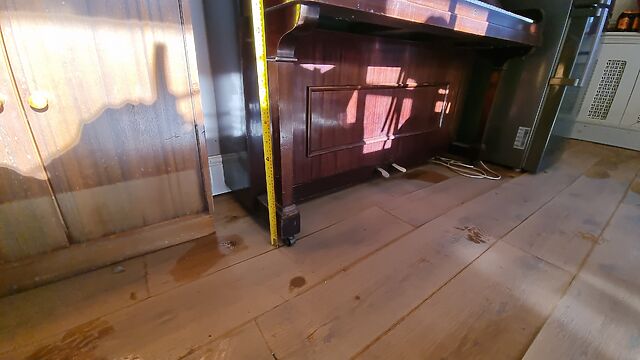
The day after the flood water receded, I took this photo while we were assessing damage – you can see the tide marks left by the water:

Close-up of a water-damaged floor, cabinet, and piano.

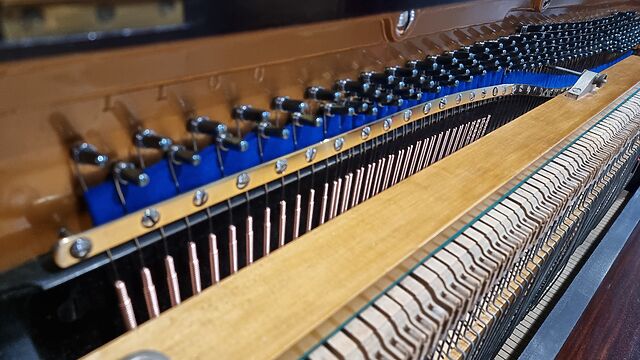
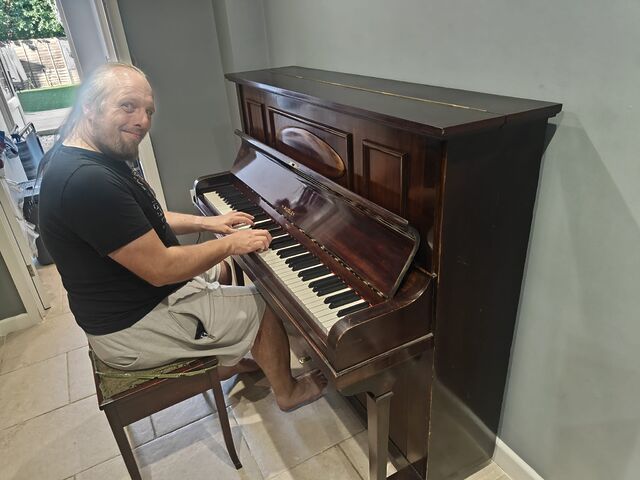
That picture shows part of our piano, which took in a lot of water and was significantly damaged. It’s off at a nice piano hospital right now being repaired, and I miss it much more than I expected.

After playing maybe ten minutes a day almost every day for years, I routinely get up from my desk to stretch my legs or heat up my lunch and my fingers itch to plink-plonk away at it. Of all the hundred inconveniences of our temporary living situation and everything that goes along with it, that’s the one that bites most-frequently. It’s a strange sensation.

But all the builders and the insurance company and everybody else seem confident that they can get us back into our home in the Autumn, and certainly by Christmas, so there’s something to look forward to. A light at the end of the tunnel.

× ×

Wikipedia @ 25: Yousuf Karsh

Duration

Podcast Version

This post is also available as a podcast. Listen here, download for later, or subscribe wherever you consume podcasts.

To celebrate the site’s 25th birthday this year, Wikipedia is encouraging/challenging people to read one Wikipedia article a day for 25 consecutive days. I felt that I could do one better than that: not only reading an article but – where I found one that was particularly interesting – to write a blog post or record a podcast episode for each of those days, sharing what I learned. For each entry, I’ll hit “random article” a few times until something catches my interest, start reading, and then start writing! Everything I’ve written below came from Wikipedia… so you should check other sources before you use it to do your homework. Happy birthday, Wikipedia!


Today’s random article: Karsh (crater)
Today’s topic: Yousuf Karsh

The planet Mercury is covered with impact craters, which isn’t surprising because it has no atmosphere to slow down incoming meteors nor significant active tectonic or erosion processes to conceal them once they’re created. In 2015 the IAU ran a competition to name four such craters: the winning entries resulted in the naming of the craters Carolan, Enheduanna, Kulthum, Rivera, and Karsh.

Karsh crater on Mercury, on the west side of the larger Rembrandt crater.
The Karsh crater is about 180km wide, which is approximately comparable to… your mum.

This crater is named after Yousuf Karsh, who’s sufficiently famous that I’d actually heard of him, which was an unusual result from hitting “random article” on Wikipedia.

But in case you don’t know who Yousaf Karsh is – or if, like me, you just wanted to learn more about him – then you’re in luck!

Monochome photo, presumably taken using a mirror, of a balding man operating a box camera.
Selfies used to be a lot harder in 1958.

Yousuf Karsh was an Canadian-Armenian photographer who took principally portrait photographs, some of which you’ve almost-certainly seen already. He photographed a huge number of famous and significant individuals of the 20th century. Like this one:

Monochrome photograph of Sir Winston Churchill.
“Oh yes!” No wait, that’s the other Churchill’s catchphrase.

That photo, taken in 1941, is titled The Roaring Lion, and it’s got a story to it.

Winston Churchill posed for his photograph on his way out from delivering the “some chicken! some neck!” speech to the Canadian parliament (you can see his notes from the speech tucked into his jacket pocket). He had his trademark cigar in his mouth, but Karsh wanted it gone. He asked Churchill to remove it, but Churchill refused, and Karsh went ahead to take the photograph anyway. But then at the last second, Karsh said “Forgive me, sir” and snatched the cigar directly out of the Prime Minister’s mouth.

“By the time I got back to the camera, he looked so belligerent, he could have devoured me,” said Karsh later, of the expression on Churchill’s face. But it’s that expression that he captured with the camera, and that would go on to be described by the USC as a “defiant and scowling portrait [which] became an instant icon of Britain’s stand against fascism.” Absolutely iconic.

Churchill himself said, after the picture was taken, that “you can even make a roaring lion stand still to be photographed.” Hence the portrait’s name.

Or how about this picture of the Marx Brothers in 1948:

Chico, Harpo, and Groucho Marx.
Karsh became known for his use of harsh lighting to pick out the fine details of his subjects’ faces, which I think is especially clear in this picture.

Or how about this fantastic photo of the then Princess Elizabeth, aged 21 or 22, before her accession as Queen Elizabeth II:

Princess Elizabeth sits comfortably in an upholstered chair.
“So long as Daddy manages to die before he has any sons, I’mma get me so much Empire Commonwealth.”

Here’s some things I didn’t know about Yousuf Karsh, though:

Being born to ethnic Armenians in the Ottoman Empire could have been a death sentence in itself for young Yousuf. Ottoman and later Turkish Nationalist authorities and paramilitaries deported, confined, or murdered hundreds of thousands and quite possibly over a million Armenians, who they saw as a threat to their national identity (among other candidate causes).

Karsh and his family travelled with a Kurdish caravan to Aleppo in Syria in 1922, and a year later his parents took advantage of a humanitarian scheme to transport displaced Armenians to live with relatives in Canada: the then 15-year-old who “spoke little French, and less English” and “had no money and little schooling” moved half way around the world to live with his uncle.

Yousuf’s uncle was a photographer and taught him the essentials of early-20th-century photography technology and techniques, before sending him to apprentice in Boston under John H. Garo, a fellow Armenian whose studio hosted the still-running Boston Camera Club. He worked in the USA for a time then returned to Canada, opening his own studio in 1932. When his brother Malak was able to join him in Canada in 1937, Yousuf helped Malak break into a career in photography too: a career that would probably have been better-known were it not for being in the shadow of his older brother!

I don’t know whether he’d care about having a crater named after him or not. But he’d probably have been more proud of the legacy that lives on in the Karsh Award, given every alternate year by the City of Ottawa for outstanding artistic work in a photo-based medium.

Bloomscrolling & Agentic Intelligence

This is a repost promoting content originally published elsewhere. See more things Dan's reposted.

A lot of the AI bubble – and that’s what it is, for all there are useful things inside there – is based on “Invest now, because when it works it’ll be fantastic!” rhetoric that’s like investing in a mainframe company in the late 60s on the basis that smartphones will take over the world. We’re moving a lot faster than mainframes went to PCs, but it’s important to invest in the things you can do with the system that work *now*.

There isn’t a good consumer use for AI right now. ChatGPT is a terrible source of information, confidently wrong in a way that sounds human enough to cause delusion and psychosis.

Things that AI/LLM tech is good for right now – pattern matching, repetitive tasks, logic flow – have some great business cases (It’s made some amazing breakthroughs in satellite and medical imagery, it’s got a bright future in automated transcription), and I think there’s a good case for it in content moderation (Yeah, it’s not great at it, but given the sick shit content mods on Facebook have had to deal with has given them cPTSD, I strongly believe it should be a machine job). It’s use for writing, music, translation, or art is still at the very least questionable and at the most utterly immoral.

Well-said, Aquarion!

The current generation of Generative AI isn’t useless. But its uses are quite specific and it certainly does more-harm-than-good that it’s promoted as an “everything” solution to every problem. I’ve used some form of agentic coding for several years, mostly of the “spicy autocomplete” variety1, and I mostly agree with Aquarion’s observations.

The whole post is an enjoyable tale.

Footnotes

1 My experiments with “vibe coding” have shown me that AI working alone can produce usually-functional code to specification, but that code is often of low quality and rarely maintainable, even by the AI.